For a finite-range isotropic Heisenberg model, the Mermin-Wagner theorem excludes spontaneous magnetic order in one dimension at every nonzero temperature. Long-wavelength rotations cost very little energy: a smooth orientational fluctuation has , so its thermal variance contains , which diverges in the infrared. In a Heisenberg ferromagnet, the same obstruction appears as a divergent thermal occupation of quadratic long-wave spin waves. This explains why a finite magnetization cannot be supported, although correlations can be strong over a long finite distance. The rigorous statement requires short-range interactions and the stated continuous symmetry; interchain coupling and anisotropy change the problem. Symmetry forcing the mean to zero in a finite chain alone would not prove absence of thermodynamic order. [ref]
Absence of Ferromagnetism or Antiferromagnetism in One- or Two-Dimensional Isotropic Heisenberg Models by N. D. Mermin and H. Wagner. 1966 abstract and theorem: finite-range isotropic spin models at nonzero temperature
For the Ising model, use dimensionless , , and . Its pair Boltzmann factor isMultiplying N such factors around the periodic ring counts each bond once and each field term twice with weight one half. Summing the closed spin-index sequence therefore gives the transfer matrix for the one-dimensional Ising modelThe two eigenvalues areAt finite temperature every entry of P is positive, so the Perron–Frobenius theorem gives . ConsequentlyThe exact finite-N correction to the extensive expression is . No assumption that is positive is needed.
Differentiate at fixed temperature. For , . The Ising-chain magnetization with spin-half normalization gives total magnetic momentThis is the thermodynamic-limit result; the moment per site is M/N. For every finite , , even with the thermodynamic limit taken first. The zero-field magnetic susceptibility per site is , large but finite.
The Ising-chain domain-wall energy convention explains the result for : changing a parallel bond into an antiparallel bond costs J in this spin-half normalization. Domain walls, occurring in pairs on a ring, acquire a nonzero density at any nonzero temperature. Indeed the zero-field correlation length is at low temperature. The Ising symmetry is discrete, so this is a separate one-dimensional domain-wall mechanism rather than an application of the continuous-symmetry theorem. At zero temperature a ferromagnetic chain can select a fully polarized state; the and limits do not commute.
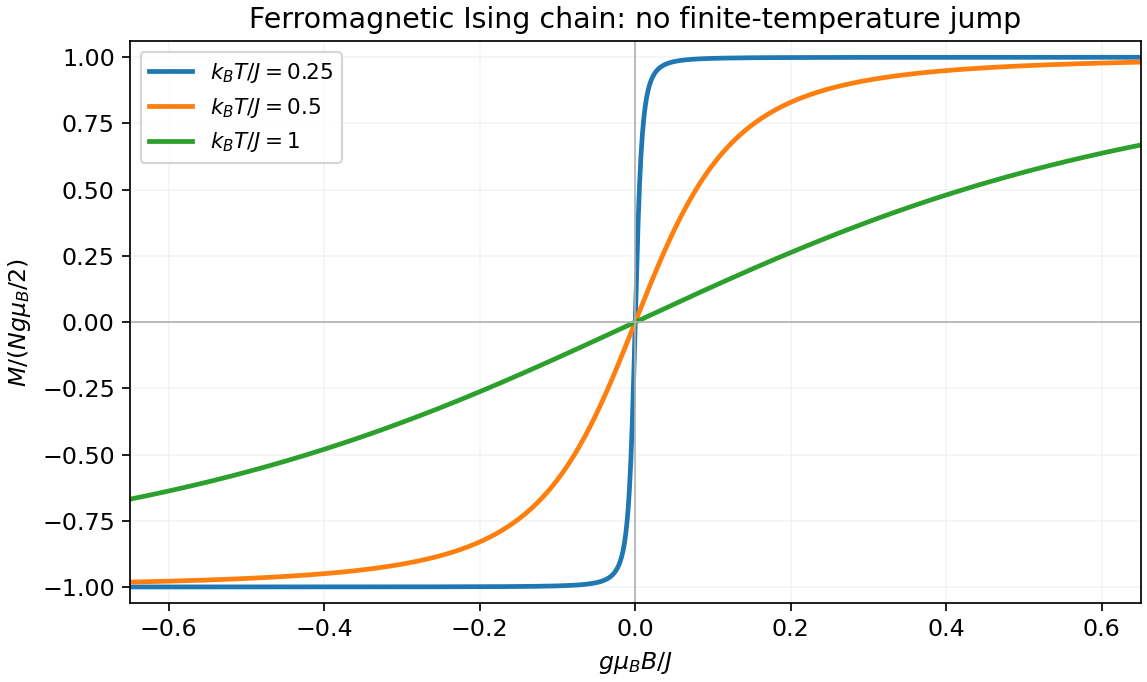
Ising magnetization
. Source. Details. 
Articles by others on the same topic
There are currently no matching articles.