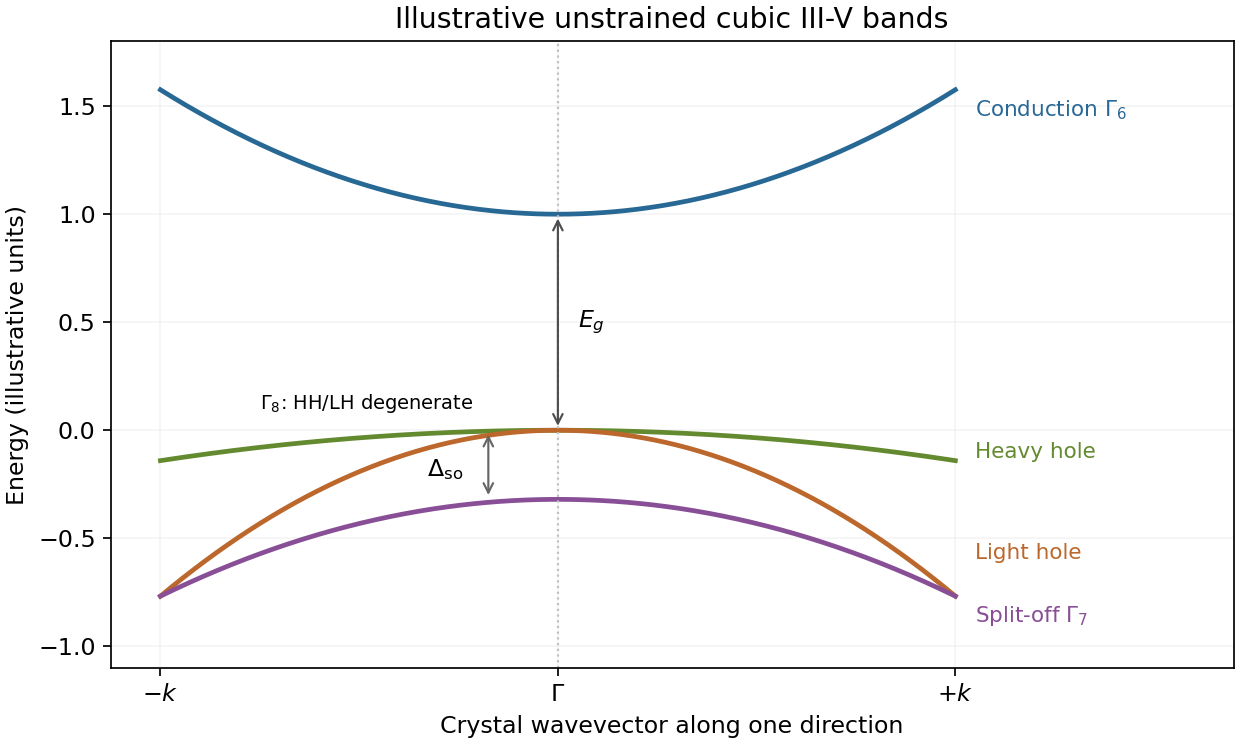
For a representative unstrained zinc blende structure III-V semiconductor such as gallium arsenide, take the valence-band maximum at the Gamma point as zero. The near-centre ordering is an s-like conduction band doublet above a p-like valence quartet. Spin-orbit interaction puts the p-like doublet below the quartet by . These are the zone-centre bands of a zinc-blende III-V semiconductor.
The quartet produces the heavy-hole and light-hole bands. Along a chosen symmetry direction, their components have and respectively; their different curvatures define different positive hole effective masses. They are degenerate at zero wavevector in the unstrained cubic crystal, but separate away from it. The doublet is the split-off valence band. To leading isotropic order,Valence-band curvature is negative for electrons; the corresponding hole masses are positive. Real valence bands warp with direction, so these are illustrative effective-mass parabolas rather than an exact spherical band structure.
The k·p perturbation theory couples the s-like and p-like states through momentum matrix elements. It controls the conduction-band mass, nonparabolicity and mixing of hole characters. Strain or quantum confinement can split the heavy/light degeneracy even at zero in-plane wavevector. The lack of inversion symmetry in zinc blende also permits spin splitting away from the zone centre; time-reversal symmetry still protects the zone-centre doublets.
The s–p electric-dipole transitions near are optically important and produce structures at and with polarization-dependent weights. For direct band gap compounds the conduction minimum is also at , allowing near-edge absorption and emission without a momentum-supplying phonon. Not every III-V compound is direct-gap, and wurtzite materials have an additional crystal-field splitting; the cubic scheme should not be imposed on every III-V semiconductor. [ref]
Optical Properties of Solids by Mildred S. Dresselhaus. §3.4, spin-orbit interaction in solids;§6.2, band-structure optical features;§7.7, heavy/light GaAs valence states and confinement splitting

Indirect exchange couples magnetic moments through intervening degrees of freedom. Its mechanism and sign depend on whether the mediators are virtual charge excitations or mobile carriers.
In superexchange, electrons hop virtually through intermediate ligand orbitals in an insulating solid and return to the original charge sector. For two half-filled orbitals, virtual double occupation lowers the antiparallel-spin state more strongly. In a one-band reduction,This positive sign denotes antiferromagnetism in this convention, unlike the convention in Question1. A metal–ligand–metal path has and hence the scale . Orbital geometry, occupation and Hund's coupling can instead favour ferromagnetic channels; superexchange is not universally antiferromagnetic.
In the RKKY interaction, a localized moment polarizes conduction-electron spins through a local exchange, and another moment samples that polarization. Second-order response gives an effective coupling governed by the static spin susceptibility. For an ideal three-dimensional spherical Fermi surface, its long-distance form oscillates approximately asThe overall sign convention and precise prefactor must be specified; the alternating sign and power-law range are the main features. This mechanism is useful for localized moments in metals, for example rare-earth systems. The Fermi surface and dimensionality change the range and oscillation pattern. [ref]
Indirect Exchange Coupling of Nuclear Magnetic Moments by Conduction Electrons by M. A. Ruderman and Charles Kittel. 1954, conduction-electron-mediated indirect magnetic coupling
In double exchange, carriers move between sites of different valence while strongly aligned by Hund's coupling to local core spins. In the strong-coupling classical-spin limit, the magnitude of their hopping isParallel moments maximize the carrier bandwidth and lower its kinetic energy, favouring ferromagnetism. Doped mixed-valence manganites are the standard setting. The process involves real carrier motion and is distinct from a virtual insulating superexchange or weak-coupling conduction-electron response. [ref]
Interaction between the d-Shells in the Transition Metals. II. Ferromagnetic Compounds of Manganese with Perovskite Structure by Clarence Zener. 1951, connection between conduction and ferromagnetism underlying double exchange
In a real material several mechanisms compete. Ligand geometry, charge-transfer and repulsion energies, carrier concentration and the band susceptibility are therefore needed before predicting the net ordering.
The clearest examples are the cuprate superconductors. Their unusual properties should be compared with the clean, weak-coupling, fully gapped s-wave electron–phonon limit of BCS theory; that limit is not a definition of all possible BCS-like paired states.
Cuprates are layered copper oxides with strongly anisotropic transport. Their undoped parents are antiferromagnetic Mott insulators or, more specifically for many compounds, charge-transfer insulators, despite partially filled bands in a simple band picture. Doping produces a superconducting dome rather than simply improving an ordinary weakly interacting metal. This points to strong electronic correlations. Near optimal doping, an extended temperature range often shows approximately linear electrical resistivity, termed strange-metal behaviour, instead of the low-temperature law of a conventional Fermi liquid. Neither law applies at every temperature and doping.
The dominant Cooper pair symmetry is spin-singlet , with a representative gapIt changes sign under a quarter turn and has nodes on the zone diagonals. Phase-sensitive experiments detect that sign change; it is not established by a large transition temperature alone. [ref]
Pairing symmetry and flux quantization in a tricrystal superconducting ring by C. C. Tsuei and others. 1994, half-flux-quantum phase-sensitive YBCO ring experiment
Clean nodal quasiparticles give power-law low-temperature responses, for example electronic heat capacity and penetration-depth change , in contrast with activated responses of a fully gapped s-wave state. Disorder, dimensional crossover and competing phases can alter these powers.The cuprate pseudogap is a partial, momentum-dependent loss of low-energy electronic spectral weight extending above the superconducting transition in underdoped materials. It need not be identical to the superconducting gap, and observing it alone does not identify its microscopic origin or prove preformed pairs. [ref]
The pseudogap: friend or foe of high Tc? by Michael R. Norman and others. 2005 perspective, pseudogap above the transition and unresolved relationship to superconductivity
Short coherence lengths, anisotropy and low phase stiffness in underdoped systems make thermal phase and vortex fluctuations important. Many cuprates are strong type-II superconductors, with large London penetration depths relative to their superconducting coherence lengths. Gap-to-transition-temperature ratios and isotope effects vary with doping and need not obey the simplest weak-coupling benchmarks and . A weak or variable isotope effect by itself does not identify the pairing mechanism.
These features motivate strongly correlated pairing descriptions, often involving spin fluctuations, but do not uniquely establish a microscopic pairing glue. Other high-temperature families need not share every cuprate property: iron-based superconductors are multiband and may be nodeless. The robust distinction is the observed combination of correlated normal states, unusual gap symmetry and important collective fluctuations, rather than high alone.
Articles by others on the same topic
There are currently no matching articles.