There is one tree-level Feynman diagram: annihilation of the up quark and its antiquark into an -channel gluon, followed by production of the down quark and its antiquark. A gluon interaction vertex preserves quark flavor, so a -channel line joining the incoming up quark to the outgoing down quark is impossible.
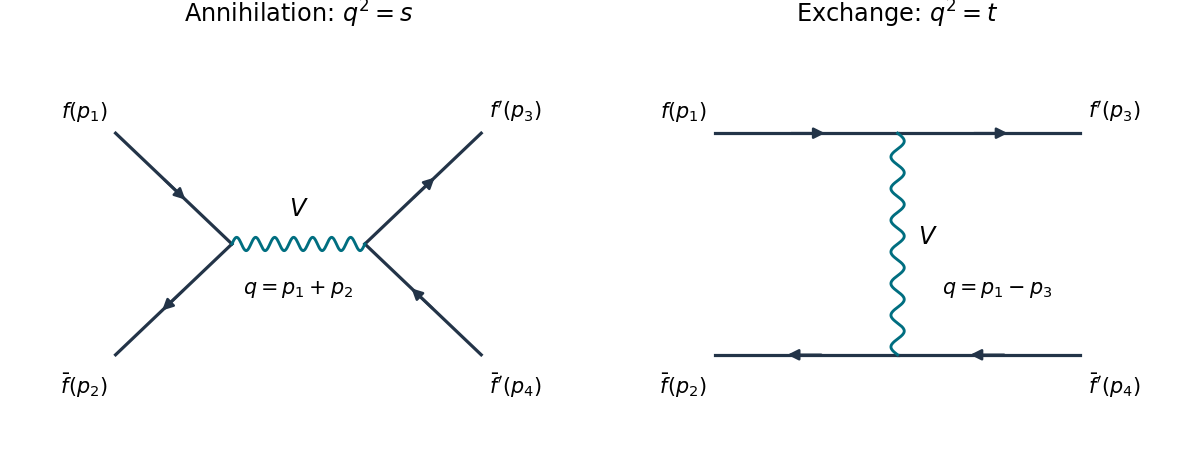
Annihilation and exchange channels with labelled external momenta
. Original Feynman diagrams, with arrows denoting fermion flow. The left panel with and is the distinct-quark flavor process. Both panels with describe Bhabha scattering; both with and describe identical-quark flavor scattering. The wavy internal line stands for the indicated vector mediator. Details.
Let label the initial quark, initial antiquark, final quark, final antiquark color charges. Up to an irrelevant common sign, the scattering amplitude isThe Mandelstam variables are , , , with in the zero-mass limit. The spin sum uses , and the initial spin average contributes . The resulting two gamma matrix traces contract toThe initial color average contributes . Summing final color charges gives the distinct-flavor quark scattering color factorThereforeEquivalently for the QCD coupling . There is no initial gluon spin average: the gluon is internal.
The two Bhabha scattering tree-level Feynman diagrams are the two panels of Solution with a photon mediator: -channel annihilation with internal momentum , and -channel exchange with internal momentum . Each interaction vertex preserves the electron species. There is no independent -channel Feynman diagram, since the outgoing electron and Positron are distinguishable.
Removing the color charge factor from Solution and replacing by givesCrossing symmetry interchanges and for the exchange Feynman diagram, givingSquaring the sum of the two scattering amplitudes also produces the interference term . The given third term must be this cross term: it has both propagator denominators , whereas a squared individual Feynman diagram has or . With the correct relative fermionic sign, its value is . ThusThe coefficient of the last displayed fraction is positive, but and in the physical scattering region, so this interference is destructive. The relative sign originates in the two possible external fermion contractions; changing an external-state phase changes both scattering amplitudes together.[ref]
Quantum Field Theory by David Tong. §6.6, Electron Positron Scattering: annihilation and exchange spinor contractions and their relative sign
Both -channel annihilation and -channel gluon exchange are now allowed. Their spin sum factors are the Bhabha scattering factors with . Their color charge tensors, with the external indices of Solution, areEach squared term has . The cross term instead has the color averageTo evaluate it, use the SU(N) fundamental completeness relationThis follows by completing the orthogonal basis of traceless Hermitian matrices with the identity. Since , it gives , and henceMultiplying the two squared Bhabha scattering terms by and its cross term by givesFor the SU(3) gauge group, this isThe negative color charge overlap reverses the sign of the QED interference. Since , this cross contribution is positive in the physical region. No additional spinor calculation is needed; all the new information is in the SU(N) fundamental completeness relation.
Articles by others on the same topic
There are currently no matching articles.