The held 2022 paper uses this title. Its source title and formal code are retained separately from later papers headed advanced quantum field theory for particle physics course of the University of Oxford.
Source bundle pages 111–115. The paper cover establishes 2022; the attachment filename uses 2021.
There are two one-loop Feynman diagrams: the two orders of the labelled photons around a top quark fermion loop, with one Yukawa interaction insertion for the outgoing Higgs boson. They are added, rather than identified by a Feynman-diagram symmetry factor. Each has the same color charge trace .
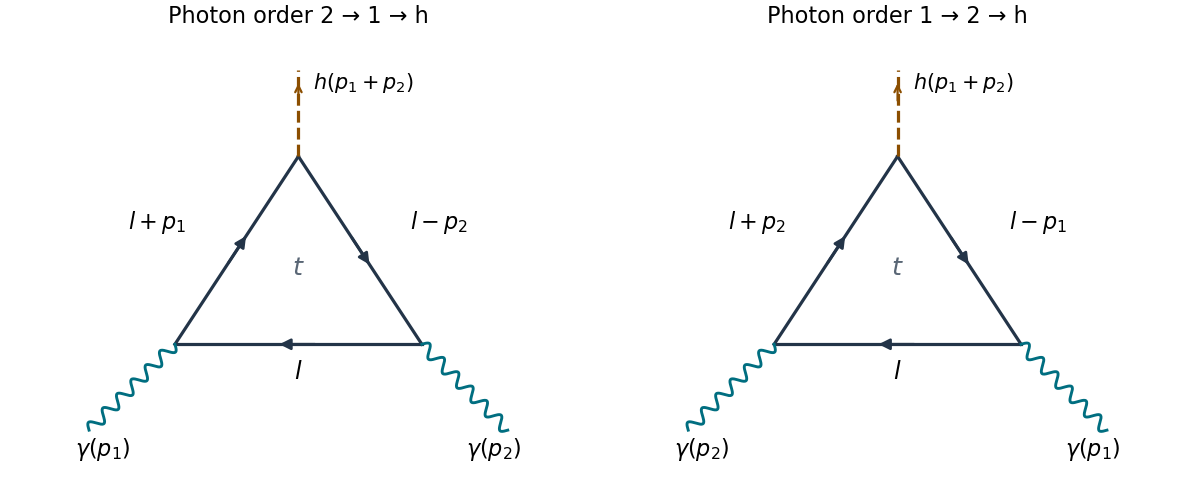
The two photon orders and consistent directed loop momenta
. Original Feynman diagrams. Solid arrows show fermion flow and the labelled internal four-momenta. Wavy external lines are incoming photons; the dashed external line is the outgoing Higgs boson. The two panels use independent dummy loop momenta. Details.
In the first routing, traverse the fermion loop from the insertion to the insertion with momentum , then to the Higgs boson insertion with momentum , then back to the insertion with momentum . Conservation at the Higgs boson insertion gives . The second routing exchanges and : its three internal momenta are , and . Reversing the orientation is another way to represent this second ordering. Two vector insertions give no Furry theorem cancellation.
Use Minkowski metric and the convention . Put , , andThe Feynman i-epsilon prescription is understood in subsequent denominators. Contracting the spinor indices around the fermion loop gives the traceHere is Feynman slash notation. The closed fermion loop sign is , the three interaction vertices contribute , and the three Dirac propagators contribute . Their product, including the color charge trace, is . Thus one ordering hasMultiplying by the incoming polarization vectors and adding the exchanged Feynman diagram givesThe displayed four-dimensional Feynman integral is formal until regularized; subsequent manipulations use dimensional regularization, which permits the required loop momentum shifts.
Set , so and . The physical polarization vectors obey . Write when they agree after contraction with these polarization vectors; terms proportional to or may then be discarded.
The gamma matrix trace identities kill the terms with an odd number of gamma matrices. The remaining three two-momentum terms and the term with three factors of areIn the coefficient the terms linear in cancel, leaving . Among the other terms, the surviving mixed products of and also cancel. ConsequentlyIn the second Feynman diagram, exchange the external labels and change the dummy loop momentum . Its projected numerator and denominator become identical to those of the first Feynman diagram. HenceWith the common factor extracted, the primitive integer coefficients areEquivalently, extracting only gives and prefactor . A common rescaling of all three coefficients changes the prefactor inversely. The physical scattering amplitude is ; the projected integrand is not an identity for an arbitrary uncontracted off-shell tensor.
Continue the loop momentum to dimensions, keeping and the external physical polarization vectors four dimensional. Introduce Feynman parameters , , denoting this integration triangle by . Completing the square givesOdd terms in integrate to zero. Lorentz invariance of dimensional regularization gives . The general projected numerator therefore becomes, under the Feynman integral,Only the term can give an ultraviolet divergence. Define, with the conventional scale factor implicit,The gamma function formula givesThus the pole of the numerator integral, including , isThe coefficients satisfy this condition. A nonzero local divergence would have to be removed by a counterterm. The Ward identity forbids a local term, and the first electromagnetic gauge-invariant coupling with one Higgs boson and two photons has the form , of engineering dimension five. It is not an independent counterterm of the Standard Model, a renormalizable quantum field theory. The top quark contribution is separately electromagnetic gauge-invariant; no additional W boson loop Feynman diagram is needed to cancel this pole.
The finite remainder must still be retained. For ,Putting before evaluating the divergent Feynman integral would incorrectly set this finite contribution to zero.
Use the Feynman parameters and defined in Solution. With , the finite term just found is . Combining it with the remaining coefficient givesThe other coefficient is . Thus, writing for the Feynman integral without the overall prefactor,For , the two coefficients must have the corresponding ratio. The mismatch is simply , independent of . Therefore the required relation iswhich is satisfied. In the primitive normalization the result isand the full top quark scattering amplitude, in our stated convention, isIndeed : replacing either polarization vector by its photon momentum makes the scattering amplitude vanish. This is the Ward identity, expressing electromagnetic gauge invariance. The result also is symmetric under exchange of the two photons. The finite term in Solution is essential for this Ward identity.
As an independent low-energy check, for the Feynman parameter integral isThe coefficient is consequently at leading order. It has the inverse-mass dimension required for an effective coupling. If , this coefficient stays finite in the large- limit at fixed ; that limit increases the Yukawa coupling, so it is not a fixed-coupling heavy-field decoupling limit.
At the stated order the renormalization-group beta function is separable:ConsequentlyFor a positive initial running coupling, this expression is used on the connected interval containing where its denominator is positive and perturbation theory remains valid.
If , the running coupling decreases at high renormalization scale and tends to zero: this is asymptotic freedom. Decreasing the renormalization scale increases the running coupling, with a formal infrared pole at . Near , perturbation theory fails; the pole alone is not a proof of confinement. Both QCD and the SU(2) weak gauge coupling have this sign for the Standard Model particle content above the relevant thresholds.
If , the running coupling decreases towards low renormalization scale and grows towards high renormalization scale. The formal ultraviolet Landau pole is . The pole signals failure of this perturbative evolution, rather than a controlled physical infinity. The hypercharge gauge coupling and ordinary QED with charged matter have this sign.
If , the running coupling is constant at this order; higher-order terms may still make it run. No Standard Model gauge factor has a vanishing one-loop order coefficient for the usual particle content.
For precise normalization, take and . The Standard Model one-loop gauge coefficients then giveThese coefficients use , not . Threshold matching changes the active particle content, so the single constant- expression is applied piecewise across thresholds.
There is one tree-level Feynman diagram: annihilation of the up quark and its antiquark into an -channel gluon, followed by production of the down quark and its antiquark. A gluon interaction vertex preserves quark flavor, so a -channel line joining the incoming up quark to the outgoing down quark is impossible.
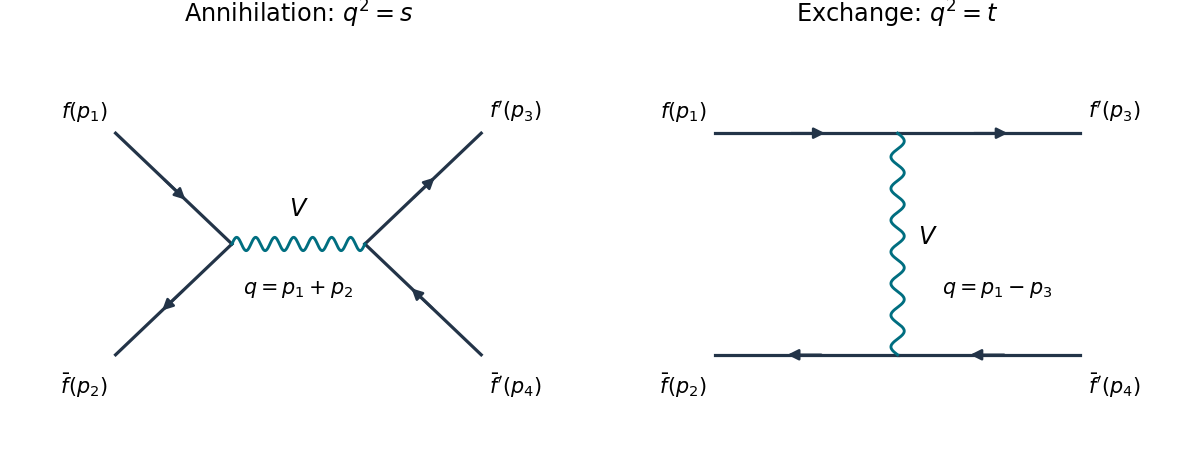
Annihilation and exchange channels with labelled external momenta
. Original Feynman diagrams, with arrows denoting fermion flow. The left panel with and is the distinct-quark flavor process. Both panels with describe Bhabha scattering; both with and describe identical-quark flavor scattering. The wavy internal line stands for the indicated vector mediator. Details.
Let label the initial quark, initial antiquark, final quark, final antiquark color charges. Up to an irrelevant common sign, the scattering amplitude isThe Mandelstam variables are , , , with in the zero-mass limit. The spin sum uses , and the initial spin average contributes . The resulting two gamma matrix traces contract toThe initial color average contributes . Summing final color charges gives the distinct-flavor quark scattering color factorThereforeEquivalently for the QCD coupling . There is no initial gluon spin average: the gluon is internal.
The two Bhabha scattering tree-level Feynman diagrams are the two panels of Solution with a photon mediator: -channel annihilation with internal momentum , and -channel exchange with internal momentum . Each interaction vertex preserves the electron species. There is no independent -channel Feynman diagram, since the outgoing electron and Positron are distinguishable.
Removing the color charge factor from Solution and replacing by givesCrossing symmetry interchanges and for the exchange Feynman diagram, givingSquaring the sum of the two scattering amplitudes also produces the interference term . The given third term must be this cross term: it has both propagator denominators , whereas a squared individual Feynman diagram has or . With the correct relative fermionic sign, its value is . ThusThe coefficient of the last displayed fraction is positive, but and in the physical scattering region, so this interference is destructive. The relative sign originates in the two possible external fermion contractions; changing an external-state phase changes both scattering amplitudes together.[ref]
Quantum Field Theory by David Tong. §6.6, Electron Positron Scattering: annihilation and exchange spinor contractions and their relative sign
Both -channel annihilation and -channel gluon exchange are now allowed. Their spin sum factors are the Bhabha scattering factors with . Their color charge tensors, with the external indices of Solution, areEach squared term has . The cross term instead has the color averageTo evaluate it, use the SU(N) fundamental completeness relationThis follows by completing the orthogonal basis of traceless Hermitian matrices with the identity. Since , it gives , and henceMultiplying the two squared Bhabha scattering terms by and its cross term by givesFor the SU(3) gauge group, this isThe negative color charge overlap reverses the sign of the QED interference. Since , this cross contribution is positive in the physical region. No additional spinor calculation is needed; all the new information is in the SU(N) fundamental completeness relation.
The Goldstone theorem states that spontaneous breaking of a continuous internal global symmetry in field theory in a local relativistic quantum field theory produces a zero-mass Goldstone boson for each independent broken generator, under the usual positive-state-space and conserved-current hypotheses. For there are symmetry-required Goldstone bosons. This count assumes a Lorentz-invariant vacuum state; nonrelativistic counting can differ.
At the classical level, invariance of the scalar potential gives . Differentiating at a stationary vacuum expectation value yieldsThese are the Goldstone directions in the scalar mass matrix. Broken generators have , so their independent directions have zero quadratic mass with a canonical kinetic term. The theorem guarantees these modes; it does not exclude further accidental zero-mass modes. A local gauge symmetry is a redundancy and does not meet the physical global-symmetry hypothesis: the Higgs mechanism can instead supply longitudinal particle polarizations of massive gauge bosons.
Put . Completing the square in the scalar potential givesSince , its global minima form the vacuum manifoldHere denotes the positive square root of the parameter . The origin is a local maximum, not a ground state. Choose . Its stabilizer subgroup is the SO(2) subgroup of rotations in the plane, so the stated SO(3) global symmetry in field theory is spontaneously broken to SO(2).
Write , , . The kinetic terms stay canonically normalized, while the scalar mass matrix isEquivalently, the quadratic scalar potential is . Therefore the particle masses areThe two angular Goldstone bosons match . The radial displacement changes and costs potential energy, giving the massive Higgs mode. These are tree-level masses; the Goldstone theorem protects the angular zero-mass modes in the exact global theory.
For any fixed , the source contribution obeys , because and . Equality occurs only at when . Thus the global ground state lies on the positive first axis. Minimize there:For , . For , , so increases strictly from to . There is exactly one root , and it is the unique global minimum. ThereforeThis argument selects the true ground state even if the full cubic has additional negative stationary roots.
Expand , , . The source is linear, so it shifts the expansion point but has zero Hessian matrix. The scalar mass matrix is diagonal at the new vacuum expectation value:Eliminating with the stationary equation givesAll three squared masses are positive. The masses themselves are the positive square roots of these expressions.
The source explicitly reduces the stated SO(3) symmetry to SO(2); the selected vacuum state preserves that remaining SO(2). There is consequently no spontaneously broken exact continuous global symmetry in field theory to which the Goldstone theorem applies. For small , the two angular excitations are pseudo-Goldstone bosons. Their squared masses vanish as , while and .
In unitary gauge the quadratic action is that of a Proca field. Use Minkowski metric and add a source . Integration by parts, dropping the boundary term, givesWith Fourier transform convention , its kernel isFor , introduce the transverse and longitudinal momentum projectorsThey obey and as mixed-index linear operators. HenceThe final expression is regular at ; the apparent singularities of the individual projectors have cancelled.
The normalized Gaussian functional integral is evaluated by completing the square with :The source-independent functional determinant cancels in this ratio. Two source derivatives insert two fields, so the covariant Feynman propagator is , with the Feynman i-epsilon prescription at the physical pole:This is the Proca propagator. Its pole residue has the three physical particle polarizations of a massive spin-one gauge boson. No additional gauge-fixing term is needed to invert this already gauge-fixed massive quadratic action. In a full interacting Higgs mechanism calculation, any field-dependent unitary gauge measure belongs to the interacting theory; the free quadratic gauge boson propagator above is unaffected.
Articles by others on the same topic
There are currently no matching articles.