Uniform system and dispersion. A plane wave reduces the differential Hamiltonian to a two-by-two matrix acting on its spinor:The Pauli anticommutation relations imply . Choosing a spinor in one of its eigenspaces therefore givesAn arbitrary constant spinor multiplying a plane wave is not necessarily an energy eigenstate; it must be an eigenvector of this matrix. For example, for the upper branch and , one can useaway from the coordinate singularity , where another normalized eigenvector chart is used.
For the usual convention, the massless branches are . For nonzero , the two branches have a gap and are quadratic near :Changing the sign of does not change these energies. It reverses the out-of-plane spin polarization of a given band at the origin. The plots for equal positive and negative mass magnitudes therefore have identical dispersion curves, despite their different spinors.
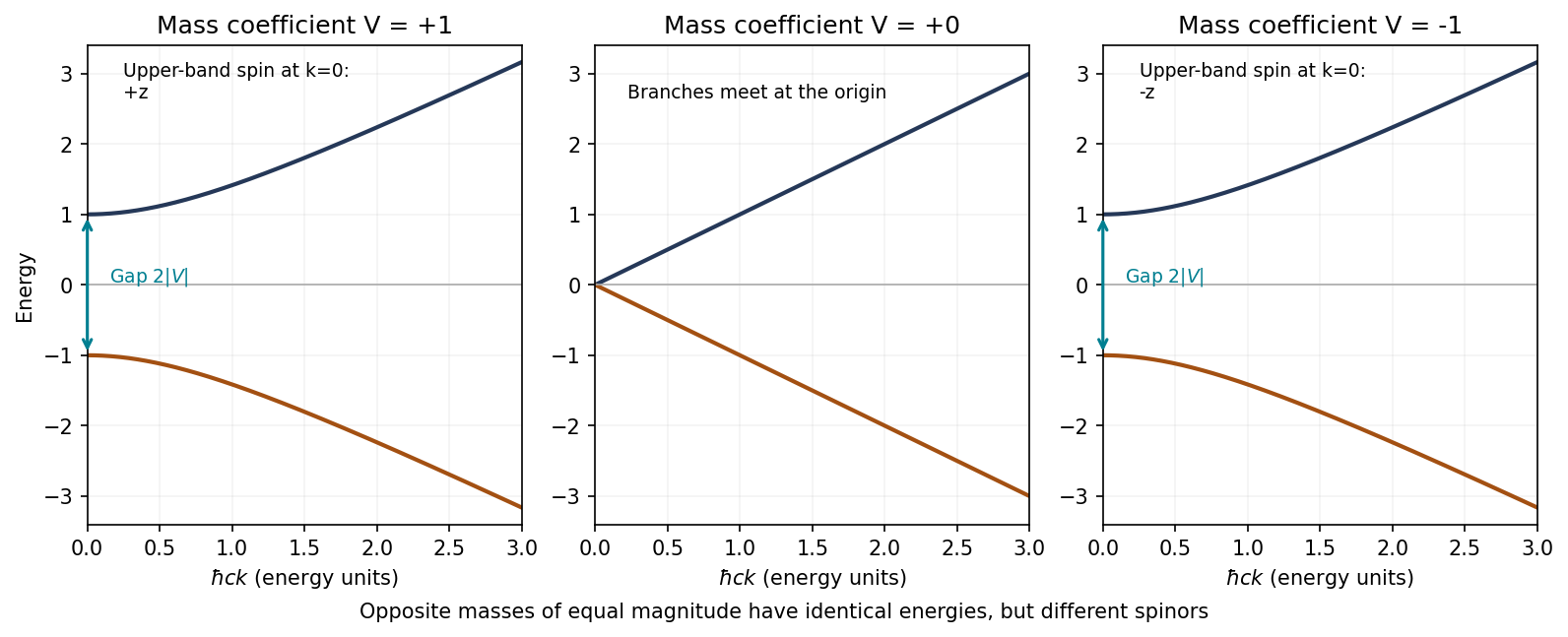
Original calculated massive and massless two-dimensional Dirac dispersions; equal and opposite masses share energies but reverse the band spin at zero momentum
. Details. 
Spin direction in the massless case. For put . The normalized eigenspinors can be chosen asDirect multiplication gives , and . Since the Pauli matrices represent physical spin in this question,The spin is parallel to momentum on the positive-energy branch and antiparallel on the negative-energy branch. Thus the branch-independent statement is collinearity; the printed parallel claim needs the positive-branch qualification. At , the Hamiltonian is zero and spin is not fixed by a wavevector direction.
Mass-domain-wall eigenstate. Assume for the stated normalizable wall state and writeThen , , and . Applying the full operator givesThe transverse derivative and mass terms cancel pointwise. Hence the specified state is an eigenstate with .
For a step mass above the interface and below it,The Localization length at a step Dirac mass wall sets the two exponential tails. The amplitude is continuous, peaks at the interface and decays on both sides, with generally unequal decay lengths. The probability density decays with lengths . A normalized transverse function is when multiplying the unit spinor . The longitudinal plane wave can independently be box-normalized. A step in allows a step in ; the first-order Dirac equation does not impose continuity of that derivative.
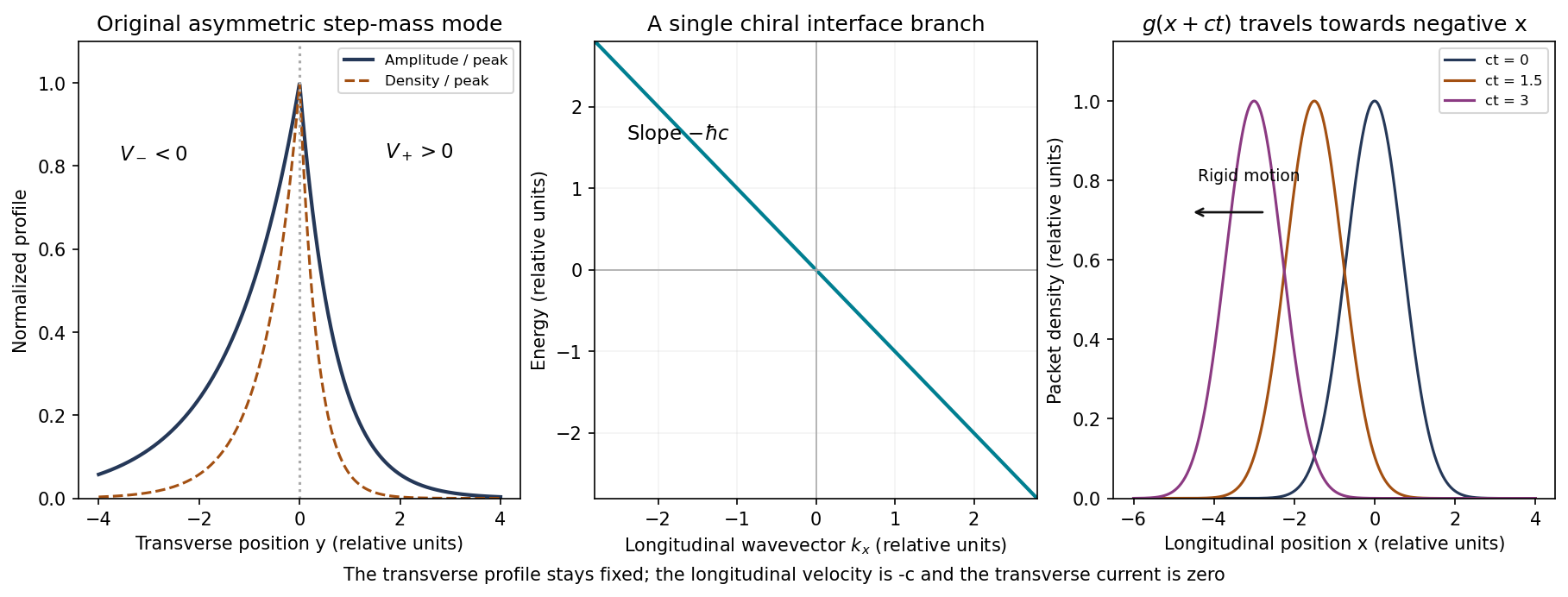
Original mass-wall solution: asymmetric exponential confinement, the chiral energy branch and rigid longitudinal translation of a localized packet
. Details. 
Propagation. The interface dispersion is the straight lineEvery component on this branch travels in the negative direction. A packet has the formThis dispersionless chiral interface wavepacket therefore translates rigidly with speed in that direction, without dispersion in this exactly linear model. It remains confined in ; there is no free transverse group velocity, because the bound-state family is not labelled by a transverse travelling-wave momentum.
The continuity equation gives the current components and . This explicitly confirms absence of probability transport away from the interface. For the step-mass case the profile is normalizable because its tails have positive decay constants and . A general sign-changing profile also requires ; nonzero asymptotic masses suffice, whereas signs alone do not guarantee confinement if their integrated magnitudes grow too slowly. If , the supplied exponential instead grows at infinity; a normalizable state requires the opposite spinor and envelope sign. Reversing the wall orientation also reverses the propagation chirality.
Articles by others on the same topic
There are currently no matching articles.