Let the electric charge be , where is the elementary charge. Minimal coupling to a tangential magnetic vector potential givesA constant tangential magnetic vector potential is an available gauge on the ring, so . By Stokes theorem, its circulation is the oriented magnetic fluxThe orientation matters here. In the original diagram, increasing goes anticlockwise, whose associated positive normal points out of the page, whereas the indicated positive magnetic flux points into the page. Hence for that diagram, and its convention gives . If instead is defined with the normal associated to , the relation is .
There is no requirement that the magnetic field be nonzero on the ring: it can be confined to a solenoid inside it. The nonzero circulation of the magnetic vector potential still affects the Electron through the Aharonov-Bohm effect.
Define a transformed wavefunction byIndeed, writing givesThis is the electromagnetic gauge transformation generated by : and . The transformed Hamiltonian operator is consequently , but the original periodic boundary condition becomes the twisted boundary conditionFor the domain of the self-adjoint kinetic Hamiltonian operator, the derivative has the same twist, . Thus the magnetic flux has moved into the boundary condition. The transformation is a single-valued gauge on periodic representatives only when is an integer multiple of ; otherwise it is understood on the cut interval with the displayed identification of its endpoints.
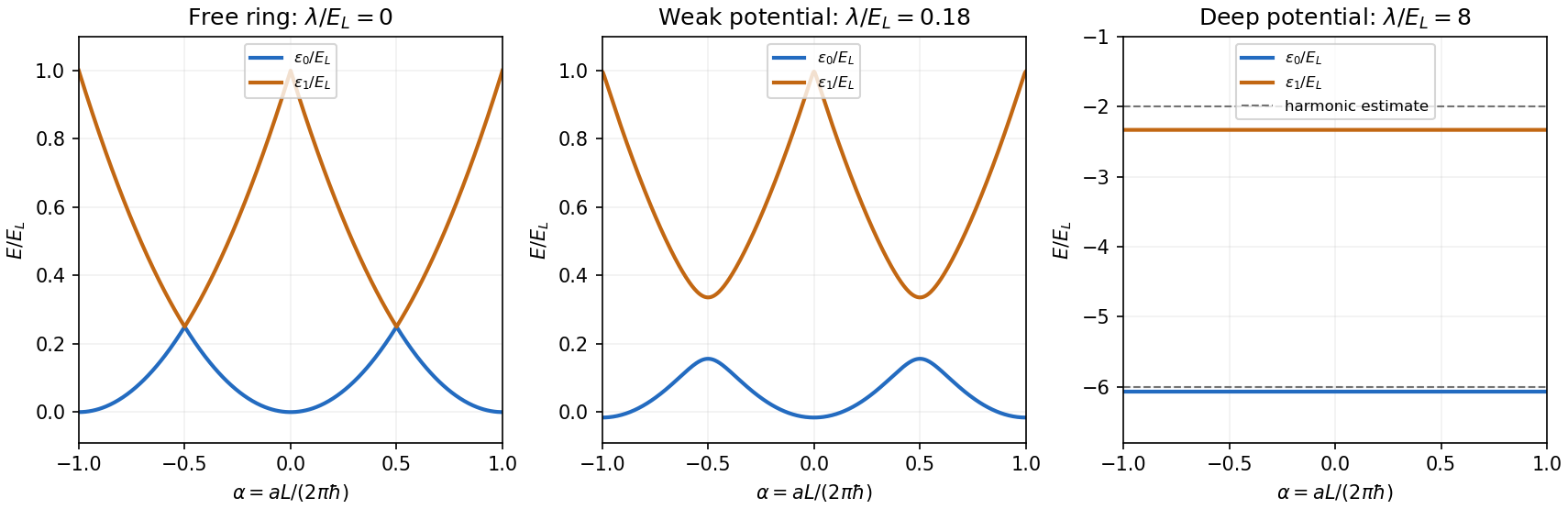
For the magnetic flux spectrum of a quantum ring, the periodic boundary condition permits the normalized plane waves , with . Their energy eigenvalues areShifting by an integer relabels , so the ordered energy levels have period one in , or in . For , the lowest two areextended periodically. The lowest branches cross at every half-integer , with energy . At integer , the first excited energy level has multiplicity two. The corresponding magnetic flux period is the electron magnetic flux quantum .

In the normalized plane wave basis, the only nonzero potential matrix elements areThus a useful small parameter is , which suppresses admixture of well-separated energy levels. First-order nondegenerate perturbation theory further requires for the coupled states. This latter condition fails near a half-integer even for very small ; there one must use degenerate perturbation theory in the nearly degenerate pair. Smallness is measured against the gaps to the other states, not the vanishing gap inside this pair.
Near , keep . The resulting Hamiltonian operator matrix and its eigenvalues areIn particular,For positive , the lower quantum state at the crossing is the symmetric combination of , and the upper state is the antisymmetric combination. A negative exchanges these combinations but leaves the ordered energy eigenvalues unchanged.
This cosine-potential gap in a quantum ring appears in the middle panel above: each lowest-branch crossing opens into an avoided crossing of gap to first order. Away from these crossings, the diagonal matrix elements vanish, so the leading shifts are second order. At integer , the two first-excited plane waves differ by two units of and therefore have no first-order coupling; their smaller splitting begins at second order. The numerical plot includes that splitting.
Put . Changing the sign of translates the potential by without changing its energy eigenvalues, so take a minimum at and expand there. The parabolic approximation givesThe low-lying wavefunctions are localized well inside one period. A local gauge transformation removes from their quantum harmonic oscillator equation, givingConsequently,The sketch consists of two nearly horizontal branches, separated by this gap, as in the right panel above. The parabolic approximation makes them completely independent of magnetic flux; in the actual ring they retain exponentially small periodic dependence through quantum tunnelling around the ring. Corrections from the nonquadratic part of the potential shift the mean energies and gap by relative order , whereas the tunnelling dependence is smaller than every power of that parameter.
Articles by others on the same topic
There are currently no matching articles.