For fixed frequency , the Fourier transform of a derivative gives . The transformed initial value problem is thereforeSolving this scalar ordinary differential equation yieldswhere the value at is interpreted by continuity and equals two. Thus diffusion suppresses high frequencies by the Gaussian multiplier while preserving the zero-frequency mass.
The differentiation and transform steps are justified for the heat kernel solution : for positive time its spatial derivatives are integrable, since Gaussian derivatives are integrable and is bounded with compact support. Alternatively, the transformed calculation first suggests the formula, and the next part verifies the resulting solution directly.
Insert part (i) in the inverse Fourier transform. The factor two in cancels half of the inverse normalization:The integrand has a removable singularity at zero. For , the Gaussian controls every polynomial factor at infinity, so differentiation under the integral is valid. Differentiation in and twice in both multiply the integrand by , proving .
There is also a direct physical-space representation:Since has integral one, writeThe continuous compactly supported profile is uniformly continuous. Given , choose so its change is below for . That part of the integral is bounded by . The other part is bounded by , which tends to zero by the substitution and the vanishing tails of the Gaussian integral. This proves uniformly as and verifies the initial condition.
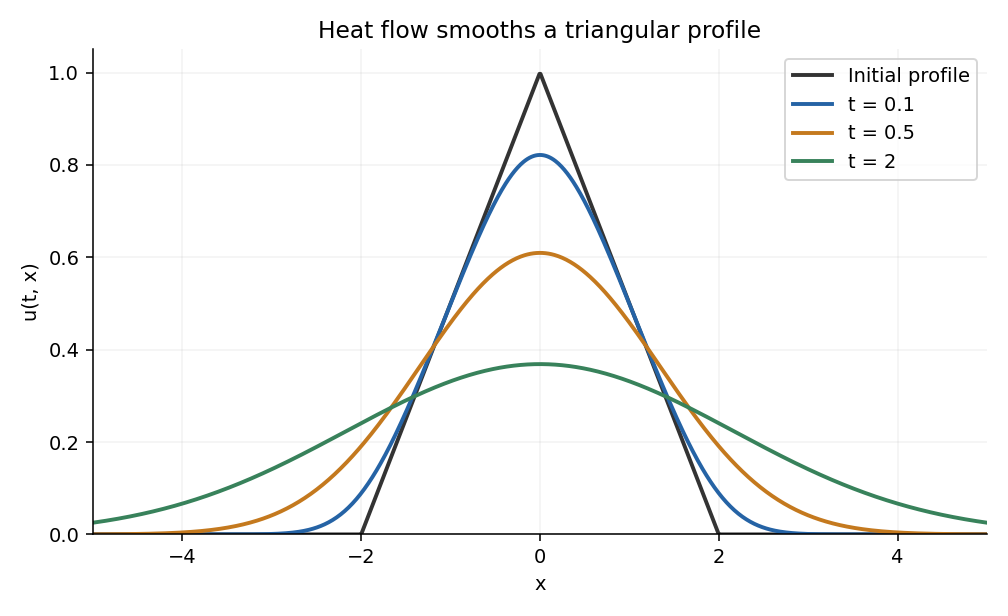
Thus the formula supplies the full heat evolution of a triangular profile, including the corner points of the initial profile. Positive time immediately smooths those corners.

Articles by others on the same topic
There are currently no matching articles.