Parametrize the vertical line as , . Then , whose modulus is and whose argument takes every value. The image isIncreasing traverses the circle counterclockwise, repeating with period . There is no injectivity on the full line.
Parametrize the horizontal line as , . Then , and takes every positive real value exactly once. The image isThis is the ray with argument modulo , excluding its endpoint zero. As increases, the image moves outward from arbitrarily small to arbitrarily large radius.
Let and invert to . The pole lies on the excluded boundary, so it is not a point of the original region. For the first inequality becomesThe second becomesThus the image is contained in the vertical strip . Conversely every point in that strip is nonzero; its inverse satisfies both original inequalities, so no points are missing. ThereforeThe two circles pass through the pole of the Möbius transformation, which is why their images are straight lines. Direct inequality transformation fixes which side of each line is required.
The complex exponential function gives the natural onto map:Its derivative is never zero, so it preserves angles locally. Conversely any point in this annulus has a logarithm with real part in , proving surjectivity.
There is a terminology qualification. This map is not injective, since and the strip contains both points. If “conformal mapping onto” requires a biholomorphism, no such map exists: the strip is convex and simply connected space, whereas the annulus contains a loop of winding number one around zero that cannot contract inside it. A biholomorphism would be a homeomorphism and preserve this property.
Thus the complex exponential function is a locally conformal covering; a biholomorphism is impossible. It identifies imaginary translates by . The printed request is satisfied under its local-angle-preserving convention, with the injectivity distinction made explicit. This is exponential covering of an annulus by a vertical strip.
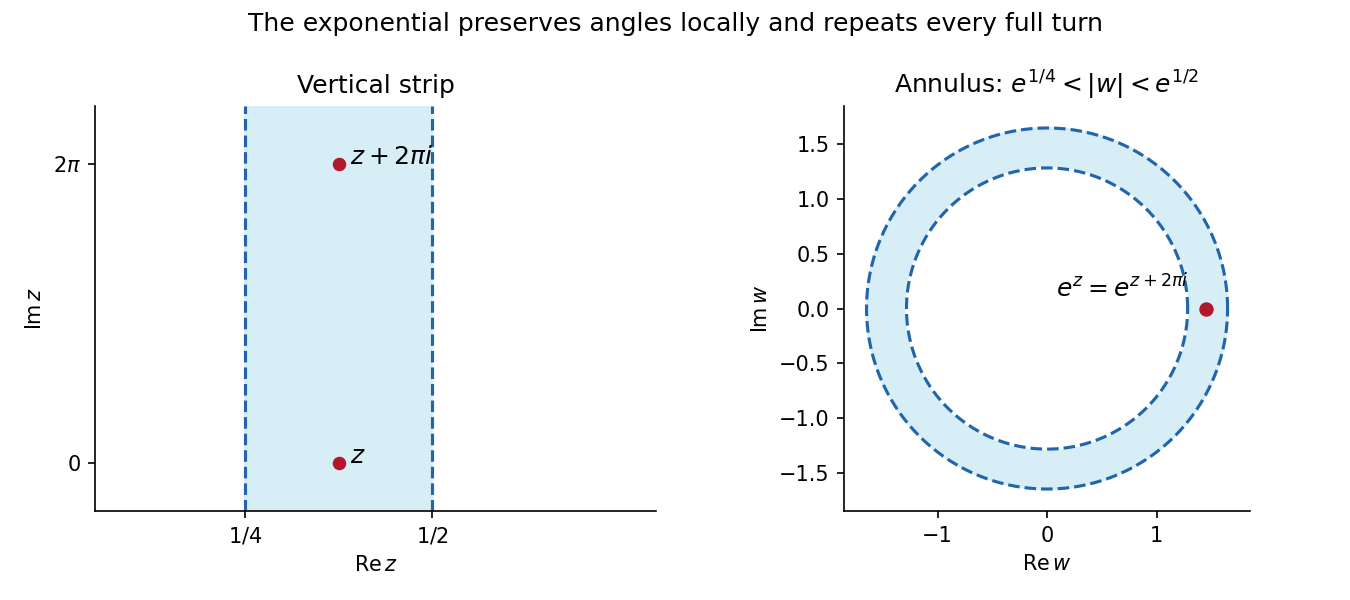
The strip wraps repeatedly around an annulus under the complex exponential function
. Details. 
Articles by others on the same topic
There are currently no matching articles.