The weight is strictly positive and all its polynomial moments are finite. Thus the given integral is a inner product: for a nonzero polynomial, its square is positive on a nonempty interval, so its weighted integral is strictly positive.
In the finite-dimensional vector space , subtract the orthogonal projection onto a finite-dimensional subspace of onto :This is monic, since the subtracted polynomial has lower degree, and is orthogonal to every lower-degree polynomial. If were two such monic polynomials, their difference would lie in and be orthogonal to that space. Taking its inner product with itself gives zero, hence the difference vanishes. This proves existence and uniqueness for every , with .
Odd moments vanish because the weight is even; the even moments areConsequently , while a monic quadratic orthogonal to has no linear term, and orthogonality to one gives its constant term . ThusFinally is also monic and orthogonal to every lower-degree polynomial, by the change of variable . Uniqueness implies . In particular is odd andThis is parity of monic orthogonal polynomials for an even weight.
Use the monomial basis , . Direct differentiation giveswith the endpoint terms zero. Repeated application therefore gives , while and . Each nilpotency index is exactly , soNextand hence . These real eigenvalues are distinct. A polynomial annihilates this operator exactly when it vanishes at all of them, givingThe commutator is diagonal in the displayed monomial basis. Since , are nonzero nilpotent linear map; a diagonalizable nilpotent map would have a diagonal matrix with all eigenvalues zero and thus be the zero map. Therefore only is diagonalizable. The calculation realizes raising and lowering on binary homogeneous polynomials.
For , let denote the algebraic conjugate, not necessarily ordinary complex conjugation when . Conjugation respects multiplication, and . ThereforeIf is a unit in a ring, choose its inverse in the same ring. Then , and both norms are nonnegative integers, forcing . Conversely, if , then , so belongs to the ring. Thus is a unit in a ring exactly when .
For negative , the equation becomes . If , its integer solutions give the four units . If , the term forces , leaving . HenceFor , the element has field norm . Its powers , , are all units by multiplicative function and are distinct, since their positive real values strictly increase with . Thus has infinitely many units. This argument concerns the stated integer-coefficient ring; it does not replace it by a larger ring of algebraic integers.
The topology on is the subspace topology inherited from the complex plane. A subset is open in if for some open subset . Equivalently, every has a radius such that .
A subset is closed in if is open in , equivalently if for a closed subset of the complex plane. These are relative properties: the same subset need not be open or closed in the ambient plane.
The set is disconnected space if it has a separation of a topological space: two nonempty disjoint subsets open in with . Each is then also closed in , being the other's complement.
The set is connected if no such separation of a topological space exists. Equivalently its only subsets that are both open and closed are and . A separation of a topological space uses openness in rather than necessarily in the entire complex plane.
Because the image is integer-valued, the open interval contains exactly one possible image value, namely . ThusThe right side is open in by continuity, soThis includes the possibility of an empty fiber. The source notation is understood as the preimage of the singleton .
Since is nonempty, choose and put . The fiber is nonempty and open by part (c). Its complement is the union of the other integer fibers and is therefore also open. If the image contained a second value, that complement would be nonempty, and these two disjoint open subsets would separate . connectedness excludes this. HenceEquivalently a continuous function from a connected space to the discrete space of integers is constant. The proof uses relative openness and does not require the original subset to be open in the plane.
A function on the open set is holomorphic if at every the complex limitexists. The limit is independent of the direction of approach.
A pole of order at means that in a punctured neighborhood, where extends holomorphically across and . Equivalently has a nonzero finite limit at .
For the given quotient, is equivalent, on putting , to , or . Thus all possible poles are , , with no additional nonreal solutions. At such a point,At the numerator does not vanish, so the pole has order two. At zero the numerator cancels one order:ThereforeThe numerator's cancellation at zero is why not every denominator zero produces the same pole order.
Parametrize the vertical line as , . Then , whose modulus is and whose argument takes every value. The image isIncreasing traverses the circle counterclockwise, repeating with period . There is no injectivity on the full line.
Parametrize the horizontal line as , . Then , and takes every positive real value exactly once. The image isThis is the ray with argument modulo , excluding its endpoint zero. As increases, the image moves outward from arbitrarily small to arbitrarily large radius.
Let and invert to . The pole lies on the excluded boundary, so it is not a point of the original region. For the first inequality becomesThe second becomesThus the image is contained in the vertical strip . Conversely every point in that strip is nonzero; its inverse satisfies both original inequalities, so no points are missing. ThereforeThe two circles pass through the pole of the Möbius transformation, which is why their images are straight lines. Direct inequality transformation fixes which side of each line is required.
The complex exponential function gives the natural onto map:Its derivative is never zero, so it preserves angles locally. Conversely any point in this annulus has a logarithm with real part in , proving surjectivity.
There is a terminology qualification. This map is not injective, since and the strip contains both points. If “conformal mapping onto” requires a biholomorphism, no such map exists: the strip is convex and simply connected space, whereas the annulus contains a loop of winding number one around zero that cannot contract inside it. A biholomorphism would be a homeomorphism and preserve this property.
Thus the complex exponential function is a locally conformal covering; a biholomorphism is impossible. It identifies imaginary translates by . The printed request is satisfied under its local-angle-preserving convention, with the injectivity distinction made explicit. This is exponential covering of an annulus by a vertical strip.
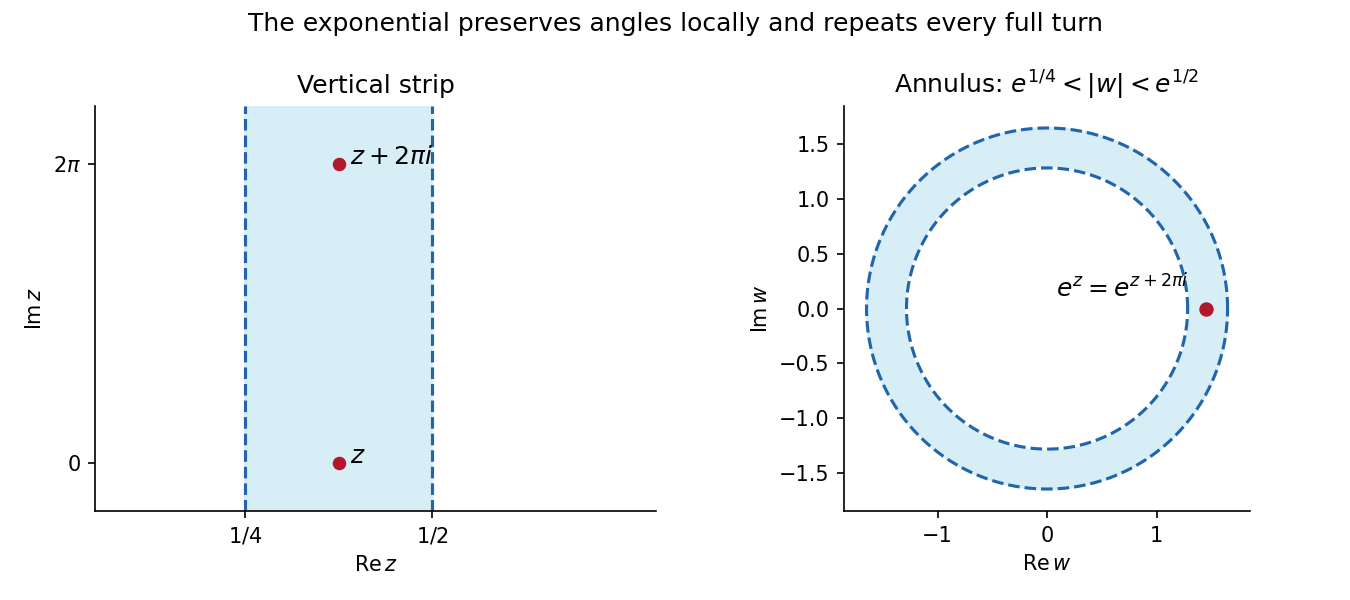
The strip wraps repeatedly around an annulus under the complex exponential function
. Details. For , the derivatives are and . Substituting gives . The independent solutions have Wronskian on , so they form a fundamental system of solutions.
Divide the inhomogeneous linear differential equation by and use variation of parameters. Choosing integrals from one gives the particular solutionThus . The first boundary condition gives . The integral endpoint terms cancel when differentiating , so the second givesConsequentlyCollect the coefficient of on either side of . A suitable Green function isThe two pieces agree at , , and for . For an interior source point its derivative jump isThus multiplication by the leading coefficient gives unit in a ring source strength. Away from , both pieces solve the homogeneous linear differential equation. With continuous , the integral representation has the required second derivative and solves the equation pointwise in .
For uniqueness, the difference of two solutions is . Its boundary conditions give and , forcing . Hence the solution is unique. This is the mixed Green function for an Euler operator with exponents one and two.
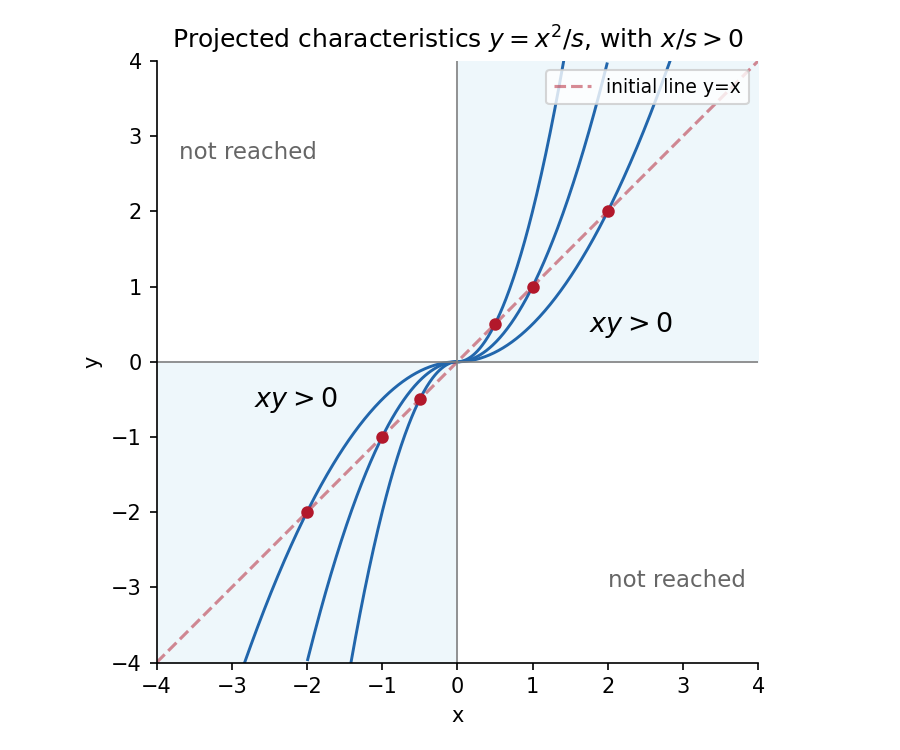
Choose characteristic parameter with initial value at . The characteristic equations areThe first two integrate immediately; substitution into the third givesEliminating gives the projected parabolaThe sign restriction selects the half-parabola actually reached from the initial point.
The projection map has Jacobian determinant , so the initial curve is noncharacteristic for every allowed . Its global inverse isdefined precisely when have the same nonzero sign. Every such point is reached by exactly one characteristic. Hence the region of unique determination from these initial data projects ontothe first and third quadrants. The axes are not reached for finite parameter from , and the other two quadrants have no method of characteristics issued from this initial curve.
As a direct check, substitution of the inverse parameters gives the solutionIt has , and differentiating gives . This is quadrant uniqueness for unequal dilation characteristics.


The second equilibrium point equation gives . Substituting into the first gives , so . Put , with . ThenThe function is strictly increasing on , since . It starts at zero and tends to infinity, so it takes the value one exactly once. Moreover , so . This proves uniqueness of the stated equilibrium point.
At that point , and the Jacobian matrix isIts trace is and determinant . The characteristic discriminant is , so its two eigenvalues areThey are distinct and positive, with eigenvectors and respectively. Thus the linearized critical point is an unstable node. It is a hyperbolic equilibrium, so the original nonlinear equilibrium point is also locally repelling; this last observation is stronger than the requested linearized classification.
Articles by others on the same topic
There are currently no matching articles.