An affine variety in is the common zero set of a collection of polynomials in , with its Zariski topology. We use the convention of this question that such a variety need not be irreducible. Its vanishing ideal and coordinate ring areThe quotient identifies polynomials that give the same function on , so its elements are exactly polynomial functions on .
For affine embeddings and , a morphism of affine varieties is a map with and image in . Pullback of polynomial functions defines the contravariant homomorphismIt is well defined because any polynomial vanishing on pulls back to zero on , and it preserves addition, multiplication, one, and the constants in .
The radical of an ideal isThe ideal is radical if . Its zero set is , an affine variety by definition.
Every vanishes at every point of , so . If , then in the field for every , so for each such point. Hence and
Part (b) immediately gives . For the reverse inclusion, let . The case is immediate, so assume . Noetherianity gives finite generators .
Use the Rabinowitsch trick: in the polynomial ring with one auxiliary variable, formApply the assumed maximal-ideal description to polynomial rings, including this ring in variables. If were proper, it would lie in the maximal ideal of some point . Then and , impossible because vanishes on . Therefore is the whole ring, and there is an identitySubstitute in the localization . The last term vanishes; clearing the finitely many powers of from the remaining denominators yields for some . Thus andThis proves the strong Hilbert Nullstellensatz from the polynomial-ring weak form by converting nonvanishing into an extra equation.
Here subvariety means a closed affine subvariety. Suppose first that is onto, and write , . Put and . Choose with and let have components .
Let the components of be polynomial functions on . For each target coordinate , the element has zero pullback, hence belongs to . It vanishes on , giving . Both maps have polynomial components, so is an isomorphism onto the closed subvariety .
Conversely, if is an isomorphism onto a closed subvariety, restriction is surjective, and the pullback of that isomorphism is an isomorphism. Their composition is , provingThe word closed matters: an isomorphism onto a merely locally closed subset need not induce a surjective coordinate-ring map. For example induces .
The parametrization lands on the curve because . Its pullback has imageEvery monomial in this subalgebra has exponent for nonnegative integers . No such exponent is one, so no linear combination of these monomials is . Thus is not surjective and is not an isomorphism.
It is nevertheless bijective on points. Away from the origin, and gives and using ; the origin comes only from . The rational inverse cannot extend regularly at the origin: if with , then has a nonzero degree-one term, whereas has none.This distinguishes a set-theoretic bijection from an isomorphism of varieties in every characteristic.
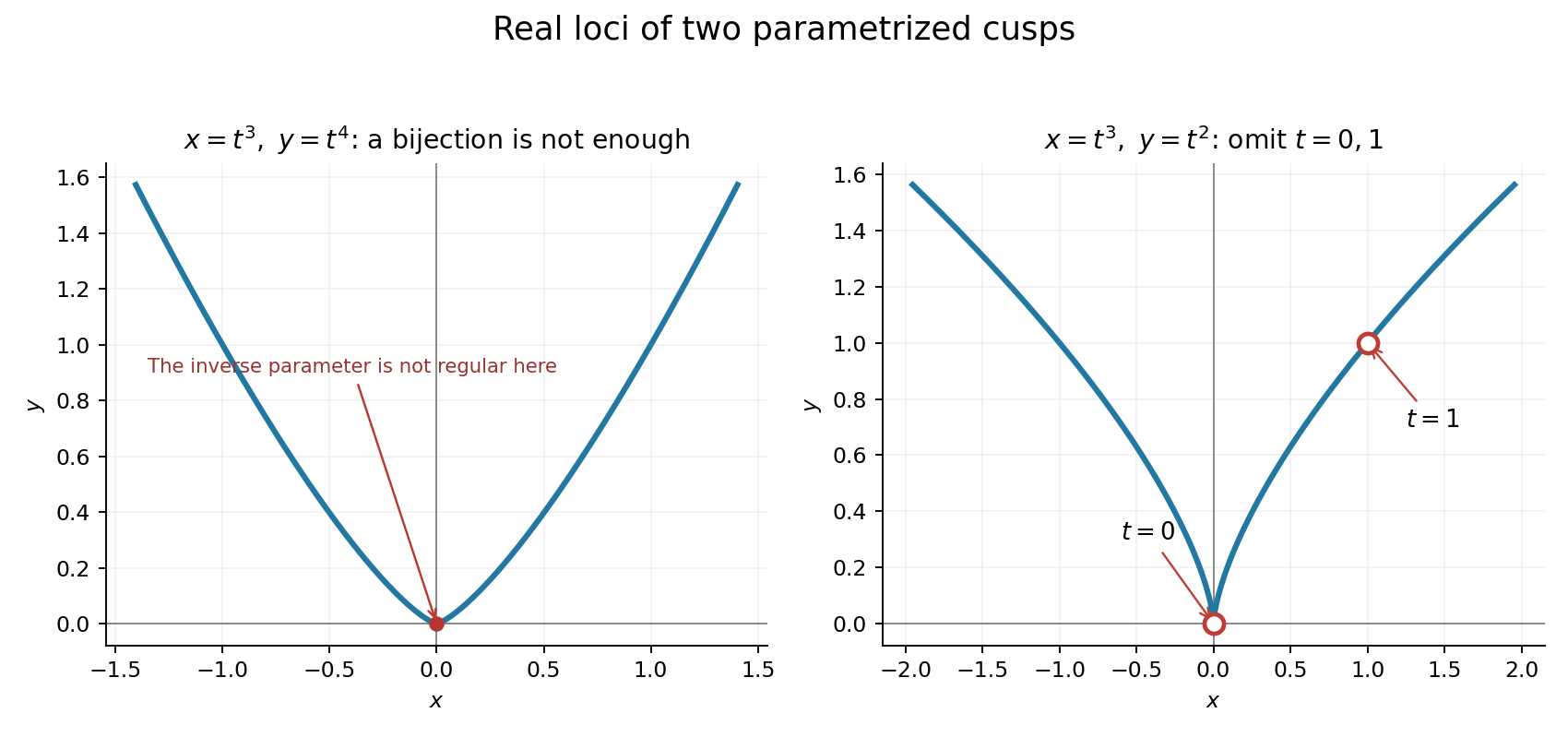
Cusp parametrizations reveal which rational coordinates fail to be regular
. The left curve uses x=t cubed and y=t to the fourth; recovering t fails regularly at its origin. The right curve uses x=t cubed and y=t squared; the open subset used later omits the parameter values zero and one, marked with hollow circles. Details.
Articles by others on the same topic
There are currently no matching articles.