Source paper: FOI request thread. The intact cover identifies Algebraic Geometry, C3.1a, Tuesday 7 June 2011, 2.30pm to 4.00pm. Its three readable pages are original private-bundle pages 413–415.
An affine variety in is the common zero set of a collection of polynomials in , with its Zariski topology. We use the convention of this question that such a variety need not be irreducible. Its vanishing ideal and coordinate ring areThe quotient identifies polynomials that give the same function on , so its elements are exactly polynomial functions on .
For affine embeddings and , a morphism of affine varieties is a map with and image in . Pullback of polynomial functions defines the contravariant homomorphismIt is well defined because any polynomial vanishing on pulls back to zero on , and it preserves addition, multiplication, one, and the constants in .
The radical of an ideal isThe ideal is radical if . Its zero set is , an affine variety by definition.
Every vanishes at every point of , so . If , then in the field for every , so for each such point. Hence and
Part (b) immediately gives . For the reverse inclusion, let . The case is immediate, so assume . Noetherianity gives finite generators .
Use the Rabinowitsch trick: in the polynomial ring with one auxiliary variable, formApply the assumed maximal-ideal description to polynomial rings, including this ring in variables. If were proper, it would lie in the maximal ideal of some point . Then and , impossible because vanishes on . Therefore is the whole ring, and there is an identitySubstitute in the localization . The last term vanishes; clearing the finitely many powers of from the remaining denominators yields for some . Thus andThis proves the strong Hilbert Nullstellensatz from the polynomial-ring weak form by converting nonvanishing into an extra equation.
Here subvariety means a closed affine subvariety. Suppose first that is onto, and write , . Put and . Choose with and let have components .
Let the components of be polynomial functions on . For each target coordinate , the element has zero pullback, hence belongs to . It vanishes on , giving . Both maps have polynomial components, so is an isomorphism onto the closed subvariety .
Conversely, if is an isomorphism onto a closed subvariety, restriction is surjective, and the pullback of that isomorphism is an isomorphism. Their composition is , provingThe word closed matters: an isomorphism onto a merely locally closed subset need not induce a surjective coordinate-ring map. For example induces .
The parametrization lands on the curve because . Its pullback has imageEvery monomial in this subalgebra has exponent for nonnegative integers . No such exponent is one, so no linear combination of these monomials is . Thus is not surjective and is not an isomorphism.
It is nevertheless bijective on points. Away from the origin, and gives and using ; the origin comes only from . The rational inverse cannot extend regularly at the origin: if with , then has a nonzero degree-one term, whereas has none.This distinguishes a set-theoretic bijection from an isomorphism of varieties in every characteristic.
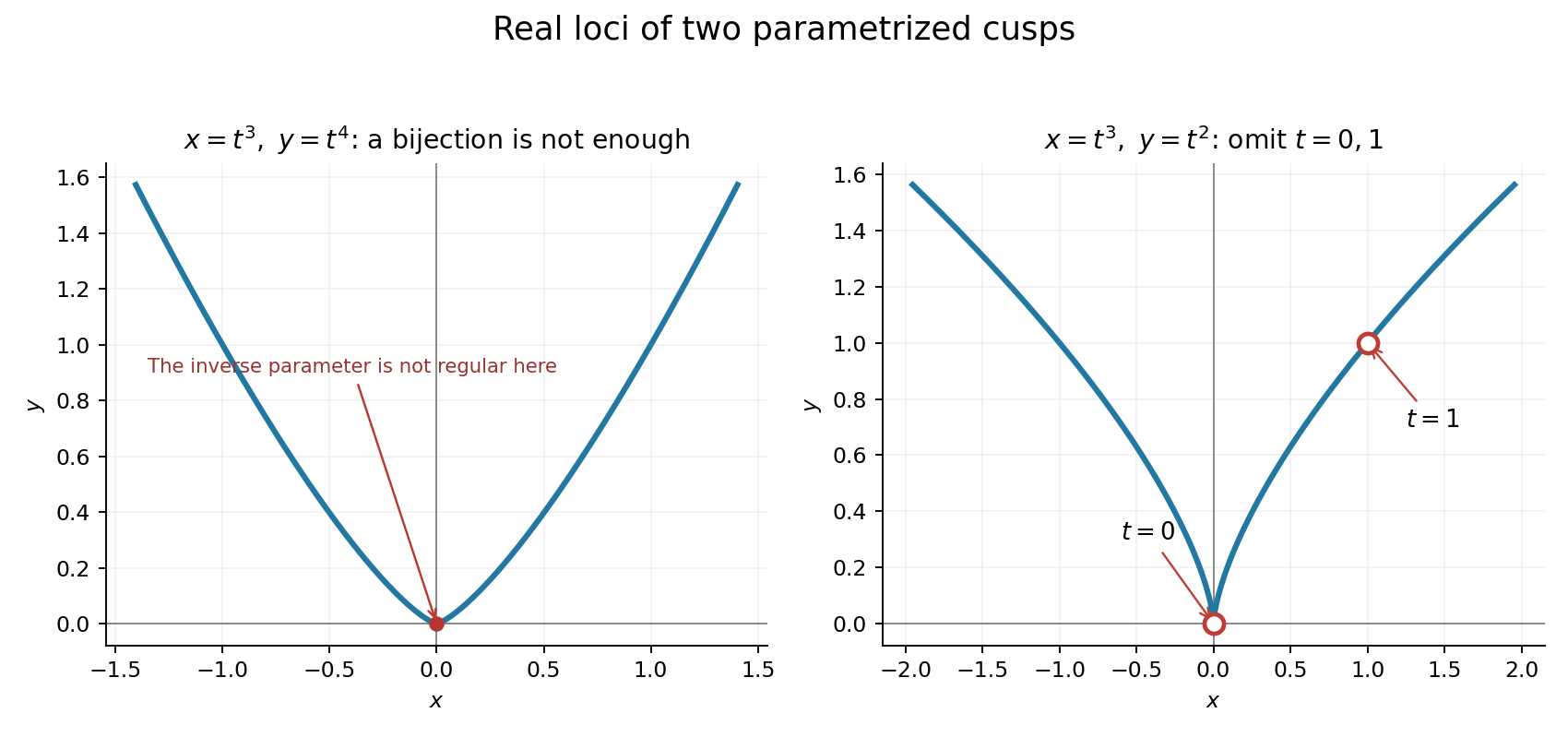
Cusp parametrizations reveal which rational coordinates fail to be regular
. The left curve uses x=t cubed and y=t to the fourth; recovering t fails regularly at its origin. The right curve uses x=t cubed and y=t squared; the open subset used later omits the parameter values zero and one, marked with hollow circles. Details.
A projective variety is a Zariski-closed subset of projective space , equivalently the common zero set of homogeneous polynomials. Homogeneity makes their vanishing independent of the nonzero scalar used to represent a projective point.
A morphism is a map locally given by regular coordinate functions in affine charts. Equivalently, near each point of a projective source embedded in , a morphism to can be writtenusing homogeneous polynomials of a common degree that are not all zero on that neighbourhood. The expressions must agree on overlaps, and for a specified target variety their values must lie in it. A single global tuple is a sufficient description when available, but is not part of the general definition.
The Segre embedding isRescaling the two representatives multiplies every target coordinate by the same scalar, and at least one product is nonzero, so the map is well defined. In affine source charts its coordinate ratios are regular products, so it is a morphism.
Arrange target coordinates into a matrix . Every image matrix has rank one and satisfies all homogeneous equationsConversely, a nonzero matrix satisfying these equations has rank one. Choose and set , . The minors imply . Thereforea projective variety. The two projective factors are uniquely recoverable from a nonzero column and row. This also shows injectivity and supplies the local inverse formulas used in the next part.
Choose projective embeddings and . Define their product as the Segre image of the set of pairs , with its induced variety structure.
It is closed in the Segre variety. To see this directly, for every homogeneous impose the equations on every column, and for every homogeneous impose on every row. For a rank-one matrix , the column equations are . A nonzero therefore forces . The row equations similarly force . Thus these homogeneous equations together with the minors cut out exactly , proving it is projective.
On a chart where , the projections have formulasThese homogeneous coordinate tuples are nonzero on the chart and agree on overlaps, so both projections are morphisms.
Given morphisms and , define . Locally write their coordinates as and . Then has coordinates , which are regular with a nonzero coordinate near each point. Hence is a morphism andThe two projections determine the underlying pair uniquely, so this morphism is unique. This is the product universal property, and it makes the construction independent up to canonical isomorphism of the chosen embeddings.
Let and let be the homogeneous coordinate ring of a nonempty projective variety. Its Hilbert function is . For all sufficiently large integers , this function agrees with a polynomial , the Hilbert polynomial.
The dimension is the largest length of a strict chain of nonempty irreducible closed subvarieties of . Equivalently . The degree of the embedded variety is the integer specified by the leading termGeometrically it is the number of intersection points with a general linear subspace of codimension , counted with intersection multiplicities. The polynomial's degree is the dimension ; the variety's degree is the leading coefficient multiplied by . Keeping those two meanings separate is important in the next computation.
The homogeneous coordinate ring of the Segre image is the subalgebra , grading each product as degree one. Its degree- part is precisely the space of polynomials bihomogeneous of bidegree .
Indeed, every product of generators has those two degrees. Conversely, any monomial of bidegree can pair its individual factors with its individual factors, expressing it as a product of generators. The distinct resulting monomials are linearly independent. Counting them givesIn fact this agrees with the Hilbert function for every integer . Its leading coefficient is , so the two degree quantities areThus the Segre variety has dimension and embedded projective degree .
This gives the Segre Hilbert polynomial and degree directly from its graded monomials.
A quasi-projective variety is a locally closed subset of projective space: equivalently an open subset of some projective variety, with the induced algebraic variety structure. Affine varieties are examples, via the standard affine chart in projective space.
It is irreducible if it is nonempty and cannot be written as the union of two proper closed subsets. Equivalently, every two nonempty open subsets meet, or every nonempty open subset is dense. Closed and open are interpreted in the induced Zariski topology of .
For a multiplicatively closed set containing one, the localization of a ring consists of fractions with , under the equivalenceThe factor is needed when the ring has zero divisors. Addition and multiplication areThe canonical map sends to and makes every element of a unit. It is universal with this property: a ring homomorphism taking into units extends uniquely by . Usually zero is excluded from ; if it is included, this construction is the zero ring.
A regular function on is a function locally representable, in an affine chart of the ambient projective space, as a quotient of polynomial functions with denominator nonzero on that neighbourhood. Equivalently it is locally a quotient of homogeneous forms of the same degree. The equal-degree condition makes the quotient independent of the chosen projective representative.
The ring is the ring of germs of such functions near . Two representatives and define the same germ when they agree on some smaller neighbourhood of . Addition and multiplication use a common neighbourhood. It is a local ring: its unique maximal ideal consists of germs vanishing at , and any germ nonzero at has a regular reciprocal on a smaller neighbourhood.
A morphism is a continuous map in the Zariski topologies such that for every open and every regular function on , the pullback is regular on .
Equivalently, near every point, choose affine charts of source and target; the target coordinates of must then be regular functions of the source coordinates. These local conditions agree on overlaps. In particular a morphism is defined at every point of its source, not merely on a dense open subset.
A rational map from irreducible to is an equivalence class of morphisms defined on nonempty open subsets . Two representatives are equivalent if they agree on a nonempty open subset of their intersection.
Irreducibility makes all these nonempty opens dense and ensures their intersections are nonempty, so the equivalence expresses agreement at general points. A rational map need not extend across all of , and it need not be dominant. An injective homomorphism of function fields additionally requires a dominant morphism of affine varieties, or the corresponding condition on a rational map.
Polynomial functions are regular, giving an injective map ; injectivity follows from quotienting by the full vanishing ideal. To prove surjectivity, let be globally regular and consider the denominator idealIt is an ideal because sums and polynomial multiples preserve this property.
Fix . Locally on a neighbourhood of , with nonzero there. Principal affine opens form a basis, so choose with and . Thenas functions on all of : on it follows from the local fraction, and off both sides vanish because . Hence and .
Thus has no common zero on . By the weak Nullstellensatz for , every proper ideal lies in a maximal ideal belonging to a point of ; therefore cannot be proper. We get , so itself is polynomial. This provesThe argument works for reducible affine varieties as well: it uses functions and denominator ideals rather than assuming a single fraction field.
This is the denominator ideal proof for global regular functions.
For any affine variety and point , with , the standard localization description isAlso for a principal open subset. One way to see the latter is to realize as the affine variety ; its coordinate ring is and part (d) applies.
For this cusp use , identifying with inside . The parametrization gives exactly the relation ; its kernel is generated by this binomial. For example reduce a polynomial modulo to ; substitution has even powers from and odd powers at least three from , so it can vanish only when both polynomials are zero.
Write . The open set corresponds to , andTo simplify this ring without assuming the normalization coordinate is present, observe that in Thus becomes a unit after inverting , with inverse . Consequently belongs to the localization. Since is a unit, both and become units. Conversely every original generator lies in the corresponding two-point localization of . HenceFinally corresponds to . It lies outside , so compute its local ring from , at . The element is a unit there, hence belongs to . Every polynomial in nonzero at one is then a unit. Conversely a denominator from remains nonzero at . These inclusions proveThis smooth point has the ordinary one-variable local ring, even though the global curve has a cusp at its origin.
Articles by others on the same topic
There are currently no matching articles.