Put . The trigonometric identitygives the Chebyshev polynomial recurrence . Starting from and , successive substitution yieldsThe recurrence also proves by induction that is a polynomial of degree , with leading coefficient for .
For , set . It is monic by part (a), and its supremum norm on is . At the successive extreme points it alternates between and .
Suppose a monic degree- polynomial had . At each , the difference would have the sign of . These signs alternate, so the intermediate value theorem forces a root in each of the successive gaps. But the leading monic terms cancel, making , a contradiction. ThereforeThis is the monic monic Chebyshev extremal polynomial. The positive-degree restriction matters: at the printed scaling gives the constant two, while the only monic constant is one, so that version is false. The customary theorem uses .
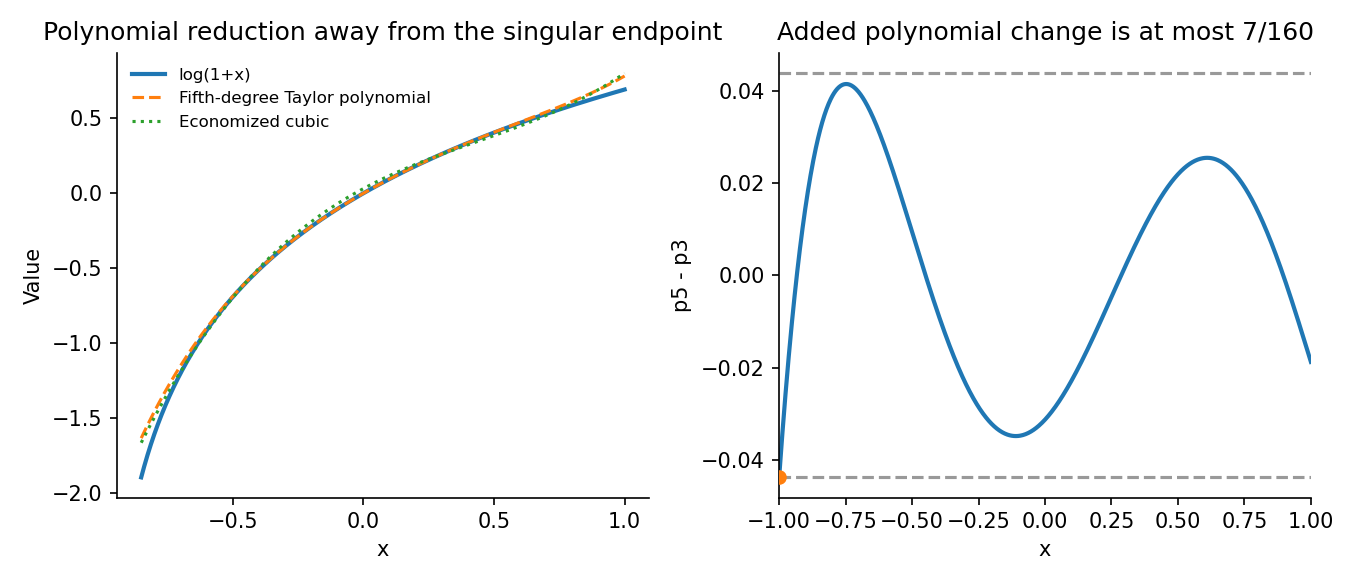
Expand the fifth-degree Taylor polynomial in Chebyshev polynomials, using the identities for powers obtained from part (a):Delete the last two Chebyshev terms and convert back to powers. The economized cubic isSince ,Equality holds at , where both deleted terms have negative sign. Thus the economization changes the polynomial by at most , exactly in supremum norm on .
For the target itself, wherever . The logarithm is singular at , so its total uniform error on all of is infinite; the finite estimate concerns the additional polynomial change, or the increase on any smaller interval where the original error is bounded.

Articles by others on the same topic
There are currently no matching articles.