For a real-valued linear error functional annihilating , the Peano kernel iswhere is the argument on which the functional acts. Under the standard boundedness and extension hypotheses, the Peano kernel theorem statesFor example, a bounded functional on continuous functions, represented by a finite signed measure and extended to the truncated powers, has this representation. Quadrature error functionals have precisely this structure.
The source's bare linearity assumption on is not by itself a complete theorem hypothesis. Truncated powers need not belong to that domain, and interchange of the functional with an integral needs justification. For instance annihilates but would require a Dirac point mass rather than an ordinary integrable kernel. The statement above supplies the usual functional class needed for the requested theorem and applies directly to part (c).
If has one sign, the weighted mean-value theorem applied to the continuous derivative givesfor some . One may prove this by bounding the weighted integral between the minimum and maximum derivative values times the total weight, then using the intermediate value theorem. If the total weight is zero, the fixed-sign kernel is zero almost everywhere and the conclusion is immediate.
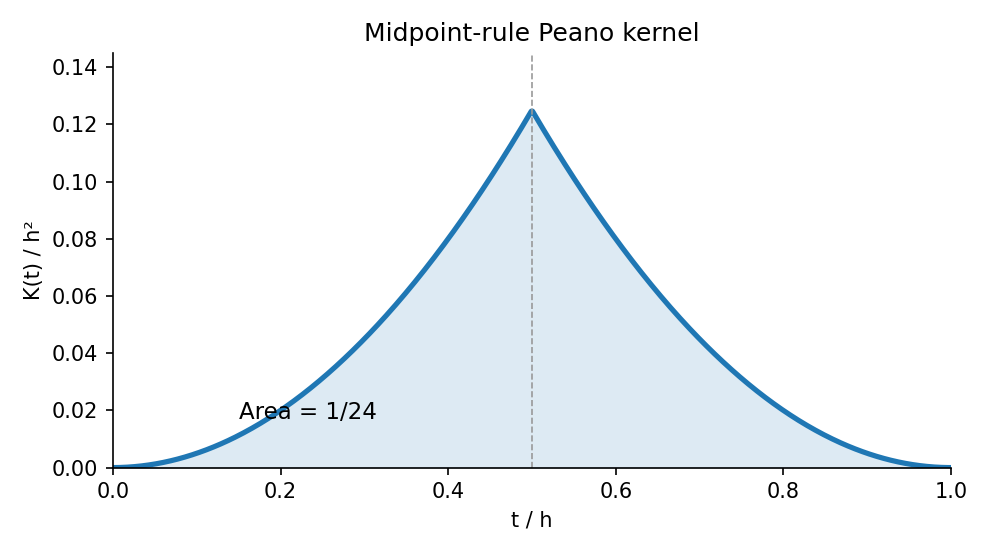
The midpoint error annihilates affine functions, so here . Apply the functional to :ThusIt is nonnegative, and symmetry gives . ThereforeFor a quadratic with constant nonzero second derivative equality holds, so this midpoint quadrature rule error constant is sharp.

Articles by others on the same topic
There are currently no matching articles.