Let be the enclosed mass. For spherical symmetry, hydrostatic equilibrium and mass conservation giveThe isothermal equation of state therefore impliesMultiply by , differentiate and eliminate :or equivalently . This is the density equation for an isothermal sphere. Here has units and equals the squared isothermal sound speed.
A regular isothermal sphere does not reach zero density at a finite radius. The finite body discussed later must therefore be truncated by a nonzero external pressure, as in a pressure-confined isothermal sphere. A finite vacuum boundary would not be compatible with this equation of state.
Set and . Then and the equation from part (a) becomesWith , the coefficients cancel, giving the isothermal Lane-Emden equationThe regular central boundary conditions areThe first makes the central mass density equal to . The second follows from smooth spherical symmetry and the vanishing central gravitational acceleration; a preferred radial slope at the origin would be singular. Substitution of a regular power series giveswhich supplies nonsingular starting data for numerical integration. The central conditions select the regular solution, not the singular isothermal sphere.
The particle count is the enclosed mass divided by the particle mass :Integrating the isothermal Lane-Emden equation giveswhere regularity makes the lower endpoint vanish. ThusThe prefactor is a mass divided by a mass, and the remaining factor is dimensionless. In particular, at fixed the dependence on central mass density is , with . Both changes must be retained when comparing equilibria at fixed .
Along a family of equilibria at fixed temperature, and the dimensionless function are fixed. The boundary mass density changes through both and the boundary coordinate :From part (c), , where is constant at fixed temperature and . Set its logarithmic variation to zero:The isothermal Lane-Emden equation gives , so the fixed- relation isSubstitute back into the boundary-density variation:For a nontrivial variation at a finite positive radius, its vanishing gives the fixed-mass turning point of an isothermal sphere:This derivative follows a fixed-mass sequence of equilibria; it is not merely the spatial derivative of density inside one sphere. The corresponding radial variation isAt small , : the boundary density increases while the radius decreases along increasing , giving the stated negative of the stable branch. The first density turning point marks its first loss of radial stability; it need not be confused with a turning point of radius itself.
Using the supplied first critical value , the critical radius of a pressure-confined isothermal sphere isNo radius in metres can be specified without and a central mass density. Here is the isothermal sound speed, consistent with the fixed-temperature variations in part (d). At a given central mass density, equilibria truncated at lie on the first stable branch, while increasing the dimensionless outer radius beyond this first threshold gives an unstable configuration. Numerical integration gives , consistent with the paper's rounded .
For a transparent comparison with the given Jeans length, set the uniform comparison density and use the same speed of sound. ThenBoth scales express the competition between pressure support and self-gravity, with characteristic length . Their numerical closeness under this density choice does not mean that the models impose the same threshold: is a boundary radius, whereas is the wavelength of a perturbation. Comparing with would instead give a factor about . Using the sphere's mean or boundary density instead of its central density changes the coefficient again, so the reference density must always be stated.
The pressure-confined isothermal sphere gives an actual finite, centrally concentrated hydrostatic equilibrium and an explicit confining pressure, making its radial stability threshold more self-consistent for a roughly spherical isothermal cloud. The uniform Jeans instability model gives a simpler local criterion, includes perturbations at different wavelengths, and does not require constructing a spherical equilibrium. Its ideal uniform static infinite background requires the Jeans swindle or an explicitly specified treatment of background gravity. Neither model includes rotation, magnetic fields, turbulent support or a realistic temperature evolution, so neither is a universal collapse criterion.
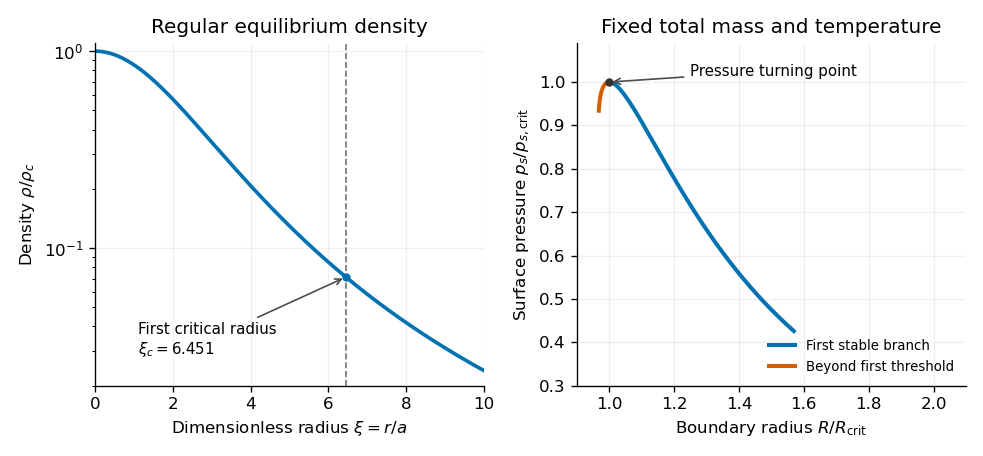
Numerically integrated isothermal-sphere density profile and the first pressure turning point along a fixed-mass sequence
. Details. 
Articles by others on the same topic
There are currently no matching articles.