Write for the retained fraction and for an opposite kick. With more than half the mass lost, . A same-direction kick cannot bind the pair, because . An opposite kick can reduce the relative speed enough to leave negative energy:Both endpoints are marginal zero-energy cases. Kicks somewhat larger than can still satisfy this interval, but then the direction of the relative orbital motion is reversed.
At , the two surviving stars have identical instantaneous velocities, so their relative velocity and orbital angular momentum vanish. Their energy is nevertheless negative,They fall radially toward each other from rest in their new centre-of-mass frame. In the point-mass idealization the collision orbit has semimajor axis and zero pericentre; real finite-size stars collide or interact before reaching zero separation. It is not a stable circular binary. Zero relative angular momentum, rather than the negative energy alone, determines this plunge outcome.
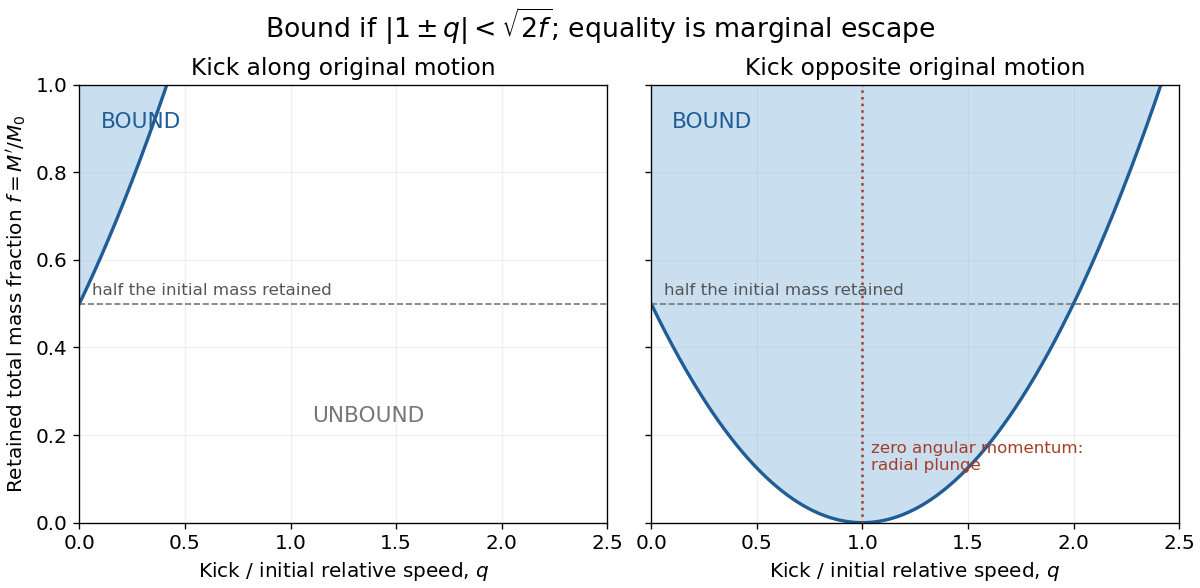
Binding after instantaneous mass loss for parallel and opposite natal kicks
. The retained mass fraction is and the kick magnitude is normalized to the original relative speed. Blue regions have negative orbital energy. The curves mark marginal escape. At an opposite normalized kick of one, the relative angular momentum vanishes and the survivors plunge together. Details.
Articles by others on the same topic
There are currently no matching articles.