Source paper: Oxford public bundle, pages 22–28. The bundle filename says 2017, but the held C1 cover is dated 11 June 2018. All six options are solved. The numerical request in c retains a source-data TODO because the stellar radius and mean particle mass are not specified.
A shock wave is a thin, irreversible compression layer across which fluid density, pressure, temperature and velocity change rapidly, while conserved fluxes satisfy the Rankine-Hugoniot conditions. In the shock frame, a compressive hydrodynamic shock converts ordered upstream kinetic energy into downstream thermal energy and increases entropy. The upstream normal flow is supersonic; the downstream normal flow is subsonic for an ordinary gas-dynamic compression shock.
In an accreting binary star, a supersonic stellar wind can be captured by a compact companion and shocked. An accretion stream striking an accretion disk, an accretion-disk boundary layer, and a magnetically guided accretion column provide other sites where infall energy is dissipated and high-energy radiation is generated. Shocks heat and decelerate material; a disk also needs transport of angular momentum before its material can reach the compact star.
In diffusive shock acceleration, charged particles scatter from magnetic irregularities on both sides of a shock and repeatedly cross the converging flows. The average energy gain is first order in the velocity jump divided by the particle speed. Escape competes with acceleration, producing a nonthermal distribution rather than a single downstream temperature. Supernova remnants are important candidate sources of Galactic cosmic rays; shocks associated with active galactic nuclei, their jets and lobes, and gamma-ray bursts are candidate extragalactic accelerators. Ultrarelativistic energies require sufficient size, magnetic field and lifetime, and losses must not outpace acceleration. In particular a relativistic particle's Larmor radius must fit within the accelerator; the existence of a strong shock alone does not guarantee unlimited particle energy.
Use a steady, plane, nonradiative normal shock wave in a perfect gas, and measure the normal speeds in the shock frame. The labels denote upstream and downstream. Conservation of mass, normal momentum and total energy givesandThe enthalpy term includes the pressure work. For very large upstream Mach number, neglect compared with . If is the shock compression ratio, the first two equations implySubstitution into the energy equation givesDiscard the no-shock solution . For a nonrelativistic monatomic gas, , so the Strong-shock Rankine-Hugoniot conditions becomeThe factor four requires this adiabatic index and negligible radiative, magnetic and escaping-particle contributions to the flux budget. For example, the same strong, nonradiative calculation with gives compression seven, not four.
A massive main-sequence donor loses material in a stellar wind. Gravitational capture by the neutron star can produce a nearly radial, supersonic infall when the captured material has little specific angular momentum. A magnetic field may channel the final infall toward polar accretion columns, where a standing shock decelerates the flow. Large angular momentum instead favours an accretion disk; strictly radial accretion is an idealization.
For mean particle mass , the ideal gas law is . Combining it with b givesFor Newtonian free fall from a distance large compared with the stellar radius , . ThereforeTODO: a unique numerical temperature and characteristic photon band require source data not supplied here. The held question gives but gives neither nor a composition fixing . The mass alone does not fix the free-fall speed or the temperature. For example, doubling at the same mass and composition halves both quantities in the last box.
A normalization, rather than an additional claimed datum, makes the scale explicit:Here is the characteristic particle energy; the mean translational energy of a nonrelativistic thermal particle is . If one additionally chose and , this ideal one-temperature estimate would correspond to gamma-ray-scale thermal photon energies. Those are conditional choices, not information recovered from the source. Real accreting neutron stars commonly emit X-rays: electron-ion disequilibrium, radiative cooling, radiation pressure, reprocessing and relativistic infall invalidate a direct identification of this ideal ion-heating estimate with the escaping photon spectrum.
Expand the density contrast in spatial Fourier modes using fixed comoving coordinates:The spatial Laplacian multiplies a mode by , while its comoving wavenumber is time-independent. Writing , the linear cosmological density perturbation equation becomesThe proper wavenumber is , since the proper wavelength is . The proper Jeans wavenumber balances the pressure and gravity terms:
For , neglect pressure support. The growing and decaying Jeans instability modes obeyIn an Einstein-de Sitter universe, gives , and the matter-density relation gives . ThusTry a power law . Its characteristic equation isTherefore the Einstein-de Sitter density-growth modes areThis is a linear result while ; a growing mode eventually leaves that regime.
In the formal static-background limit, and is constant. The gravity-dominated linear cosmological density perturbation equation reduces toThe Static-universe Jeans modes areThe unstable perturbation grows exponentially rather than as . In the expanding case, the term resists peculiar motion and the falling background density also lengthens the gravitational growth timescale. A globally homogeneous static self-gravitating fluid is not obtained merely by turning off expansion; this calculation is the conventional local Jeans-background idealization, with the uniform background force removed or otherwise supported.
When , omit the gravitational term and define . ThenThis is an acoustic damped harmonic oscillator with time-dependent coefficients. Freezing the background locally at , its amplitude damping rate is , soThe oscillation-averaged quadratic oscillator energy decays twice as fast in this frozen-frequency model, with time . Stating which quantity is damped avoids a factor-of-two convention error. Locally the solution isFor evolution over many expansion times, retain the varying frequency. Put . Direct substitution givesWhen and , the WKB approximation yieldsThese are rapidly oscillating sound waves in comoving density, diluted by the expanding background. For constant their envelope scales as , not universally as , because . In the Einstein-de Sitter universe, introducing conformal time gives the exact constant- pressure-only solution , consistent with . For that background the frozen-coefficient damping time is , while the slowly varying envelope has instantaneous decay time .
GW170817 supplied the first direct gravitational wave observation of a binary neutron star inspiral. The chirping waveform tests compact-binary general relativity, constrains masses and tidal effects, and links a class of known compact binaries to observable sources of gravitational waves. The electromagnetic counterpart identifies the host and distance, enabling complementary source and cosmological inference. This is distinct from the earlier binary-black-hole detections; it established a system involving matter that could also be observed electromagnetically.[ref]
GW170817: Observation of Gravitational Waves from a Binary Neutron Star Inspiral by LIGO Scientific Collaboration and Virgo Collaboration. Abstract and source-inference discussion: first binary-neutron-star inspiral, mass range and electromagnetic association
The short gamma-ray burst GRB 170817A followed the merger signal by about , providing direct evidence that at least some short gamma-ray bursts arise from neutron star mergers. The association connects their high-energy emission and relativistic outflows to compact-binary coalescence. It does not establish that every short burst has this progenitor, nor that the observed gamma-ray luminosity is independent of viewing angle.[ref]
Multi-messenger Observations of a Binary Neutron Star Merger by LIGO Scientific Collaboration and others. Abstract and multiwavelength counterpart discussion: GRB 170817A delay and association
The evolving optical and infrared kilonova was consistent with radioactive heating of neutron-rich merger ejecta. Rapid neutron capture, the r-process, can synthesize nuclei heavier than iron; decay of the newly formed unstable nuclei powers the transient. Its redward evolution and large inferred opacity supported production of heavy-element-rich ejecta. Thus mergers are a demonstrated important site for heavy-element production, while the fractions of individual elements and their total cosmic contribution remain model-dependent. The transient was not a direct identification of every very heavy element.[ref]
Multi-messenger Observations of a Binary Neutron Star Merger by LIGO Scientific Collaboration and others. Kilonova interpretation and conclusions: optical/infrared evolution and radioactive r-process heating
Treat the stated as the radius of a complete, volume-limited search, with uniform galaxy density . Its surveyed volume and number of galaxies areThe observing time is . One detection estimatesor one merger per approximately years per Milky-Way-type galaxy. The equivalent volume rate is about . The event's actual distance is not the survey radius and must not replace in the exposure.
A representative Galactic core-collapse supernova rate is about two per century, roughly times larger than this merger-rate estimate. The historical estimate was per century.[ref]
Radioactive 26Al and massive stars in the Galaxy by Roland Diehl and others. Abstract: Galactic core-collapse rate inferred from radioactive aluminium
The one-event Poisson uncertainty is large. Detector orientation, duty cycle, completeness and whether the quoted radius is an optimal horizon or an effective range also change the exposure; the boxed value is the specified simple-volume estimate.Keep both component masses constant during a circular, gravitational-radiation-driven inspiral. Since , differentiation gives . Combining this with the supplied angular-momentum loss yieldsThe expression printed in the source is negative during inspiral. A positive characteristic shrinking timescale isThe actual remaining coalescence time follows by integrating :This constant factor does not change the requested separation scaling.
For an old, approximately coeval population, let over the relevant separation interval, and write the positive delay as . Conservation of event counts under this change of variable givesThereforeThe scaling applies between the minimum and maximum delays of the assumed separation distribution. It is a rate per delay interval, not the number per logarithmic delay interval.
For the Double-degenerate Type Ia supernova scenario, measure the Type Ia supernova rate per formed stellar mass in old galaxies, grouped by the time since their main star-formation episode. Correct the event counts for observing time and detection efficiency. In an ideal burst population, the normalized rate measures the delay-time distribution directly. If gravitational waves inspiral dominates the delay and the initial white-dwarf separations are uniformly distributed in separation, c predicts a slope .
More generally, if and , the predicted rate scales as . A distribution uniform in has and gives . Thus a slope differing from does not alone rule out mergers: the separation distribution must also be tested.
An extended star formation history gives a convolution, , rather than the single-burst expression. The time since star formation stopped need not equal each progenitor's age. Stellar lifetimes before formation of the second white dwarf, common-envelope evolution, masses and mass ratios, metallicity, delay-dependent explosion efficiencies, galaxy-age estimates and survey selection all affect the comparison. Some CO-white-dwarf mergers need not make Type Ia supernovae, and other channels can contribute to the observed rate. Agreement in slope and normalization therefore supports the hypothesis under stated assumptions but is not a unique identification of the channel.
A spontaneous emission transition has probability per unit time and emits a photon of energy . For an optically thin gas, its angle-integrated emissivity is . Electron collisions populate excited levels at rates ; they also remove excitation collisionally at rates , returning the energy to the gas rather than producing the line photon. A collisionally excited line is usually emitted by a subsequent spontaneous radiative decay; collisional de-excitation instead quenches it.
The critical density of an atomic transition compares radiative loss from an upper level with its collisional loss. For a two-level model, ; for several lower or connected levels use the relevant sums. Below this density, excitation is commonly followed by a photon and the line cools the gas. Above it, collisions increasingly suppress radiative emission per excitation and drive the level populations toward Boltzmann ratios.
Optical forbidden emission lines have small because an electric-dipole transition is forbidden by a selection rule. Metastable levels survive long enough to radiate in dilute ionized nebulae, although collisions quench them in dense gas. Ratios from closely spaced levels with different critical densities are electron-density diagnostics; ratios involving different excitation energies probe the electron temperature through Boltzmann factors. Combining line emissivities with electron density, temperature and an ionization model estimates ionic abundances.
Infrared fine-structure emission lines connect closely spaced sublevels. Their small excitation energies make them useful over temperature ranges where optical excitation is exponentially suppressed, and dust extinction is usually weaker in the far infrared. They are important coolants and density diagnostics in ionized gas, with the choice of ion specifying the ionization zone. Neither an optical nor an infrared ionic abundance automatically equals the total elemental abundance; unobserved ionization stages require an ionization correction.
Use the complete supplied three-level model, including collisions between levels 2 and 3. Put , , , and denote a collisional rate coefficient by . Detailed balance givesAt , the supplied collision strengths give, in ,The rounded optical wavelengths set the excitation energies; treating the fine splitting as very small compared with changes none of the main conclusions.
Let , , and . Statistical equilibrium for the upper levels isEliminating yields the line-ratio formulaThe same ratio holds for integrated intensities when the two lines sample the same optically thin volume and differential extinction is negligible. Inserting the data gives the particularly simple numerical formThe low- and high-density limits are approximately and . The collisional loss channels giveThus the useful density range is around –. Maximizing for the rational expression gives its strongest fractional sensitivity at . Omitting the supplied 3–2 collisions would change the critical densities and inferred density appreciably.
For the observed ratio , inversion gives . This is on the high-density side of the transition, but is not the infinite-density limit. Solving the statistical-equilibrium equations and imposing gives the level fractionsA rough high-density estimate would instead use ; it is useful as a limiting check, not an exact solution for .
For the separate abundance calculation, use the expressly prescribed . The same model now gives , nearly the collisional Boltzmann limit. The measured angle-integrated volume emissivity givesThereforeThis is an abundance per free electron; it is approximately for predominantly ionized hydrogen with . No factor is inserted because the supplied emissivity is power per volume, not power per volume per steradian. The imposed predicts a ratio about , rather than exactly ; the two numerical instructions cannot both describe one uniform zone exactly within this model.
The source's configuration label is a typographical error for the sulfur valence configuration . This does not alter the stated values or the calculation above.[ref]
Energy Levels of Singly Ionized Sulfur by National Institute of Standards and Technology. Ground 4S and low 2D levels: 3s2 3p3 configuration, J values and energy ordering
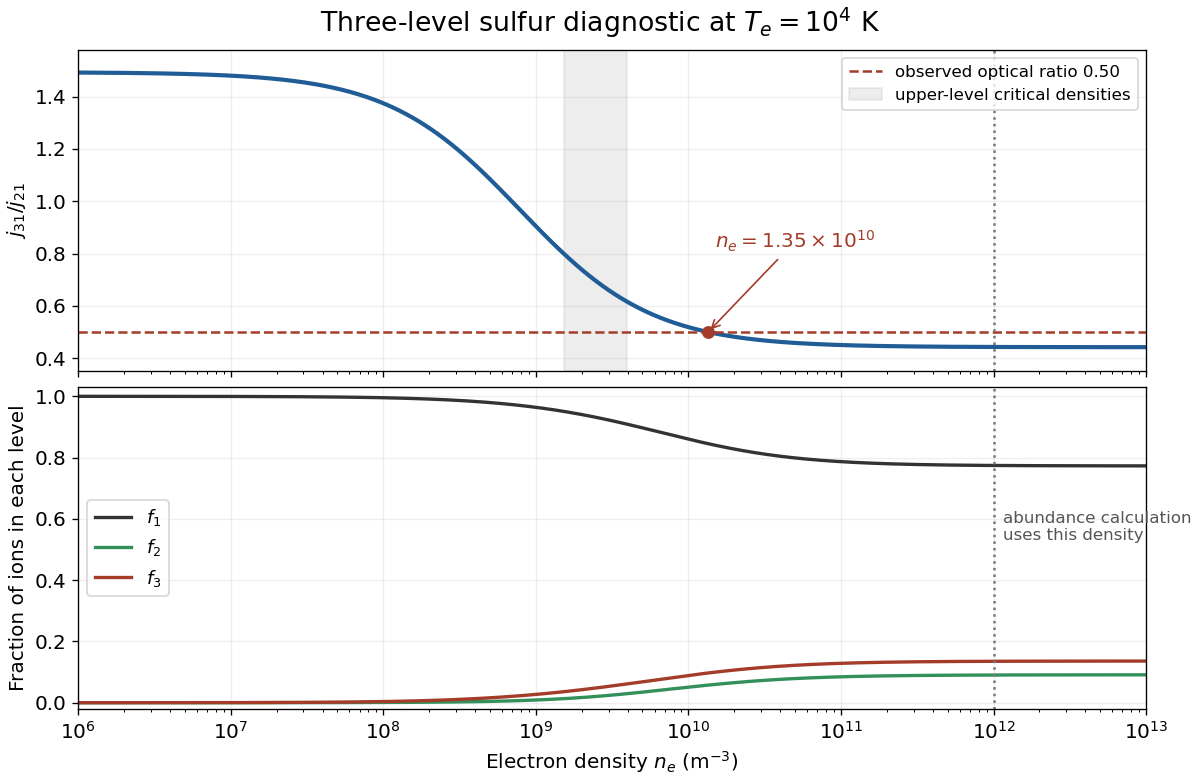

The infrared and optical transitions share the same upper level 3. Using the supplied infrared photon energy givesWith the same and three-level fraction used in the abundance calculation of b,This exceeds the optical abundance by a factor . Because the upper level is common, its population cancels in the intrinsic emissivity ratio:The observed ratio is . Thus changing only the electron temperature or a common level-population correction cannot reconcile these two lines from the same gas. Dust extinction suppressing the optical line is a natural explanation. If the far-infrared attenuation is negligible, the required optical attenuation isDifferent apertures, filling factors, optical-depth assumptions or emissivity calibrations could also cause a discrepancy. A total sulfur abundance would still need an ionization correction beyond this ionic comparison.
Interpret as a constant one-dimensional, isotropic velocity dispersion. The effective pressure is , corresponding to the stated gas-temperature analogy. For , the spherical enclosed mass isThe two sides of the hydrostatic equilibrium equation are thenEquating them fixes the singular isothermal sphere:For collisionless dark matter this is an isotropic Jeans-equation construction, not a claim that the particles thermalize by gas collisions. The central singularity and infinite total mass show that the untruncated profile is an idealization.
Use for the physical projected radius, or impact parameter, in the lens plane. Although the source calls it angular, a physical length is required in the mass and deflection equations; its relation to an angle is . Integrate along physical line-of-sight coordinate :Consequently the projected cylindrical mass inside the image radius isSubstituting a givesIf an angular radius is used instead, write and . The projected mass differs from the spherical mass ; material at three-dimensional radii larger than still projects into the cylinder.
In the weak-field thin-lens limit, circular symmetry makes the physical deflection depend on the projected enclosed mass. With the mass calculated in b,For , this is , orIt is independent of impact radius in this ideal profile.
Enclosed-mass qualification. The source's appeal to Birkhoff's theorem must not be read as permission to use the mass of a three-dimensional sphere of radius here. Deflection accumulates along the light path. A concrete counterexample is a thin spherical shell of radius : its spherical enclosed mass at is zero, but its projected mass is , and it produces a nonzero deflection. The formula above is the axisymmetric projected-mass lens result; it is consistent with b and is not that incorrect spherical-mass interpretation.
Let be the reduced, observed angular displacement between source and image. In the small-angle lens geometry, the physical bending angle is weighted by the lens-to-source and observer-to-source angular diameter distances:In a Euclidean diagram this follows because the transverse displacement at the source plane is , whose observed angle is that displacement divided by . In cosmology the same thin-lens expression uses the corresponding angular diameter distances. For a signed one-dimensional coordinate, the direction is supplied by the image's side of the lens.
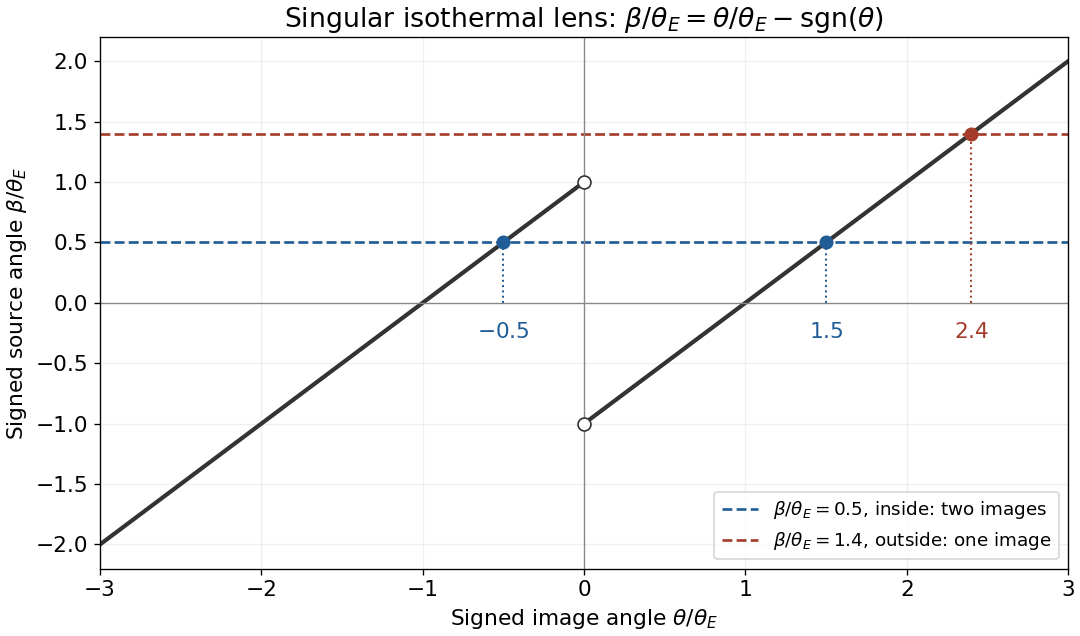
The general thin gravitational lens equation is a two-component angular relation,For a spherical lens, image, source and lens centre lie in one plane containing the line of sight. Choose its sky direction as a signed axis. Then can be signed scalars andThey are not fundamentally scalar quantities for a general lens; the reduction uses this symmetry and axis choice. An exactly aligned source requires the full ring geometry, not a unique preferred sky axis.
In general, . For example, in a spatially flat expanding cosmology, comoving radial distances giveThus differs from when the redshifts differ. Ordinary Euclidean addition applies only when the same static physical-distance convention is appropriate.
The Einstein angular radius is the image-ring radius of an exactly aligned source. For the singular isothermal sphere lens, set in ii:Choose without loss of generality. The positive branch always gives . A negative-side image would have ; this branch is admissible only when its result is negative. ThereforeAt , symmetry produces an Einstein ring of angular radius . At , the negative branch reaches the singular origin and is not an ordinary additional finite image; the one finite image is at . Reversing the source sign reverses the signed image coordinates, so the multiplicity criterion uses . These features rely on the singular isothermal profile; a smooth finite-density core changes the central-image behaviour.

In a massive star undergoing core-collapse supernova formation, an iron-rich core cannot gain further support from exothermic fusion. Electron captures and nuclear photodisintegration promote collapse. The inner core stiffens near nuclear density and bounces, launching a shock into the infalling outer core. Dissociation and neutrino losses drain its energy, so the prompt shock generally stalls while matter continues to accrete. Neutrino absorption behind the shock, aided by multidimensional flow, can revive it and eject the envelope; sufficiently rapid rotation and strong magnetic fields offer additional possibilities. The remnant may be a neutron star or black hole. Major uncertainties include progenitor structure, nuclear equation of state, neutrino transport and interactions, turbulent flow, rotation and magnetic fields.
The standing accretion shock instability is a nonradial instability of this stalled shock and accretion flow. Feedback between advected disturbances and acoustic response can amplify large-scale sloshing or spiral motions, producing an asymmetric shock even without an initially unstable convective gradient.[ref]
Stability of Standing Accretion Shocks, With an Eye Toward Core Collapse Supernovae by John M. Blondin and others. Abstract and nonradial simulations: growth of turbulence from a distorted standing shock
An asymmetric explosion can impart an opposite recoil to the remnant by momentum conservation. In neutrino-driven calculations, long-lasting gravitational attraction by asymmetric, slower inner ejecta can dominate the acceleration: the gravitational tug-boat mechanism. SASI and convection can seed the asymmetries, but the kick is not necessarily an instantaneous hydrodynamic push or uniquely attributable to SASI.[ref]
Neutron star kicks by the gravitational tug-boat mechanism in asymmetric supernova explosions by Hans-Thomas Janka. Abstract and mechanism discussion: anisotropic ejecta, gravitational acceleration and subdominant hydrodynamic forces
Let , , and let the initial circular separation be . The initial relative speed is , with . Instantaneous symmetric mass loss changes neither the separation nor either surviving star's velocity at that instant. In the new centre-of-mass frame, use the reduced mass ; the orbital energy isConsequentlyLess than half the total initial binary mass lost gives a bound orbit, not necessarily a circular one. Exactly half gives zero orbital energy and the marginal parabolic escape case. The threshold concerns the total mass of both stars, not just the exploding star. Using the old centre-of-mass kinetic energy without subtracting the new systemic motion would give the wrong binding criterion; the relative-velocity form performs that subtraction automatically.
For a kick parallel or antiparallel to star 1's original velocity, the immediate post-explosion relative speed is . ThusA positive-energy, hyperbolically escaping pair therefore satisfies preciselyThe absolute value is essential when a sufficiently large opposite kick reverses the relative tangential velocity.
Marginal case. Strictly speaking, a pair is gravitationally bound only for . If unbound includes marginal escape, replace the printed strict inequality by . For a concrete counterexample to an unrestricted “if and only if” with , take no kick and . Both sides equal one and the energy is zero: this is not a bound ellipse, although the printed strict inequality is false.
Write for the retained fraction and for an opposite kick. With more than half the mass lost, . A same-direction kick cannot bind the pair, because . An opposite kick can reduce the relative speed enough to leave negative energy:Both endpoints are marginal zero-energy cases. Kicks somewhat larger than can still satisfy this interval, but then the direction of the relative orbital motion is reversed.
At , the two surviving stars have identical instantaneous velocities, so their relative velocity and orbital angular momentum vanish. Their energy is nevertheless negative,They fall radially toward each other from rest in their new centre-of-mass frame. In the point-mass idealization the collision orbit has semimajor axis and zero pericentre; real finite-size stars collide or interact before reaching zero separation. It is not a stable circular binary. Zero relative angular momentum, rather than the negative energy alone, determines this plunge outcome.
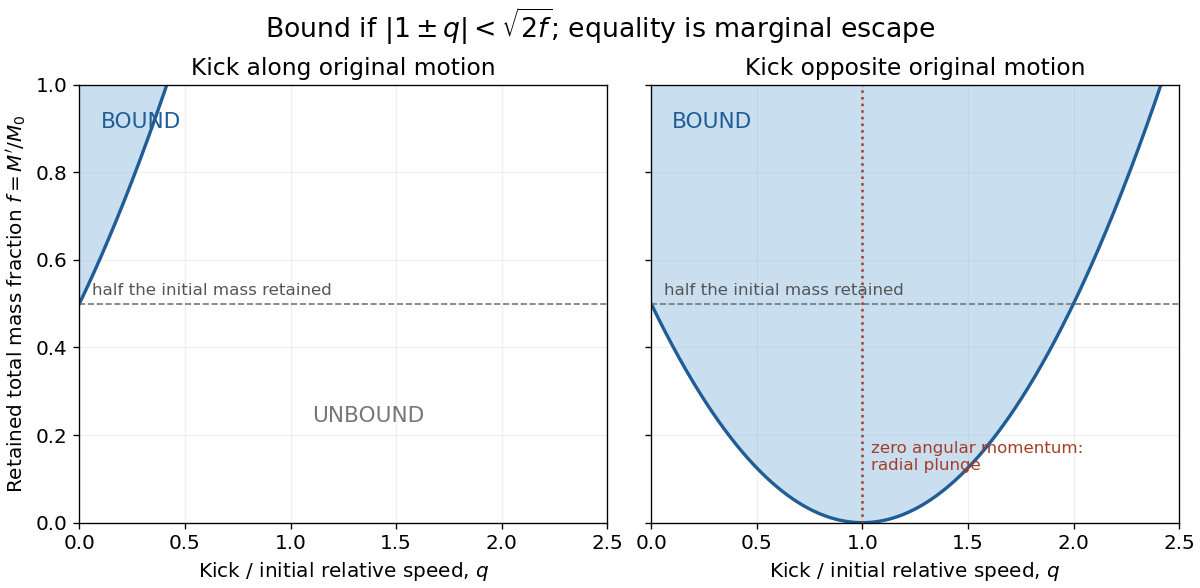
Binding after instantaneous mass loss for parallel and opposite natal kicks
. The retained mass fraction is and the kick magnitude is normalized to the original relative speed. Blue regions have negative orbital energy. The curves mark marginal escape. At an opposite normalized kick of one, the relative angular momentum vanishes and the survivors plunge together. Details.
Articles by others on the same topic
There are currently no matching articles.