In a massive star undergoing core-collapse supernova formation, an iron-rich core cannot gain further support from exothermic fusion. Electron captures and nuclear photodisintegration promote collapse. The inner core stiffens near nuclear density and bounces, launching a shock into the infalling outer core. Dissociation and neutrino losses drain its energy, so the prompt shock generally stalls while matter continues to accrete. Neutrino absorption behind the shock, aided by multidimensional flow, can revive it and eject the envelope; sufficiently rapid rotation and strong magnetic fields offer additional possibilities. The remnant may be a neutron star or black hole. Major uncertainties include progenitor structure, nuclear equation of state, neutrino transport and interactions, turbulent flow, rotation and magnetic fields.
The standing accretion shock instability is a nonradial instability of this stalled shock and accretion flow. Feedback between advected disturbances and acoustic response can amplify large-scale sloshing or spiral motions, producing an asymmetric shock even without an initially unstable convective gradient.[ref]
Stability of Standing Accretion Shocks, With an Eye Toward Core Collapse Supernovae by John M. Blondin and others. Abstract and nonradial simulations: growth of turbulence from a distorted standing shock
An asymmetric explosion can impart an opposite recoil to the remnant by momentum conservation. In neutrino-driven calculations, long-lasting gravitational attraction by asymmetric, slower inner ejecta can dominate the acceleration: the gravitational tug-boat mechanism. SASI and convection can seed the asymmetries, but the kick is not necessarily an instantaneous hydrodynamic push or uniquely attributable to SASI.[ref]
Neutron star kicks by the gravitational tug-boat mechanism in asymmetric supernova explosions by Hans-Thomas Janka. Abstract and mechanism discussion: anisotropic ejecta, gravitational acceleration and subdominant hydrodynamic forces
Let , , and let the initial circular separation be . The initial relative speed is , with . Instantaneous symmetric mass loss changes neither the separation nor either surviving star's velocity at that instant. In the new centre-of-mass frame, use the reduced mass ; the orbital energy isConsequentlyLess than half the total initial binary mass lost gives a bound orbit, not necessarily a circular one. Exactly half gives zero orbital energy and the marginal parabolic escape case. The threshold concerns the total mass of both stars, not just the exploding star. Using the old centre-of-mass kinetic energy without subtracting the new systemic motion would give the wrong binding criterion; the relative-velocity form performs that subtraction automatically.
For a kick parallel or antiparallel to star 1's original velocity, the immediate post-explosion relative speed is . ThusA positive-energy, hyperbolically escaping pair therefore satisfies preciselyThe absolute value is essential when a sufficiently large opposite kick reverses the relative tangential velocity.
Marginal case. Strictly speaking, a pair is gravitationally bound only for . If unbound includes marginal escape, replace the printed strict inequality by . For a concrete counterexample to an unrestricted “if and only if” with , take no kick and . Both sides equal one and the energy is zero: this is not a bound ellipse, although the printed strict inequality is false.
Write for the retained fraction and for an opposite kick. With more than half the mass lost, . A same-direction kick cannot bind the pair, because . An opposite kick can reduce the relative speed enough to leave negative energy:Both endpoints are marginal zero-energy cases. Kicks somewhat larger than can still satisfy this interval, but then the direction of the relative orbital motion is reversed.
At , the two surviving stars have identical instantaneous velocities, so their relative velocity and orbital angular momentum vanish. Their energy is nevertheless negative,They fall radially toward each other from rest in their new centre-of-mass frame. In the point-mass idealization the collision orbit has semimajor axis and zero pericentre; real finite-size stars collide or interact before reaching zero separation. It is not a stable circular binary. Zero relative angular momentum, rather than the negative energy alone, determines this plunge outcome.
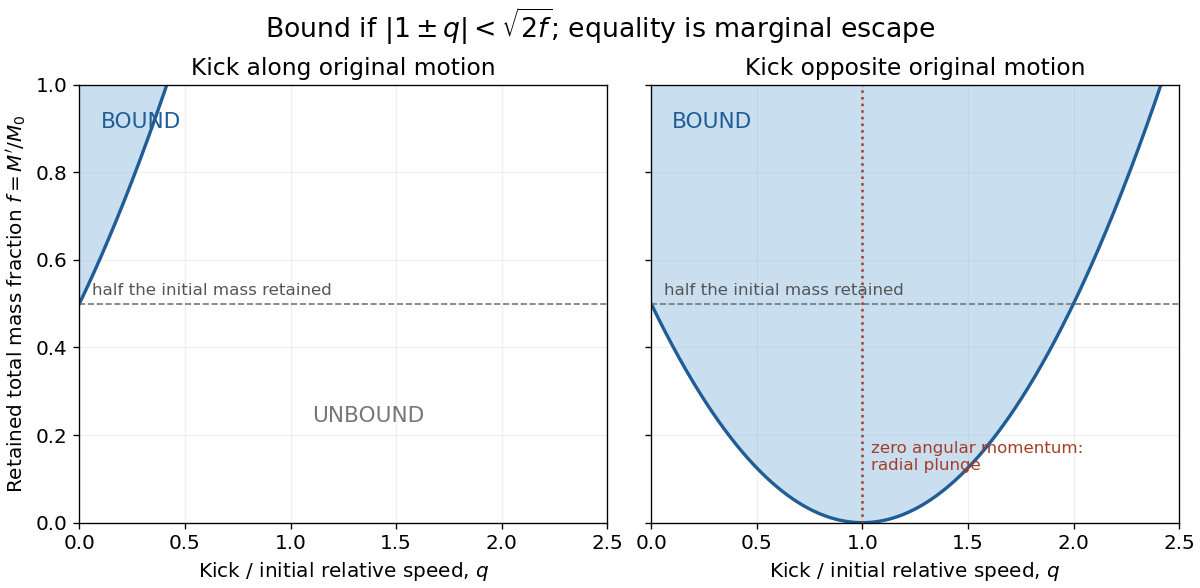
Binding after instantaneous mass loss for parallel and opposite natal kicks
. The retained mass fraction is and the kick magnitude is normalized to the original relative speed. Blue regions have negative orbital energy. The curves mark marginal escape. At an opposite normalized kick of one, the relative angular momentum vanishes and the survivors plunge together. Details.
Articles by others on the same topic
There are currently no matching articles.