Valuing health does not entail interpreting every sensation as evidence of grave disease. Intense health anxiety depends on how probability, consequences, coping and uncertainty are appraised, and on whether attention and safety behavior create a self-confirming cycle. Understanding ordinary calibration suggests treatment targets that preserve sensible health care while reducing disabling certainty seeking. The contrast is between ways of responding to uncertainty, not between caring about health and being indifferent to it.
Bodily signals are ambiguous. A change may have several explanations, and a very serious possible outcome can still be unlikely given a particular cue. The severity of a consequence and the conditional probability of its occurrence are distinct quantities. In a simple Bayesian illustration, let be an imaginary illness and an ambiguous signal. ThenIf, purely for illustration, , and , the posterior probability is about . These invented values are not estimates for any actual symptom or illness. They show why knowing that a disease can produce a signal does not establish that the signal probably means that disease.
Ordinary calibration also involves alternatives, changing information and coping. People can judge a symptom worth evaluating without assuming that only a guarantee of safety would permit normal activity. They may interpret a sensation in the context of recent activity, retain a distinction between possibility and probability, and revise their belief when appropriate evidence arrives. These are functional contrasts, not an assertion that everyone without severe health anxiety performs explicit Bayesian calculations or is always accurate. Neither realistic risk nor a prior medical experience automatically produces disabling anxiety.
The cognitive model of health anxiety identifies a different pattern: an illness interpretation increases anxiety and somatic hypervigilance; those responses increase the salience of sensations; further sensations are treated as corroboration. Reassurance seeking, repeated checking or avoidance can provide immediate relief while leaving the underlying interpretation untested. Hilary Warwick and colleagues proposed this maintenance account as an alternative to conceptualizing the difficulty merely as insufficient medical information. It explains why adding another statement of reassurance may not have the same effect as changing how evidence is interpreted.[ref]
Hypochondriasis by Hilary Warwick and others. 1990; proposed attentional, interpretive and behavioral maintenance processes
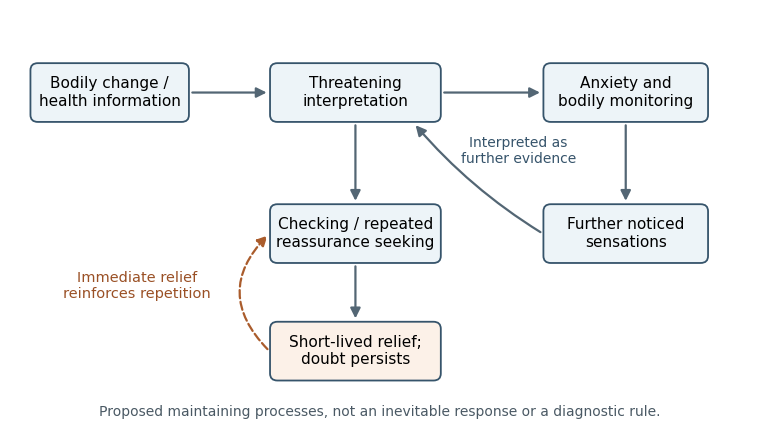
A proposed maintenance cycle for health anxiety; arrows represent testable processes, not inevitable responses to bodily changes
. Details. 
Intolerance of uncertainty can raise the required standard of evidence beyond what medical investigation can supply. If every residual possibility demands another check, a negative result can be reinterpreted as the wrong test, the wrong time or a missed condition. This account predicts repeated doubt despite short-term relief, rather than the absence of genuine concern or comprehension. It also explains a possible paradox: a response chosen to reduce anxiety can maintain the demand for certainty. The person's reason for the behavior must be established; the same observable action could be proportionate care in another context.
An appropriate formulation therefore distinguishes the presence of physical illness, the degree of concern and the pattern of maintaining responses. These are not mutually exclusive categories. Paul Salkovskis and colleagues developed the Health Anxiety Inventory to measure health anxiety across relevant clinical and medical samples rather than simply counting bodily symptoms. The validation studies compared several anxiety presentations, examined sensitivity to change and included people seeking help for physical illness. This supports measuring the psychological response separately from a conclusion about whether a disease exists. A questionnaire still does not replace clinical assessment.[ref]
The Health Anxiety Inventory: development and validation of scales for the measurement of health anxiety and hypochondriasis by Paul Salkovskis and others. 2002; clinical comparisons, treatment sensitivity and physical-illness samples
Treatment implications follow as hypotheses about learning. Collaborative cognitive behavioral therapy can identify the feared interpretation, the alternative account and what would distinguish them. A behavioral experiment should test a specified prediction about attention or a safety behavior, rather than require the person to prove that future illness is impossible. Attention can be examined as a process that changes experience, not as a declaration that every sensation is caused by attention. Likewise, reducing a repetitive reassurance cycle is different from withholding a needed explanation or discouraging appropriate medical evaluation.
The therapeutic stance is consequently important. Dismissing a symptom can reinforce the belief that the danger has not been understood. A shared formulation can instead acknowledge the sensation, explain how anxiety may amplify it and leave room to revise the account. Appropriate information may be useful, but the aim is a more flexible standard for updating and coping. This also makes the account falsifiable: if the predicted relationship between a response and the difficulty is not observed, the formulation should be reconsidered rather than blaming the person for failing to improve.
Erik Hedman and colleagues randomized 81 people with severe health anxiety to therapist-guided internet cognitive behavioral therapy or an attention-control condition over 12 weeks. The treatment produced a substantially greater reduction in health anxiety on the study measures. This gives evidence beyond the intuitive plausibility of the model and suggests that extensive face-to-face contact is not necessary for every effective delivery format. The trial does not isolate every treatment component or show that internet delivery suits every patient, and a selected trial sample limits generalization.[ref]
Internet-based cognitive-behavioural therapy for severe health anxiety: randomised controlled trial by Erik Hedman and others. 2011; masked-assessment randomized comparison, attention control and Health Anxiety Inventory outcome
The CHAMP medical-outpatient trial provides a complementary setting in which physical illness was permitted. Its health anxiety benefit reinforces the distinction between addressing an anxious maintenance cycle and denying medical disease. However, symptom improvement, functioning, costs and quality of life are different outcomes and should not be collapsed into one claim of success. The model should also accommodate social circumstances and access to care: repeated concern in a setting where appropriate assessment is unavailable cannot simply be assumed to reflect an internal cognitive bias.[ref]
Cognitive-behaviour therapy for health anxiety in medical patients (CHAMP): a randomised controlled trial with outcomes to 5 years by Peter Tyrer and others. 2017; medical eligibility, symptom follow-up and distinct economic endpoints
The useful clue from ordinary responding is the ability to combine concern with proportionate interpretation, evidence updating and tolerable uncertainty. A mechanistic treatment account aims to restore those functions by testing interpretations and changing maintaining responses, with appropriate medical collaboration. It does not promise certainty, identify all bodily symptoms as benign, or treat anxiety as evidence that a person's health concern is invalid.
Articles by others on the same topic
There are currently no matching articles.