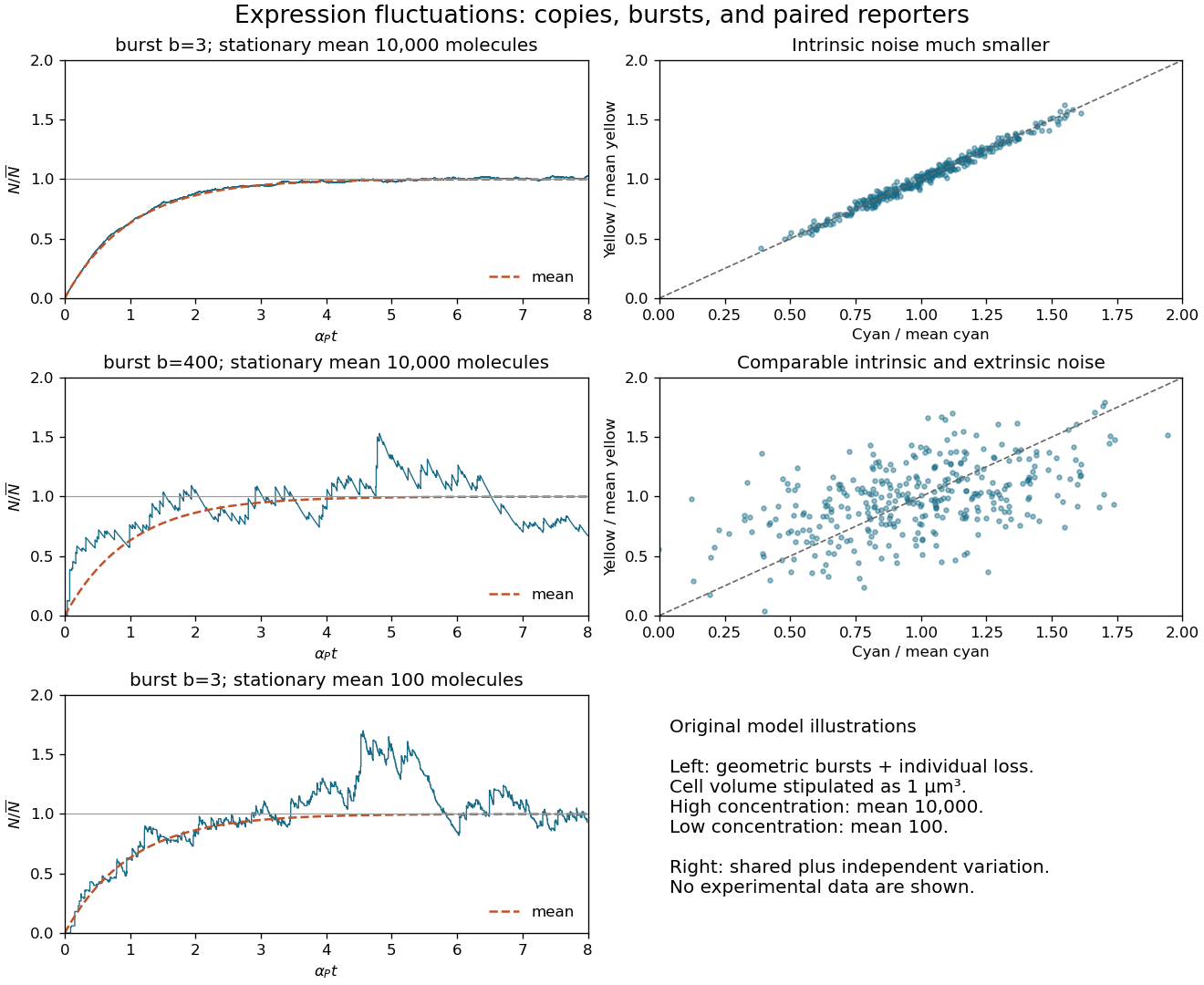
With zero initial messenger RNA and protein concentration, solving the two linear ordinary differential equations in sequence givesThe last expression applies after the short messenger RNA transient when . All three mean curves have this shape. At a fixed steady state, a larger translational burst size requires fewer transcription events: . Thus gives infrequent large upward jumps followed by protein degradation, whereas gives many smaller jumps and a smoother trace.
Noise depends on molecule counts. If the fixed cell volume is , write . In the instantaneous-burst limit, independent Poisson process arrivals of geometrically distributed bursts, with count arrival rate , and unit protein degradation giveIndeed, the moment equations are and . With zero initial counts the variance becomes . These equations explain both the approach to the steady state and the scatter about it.
For illustration only, gives at the higher concentration: the two values of the coefficient of variation are and . At the lower concentration, and gives . Decreasing the concentration by a factor of 100 therefore increases relative fluctuations tenfold, despite keeping small bursts. Absolute fluctuation sizes cannot be inferred without a cell volume. The original sketches below stipulate that volume; they are model realizations, not source data.[ref]
Transient protein-count variance in the instantaneous-burst model. Derivation of the transient and stationary variance
Translational burst size, relative expression fluctuations, and paired fluorescent reporters
. Details. 
Articles by others on the same topic
There are currently no matching articles.