At fixed voltage let and be opening and closing rates. The open probability obeysThis illustrates equal open probability with unequal ion-channel relaxation times: both channels have , but channel A has and channel B has . Starting closed, and . If channel number, unitary conductance and driving force agree, both have the same steady macroscopic current; B approaches it ten times faster.
An individual channel remains either open or closed. Its mean closed and open dwell times are and , respectively: both are in A and in B. Thus identical equilibrium open probability does not imply identical kinetics or noise correlation time. Ensemble probability relaxation depends on the sum of rates, while the mean dwell in a given state depends on its exit rate.
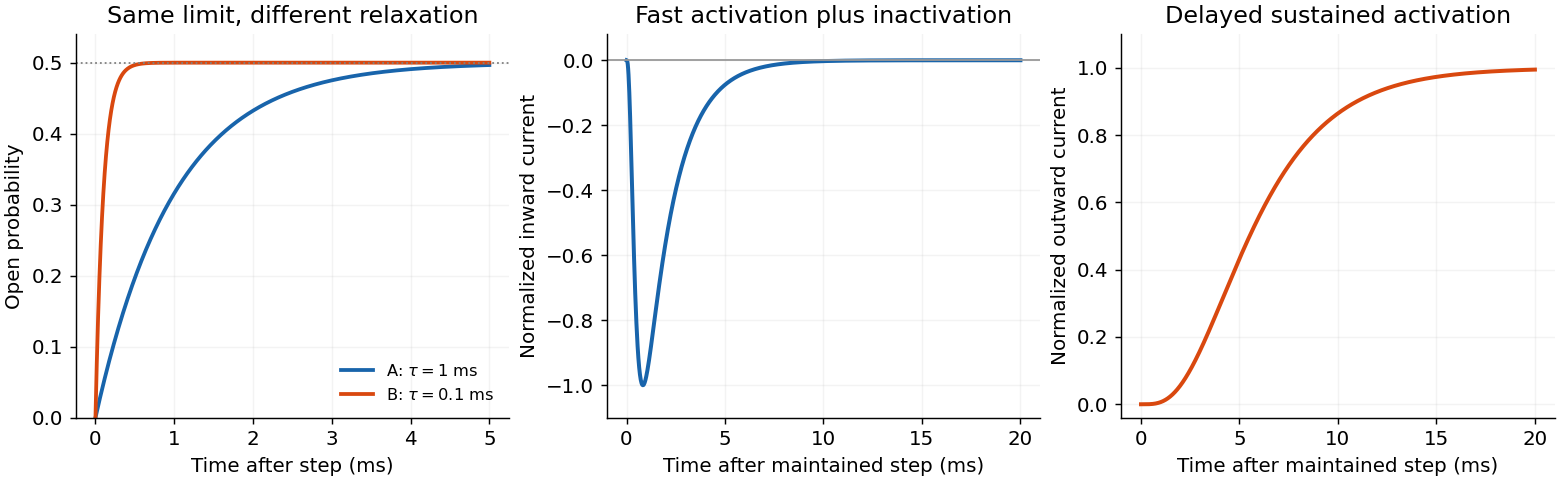
Equal equilibrium opening probabilities can conceal different channel kinetics
. Original calculations show the specified two-state rates giving relaxation times of one and one tenth of a millisecond. Separate illustrative activation-inactivation and delayed-activation curves explain transient inward sodium current and sustained outward potassium current; those illustrative curves are not fits to the source recordings. Details.
Articles by others on the same topic
There are currently no matching articles.