The sodium trace is a rapid inward current after depolarization, followed by loss of current even while voltage remains depolarized. A voltage-gated sodium channel therefore activates rapidly and then becomes unavailable through inactivation. Under ordinary cardiac ionic gradients, the test potential is below the sodium reversal potential, so opening carries inward positive charge. Rapid sodium entry supports the fast action-potential upstroke and propagation in working myocardium; inactivation and subsequent recovery contribute to refractoriness.
The potassium trace develops more slowly, is outward during the positive step, and remains approximately sustained until repolarization. It is consistent with a delayed outward potassium conductance: activation counteracts depolarization, and deactivation follows the return towards the holding voltage. Potassium currents contribute to repolarization and stable diastolic voltage. The trace does not identify a unique cardiac potassium-channel subtype, and not all potassium channels lack inactivation.
Together, fast inward activation initiates excitation and slower outward activation terminates it. Current direction is set by electrochemical driving force as well as gating: in an ohmic approximation. A voltage clamp fixes and reveals those currents; in a freely firing cell the currents instead jointly determine the voltage through the membrane-capacitance equation. Calcium current is also important for the cardiac plateau, so these two traces alone are not a complete ventricular action-potential model. The sodium-potassium pump maintains long-term gradients but is not the fast gating mechanism seen in these recordings.
Voltage gating and ion selectivity are different structural functions. A typical voltage-gated potassium channel has four pore-forming subunits; their voltage-sensing regions move charged residues in the membrane electric field and couple that motion to a pore gate. Carbonyl coordination in the selectivity filter compensates potassium dehydration in an ion-specific geometry. The smaller sodium ion is not automatically passed more readily: its hydration and coordination energetics differ. Structural work on a mammalian Kv channel resolves the sensor/pore architecture and an open activation gate.[ref]
Crystal structure of a mammalian voltage-dependent Shaker family K+ channel by Stephen B. Long and others. Kv1.2 structural study, abstract and open-pore/voltage-sensor architecture
A sodium-channel alpha subunit contains four homologous domains assembled into one pore, with separate voltage sensors. Rapid activation and fast inactivation are distinguishable conformational transitions; an intracellular inactivation apparatus stabilizes nonconducting states after activation. Repolarization favours recovery of availability. A channel can therefore be closed but activatable, or inactivated and temporarily unavailable, despite zero current in both cases.
Several types of evidence test these ideas. Ionic reversal potentials shift when ionic gradients are changed, establishing selectivity and driving force. Single-channel recordings show discrete conducting levels and stochastic dwell times; whole-cell current changes often reflect changed open probability rather than a continuously varying single-channel current. Small gating-charge transients can remain when ionic permeation is blocked, demonstrating sensor movement rather than ion flux. Conditioning and paired-pulse records separate activation, inactivation and recovery. Structural perturbations of voltage sensors and of inactivation machinery alter different kinetic properties, supporting their functional distinction.
These observations constrain models but do not make an individual macroscopic trace a unique structural reconstruction. Different distributions of closed and inactivated states can produce similar averages. In particular, the sustained potassium trace supports little inactivation on the displayed interval; it does not justify assigning every potassium channel a universal absence of an inactivation mechanism.
An increased late inward sodium current can delay repolarization if fast inactivation is incomplete or slowed, if channels reopen excessively, or if the voltage range of persistent/window current is enlarged. A larger brief peak current alone is not equivalent to a sustained depolarizing current. Conversely, reduced outward potassium current can prolong the action potential through fewer functional surface channels, reduced conductance, slower or less favourable activation, or altered deactivation/availability. Either change shifts the balance towards inward current during repolarization.
These are distinct biophysical routes to Long QT syndrome, not claims that every subtype has the same channel defect.[ref]
https://www.ncbi.nlm.nih.gov/books/NBK1129/. GeneReviews, Long QT Syndrome Overview, updated 2024: sodium gain-of-function and potassium loss-of-function mechanisms
The experimental association of sodium-channel abnormalities with inherited disease supports the inward-current mechanism.[ref]Cardiac sodium channel mutations in patients with long QT syndrome, an inherited cardiac arrhythmia by Qing Wang and others. 1995 human genetic study linking cardiac sodium-channel defects to inherited long-QT syndrome
At fixed voltage let and be opening and closing rates. The open probability obeysThis illustrates equal open probability with unequal ion-channel relaxation times: both channels have , but channel A has and channel B has . Starting closed, and . If channel number, unitary conductance and driving force agree, both have the same steady macroscopic current; B approaches it ten times faster.
An individual channel remains either open or closed. Its mean closed and open dwell times are and , respectively: both are in A and in B. Thus identical equilibrium open probability does not imply identical kinetics or noise correlation time. Ensemble probability relaxation depends on the sum of rates, while the mean dwell in a given state depends on its exit rate.
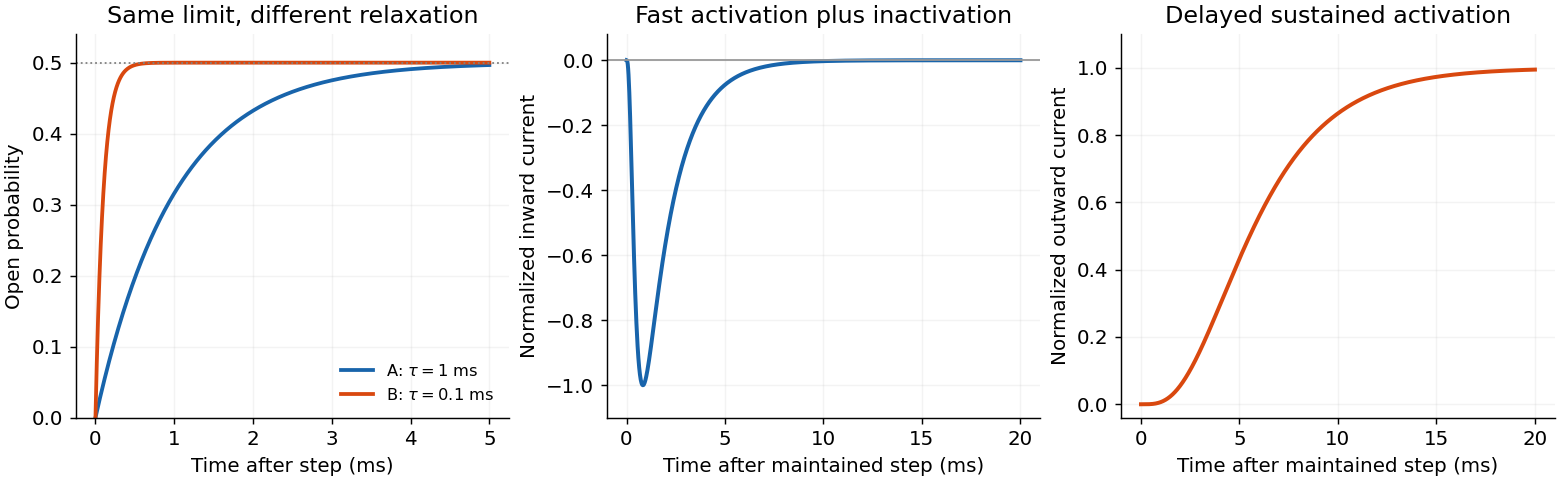
Equal equilibrium opening probabilities can conceal different channel kinetics
. Original calculations show the specified two-state rates giving relaxation times of one and one tenth of a millisecond. Separate illustrative activation-inactivation and delayed-activation curves explain transient inward sodium current and sustained outward potassium current; those illustrative curves are not fits to the source recordings. Details.
A two-state closed–open scheme at fixed voltage relaxes monotonically and cannot by itself produce a sodium-current transient during a maintained step with constant driving force. A minimal sodium scheme therefore includes an unavailable state: , with voltage-dependent activation, inactivation and recovery; closed-state recovery pathways may be added when needed. Opening is initially rapid, occupancy then accumulates in , and recovery on repolarization restores an activatable population.
For the illustrated potassium current, a closed–open model gives sustained opening, but several activation steps can account for its initial delay. A conventional illustrative coarse-grained description iswith each gate following . Fast activation, subsequent decrease of , and slower increase of produce the two qualitative records. The powers are phenomenological gate assumptions, not values uniquely inferred from these traces or an exact structural count for every cardiac channel.
A 1-Hz cardiac rhythm has about a second between successive activations, whereas a 100-Hz neuronal rhythm has only ; the available resting interval is shorter still after subtracting the action potential. Recovery or deactivation with a timescale comparable to that interval can then leave residual inactivation or potassium activation, giving use-dependent changes and refractoriness. Millisecond or faster relaxation usually completes much more readily during a long diastolic interval. The particular two-state A and B in d would both nearly equilibrate over a full at their stipulated constant rates; their values alone do not demonstrate high-frequency failure. Real comparison requires voltage-dependent recovery rates and the different cardiac and neuronal waveforms. A frozen-rate model cannot quantitatively predict either firing pattern from frequency alone.
Articles by others on the same topic
There are currently no matching articles.