Let the common production and removal constants be and , so an unrepressed protein approaches . A simple constructive motif isChoose thresholds , , and . The logic approximation for gene regulation gives , , , and . These unequal thresholds are permitted in this part; the production and degradation rates remain equal.
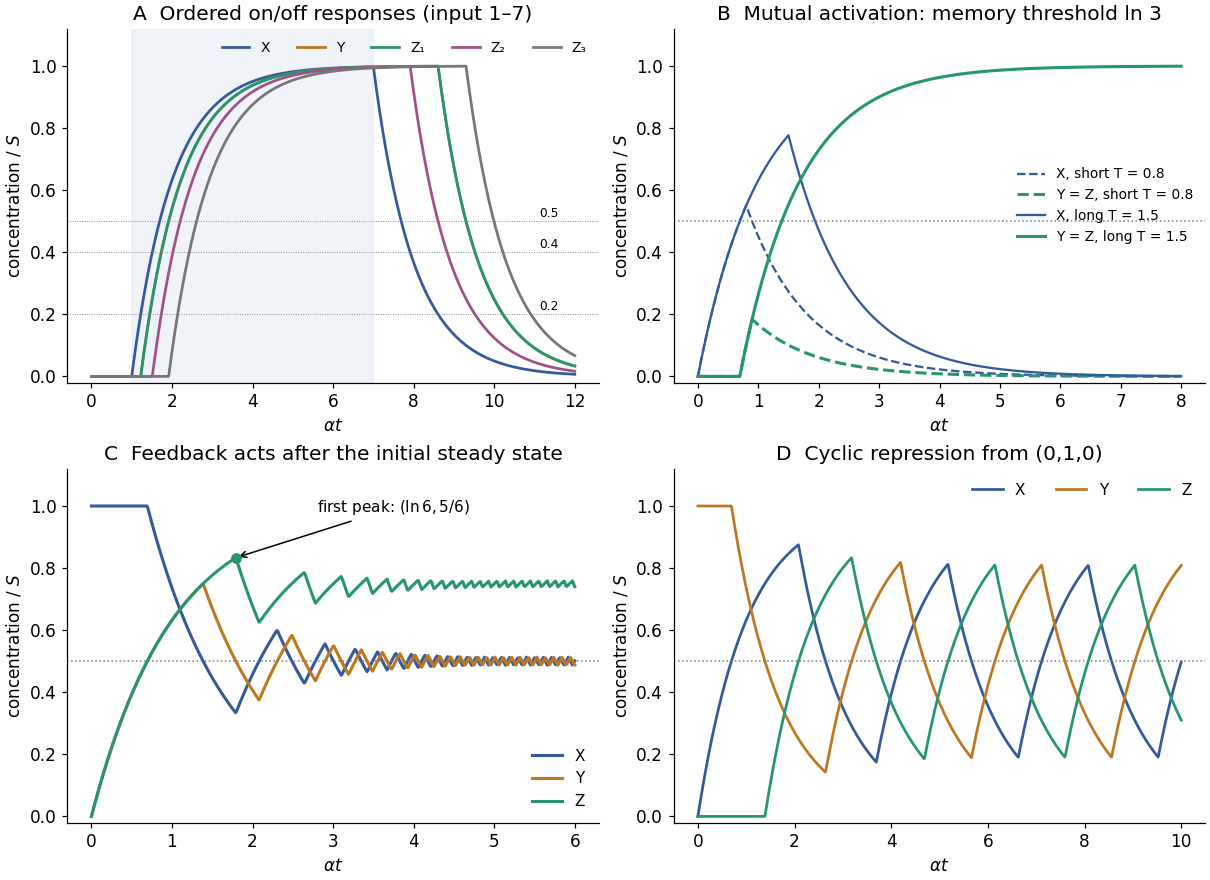
After input onset, . Production of and begins at , at , and at . Thus the required on-order is obtained. Take an input long enough that all these events occur, for example .
At input termination, , where . The higher direct threshold is crossed first: production stops at , and and production stop at . At that instant , so stops later at . For the example, the delays after are approximately , and in units of :Protein concentrations rise or decay continuously after these switches; “off” denotes cessation of production, not instantaneous disappearance. The first panel below marks the thresholds and the resulting concentrations.

Articles by others on the same topic
There are currently no matching articles.