Let the common production and removal constants be and , so an unrepressed protein approaches . A simple constructive motif isChoose thresholds , , and . The logic approximation for gene regulation gives , , , and . These unequal thresholds are permitted in this part; the production and degradation rates remain equal.
After input onset, . Production of and begins at , at , and at . Thus the required on-order is obtained. Take an input long enough that all these events occur, for example .
At input termination, , where . The higher direct threshold is crossed first: production stops at , and and production stop at . At that instant , so stops later at . For the example, the delays after are approximately , and in units of :Protein concentrations rise or decay continuously after these switches; “off” denotes cessation of production, not instantaneous disappearance. The first panel below marks the thresholds and the resulting concentrations.
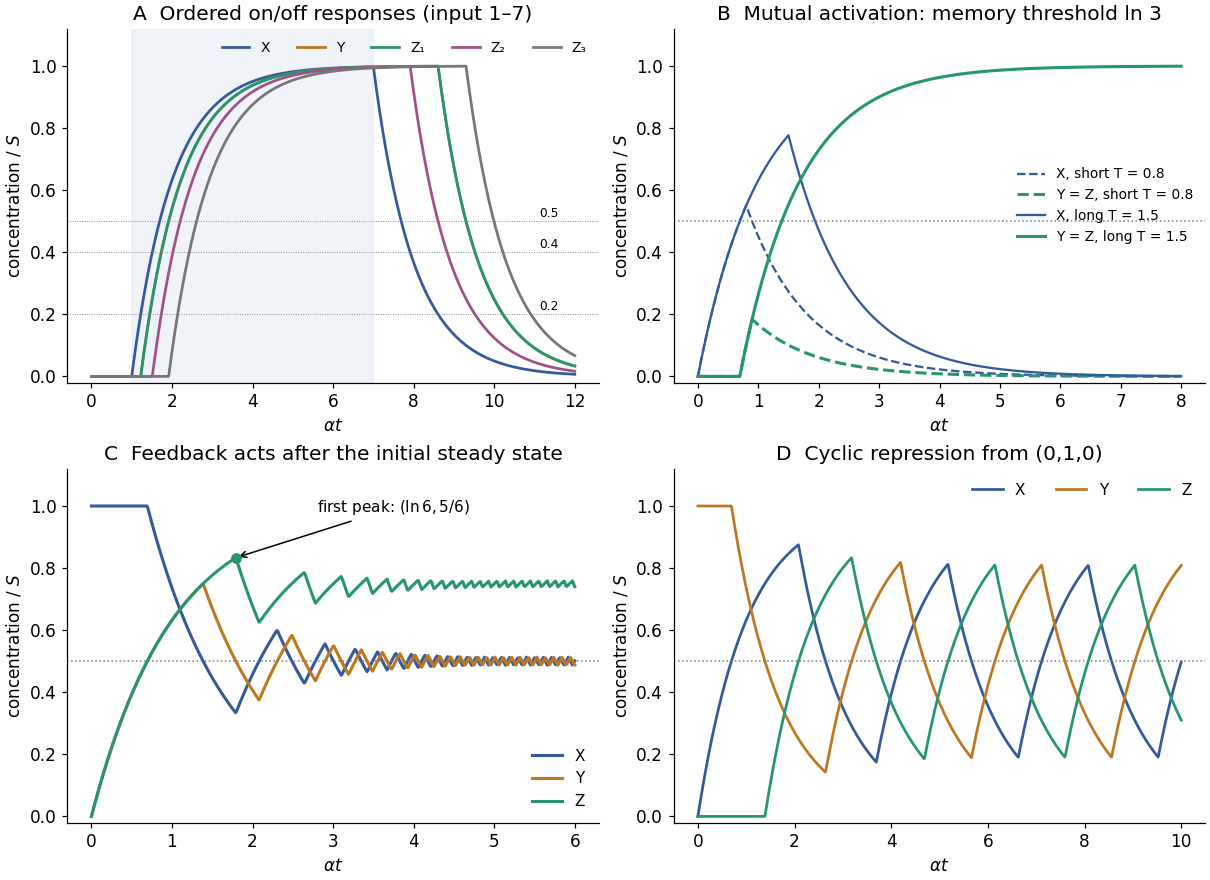
Threshold circuits implement ordered responses, persistent memory, a first output peak and cyclic repression
. Original normalized solutions of the logic models in question 3. All concentrations are divided by and time by ; illustrative common thresholds in panels B–D are . Details.
Put , require , and use the dimensionless time . While X is produced, ; afterwards . X crosses the activation threshold on its rising branch atSymmetry keeps . They initially receive production through X alone and need another interval of active input to reach . If this happens while X is still above threshold, their mutual OR activation sustains production permanently. X remains above untilThe persistence correction to a gene-circuit pulse threshold uses the limiting latch condition is , yieldingFor , and cross their common threshold and approach even after X decays away. For they either remain zero or make a subthreshold pulse and return to zero. Exact equality is sensitive to the convention for the ideal threshold, so robust switching requires a strict excess. At , , whereas and cross at in absolute time.
The shorter required production duration reflects X's persistence after production stops. Requiring would incorrectly discard that tail when all activating ligands remain present. If , no finite pulse reaches the required feedback-active state. The second panel of the figure in solution contrasts pulses shorter and longer than .
For the dynamically regulated interpretation, take , , and let X production respond to Y repression after the ligand appears. Define . Initially active X drives both Y and Z, giving . Y reaches at and switches X production off. X then decays from to , reaching it atUntil , X remains active and Y keeps being produced. Thus . At , Y production stops, but Y still activates Z. Its subsequent decay crosses atImmediately afterwards both inputs to the Z OR gate are below threshold, so Z production stops and its derivative changes from positive to negative. Since Z has been continuously produced from zero until ,For , and . Y repression is lifted at , but X must first rebuild from a subthreshold value, so Z has a genuine first local maximum before any later response.
Wording qualification: if “X is always present at its steady state concentration” is read as an external clamp maintaining after ligand arrival, it overrides Y's repression and changes the problem. Then rises monotonically, with no finite first maximum. The finite-peak result uses the consistent initial-steady-state interpretation in which the stated negative feedback can act.
Write , , , and . The repressilator in the stated logic approximation isAssume . Initially low Z allows X production; high Y blocks Z; and Y is initially at its unrepressed steady level. X first rises through at , turning Y production off. Y then decays through at , where , allowing Z to rise. Z reaches at and switches X production off. At this point , so X falls through at and releases Y production.
Y's rise then switches Z off, Z's fall releases X again, and the sequence repeats. Every segment is exponential relaxation towards one if its production gate is on, or towards zero if off. For a rising segment starting at , the next threshold time is ; for a falling segment starting at , it is . These rules determine the whole trace without pretending the concentrations are square waves. X, Z and Y peak in sequence after the stated initial condition; the last panel of the figure in solution gives an illustrative trajectory.
The delayed sequence of three inhibitory links supplies negative feedback with finite response times. Equal rates make the cycling symmetric after the initial transient, not simultaneous. If , repression is never reliably engaged and the proteins approach their unrepressed levels instead; oscillation is not implied for arbitrary thresholds or for every smooth regulatory law replacing the ideal relay.
A fluorescent reporter associated with one phase of the repressilator should show repeated rises and falls in a tracked cell, with the same underlying oscillatory period but generally delayed and smoothed relative to instantaneous promoter activity. If mature GFP is fused to a repressor and is sufficiently fast to mature, fluorescence approximately tracks that protein's abundance. If GFP is a separately expressed reporter, its own production, maturation, degradation and dilution introduce an additional filter.
For example, converts a periodic gate into a periodic, phase-lagged concentration. Very stable GFP can accumulate a large baseline and obscure oscillations rather than reproducing the regulator trace exactly; maturation delay and bleaching also matter. Biological noise and cell-to-cell phase differences can make individual cycles irregular and wash out oscillations in a population average. The appropriate sketch is therefore a delayed, rounded oscillatory fluorescence trace, with amplitude and baseline depending on reporter turnover, rather than an unqualified copy of a Boolean gate.
Articles by others on the same topic
There are currently no matching articles.