A convex function satisfiesThus its value on every line segment lies below the chord joining the endpoint values.
For the unlabelled Hessian criterion, convexity implies . Divide by and let to obtain for every . Thus the Hessian matrix is positive semidefinite.
Conversely, if every Hessian is positive semidefinite, Taylor's integral formula with givesThe allowed supporting-plane characterization then provesFor the integral inequality put . The supporting tangent at gives almost everywhere. Integrating cancels the linear term, soThis is Jensen's inequality. It remains valid with value on the right: the affine lower bound has integrable negative part, so the extended integral is well-defined.
An admissible is a global minimizer ifIn particular it attains the infimum; no closeness condition on competing admissible functions is imposed.
The integrand is nonnegative. Define the Lipschitz triangular wavesThey have zero endpoint values, slope almost everywhere, and height . Hence almost everywhere. On each of the equal cells, direct integration of the fourth power of the two affine pieces gives . ThereforeThis is an oscillating minimizing sequence with no minimizer.
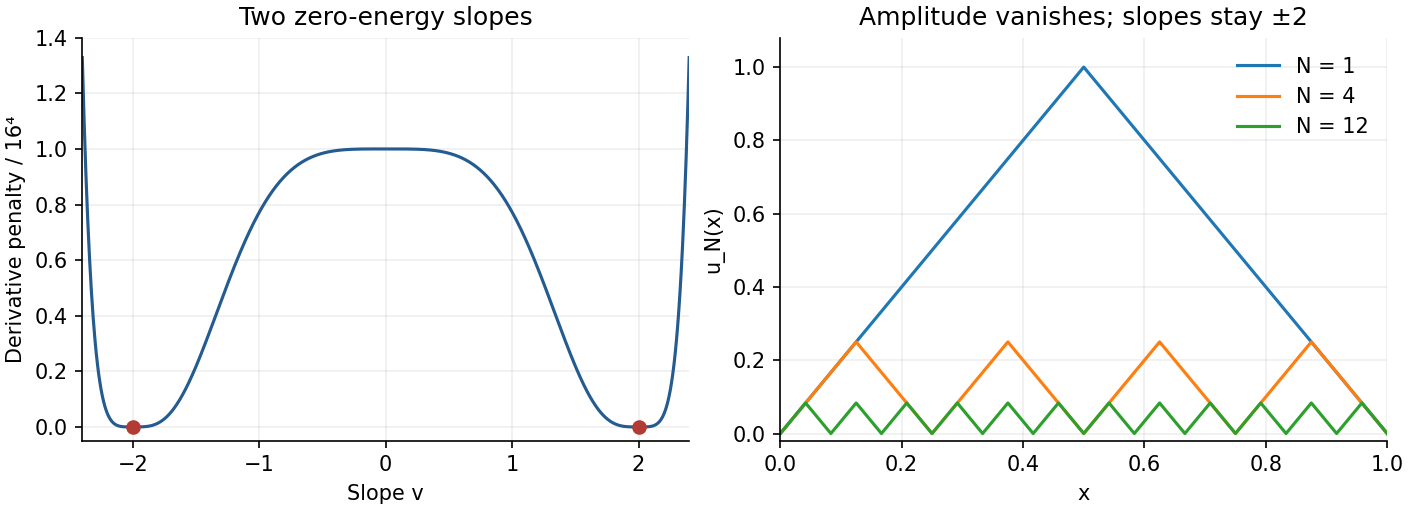

If an admissible attained the infimum, nonnegativity and would force almost everywhere, so its continuous Sobolev representative would be identically zero. Its derivative would then vanish almost everywhere, but the other integrand term would equal . This is impossible. Equivalently, zero energy would simultaneously require and almost everywhere. Thus
Articles by others on the same topic
There are currently no matching articles.