A convex function satisfiesThus its value on every line segment lies below the chord joining the endpoint values.
For the unlabelled Hessian criterion, convexity implies . Divide by and let to obtain for every . Thus the Hessian matrix is positive semidefinite.
Conversely, if every Hessian is positive semidefinite, Taylor's integral formula with givesThe allowed supporting-plane characterization then provesFor the integral inequality put . The supporting tangent at gives almost everywhere. Integrating cancels the linear term, soThis is Jensen's inequality. It remains valid with value on the right: the affine lower bound has integrable negative part, so the extended integral is well-defined.
An admissible is a global minimizer ifIn particular it attains the infimum; no closeness condition on competing admissible functions is imposed.
The integrand is nonnegative. Define the Lipschitz triangular wavesThey have zero endpoint values, slope almost everywhere, and height . Hence almost everywhere. On each of the equal cells, direct integration of the fourth power of the two affine pieces gives . ThereforeThis is an oscillating minimizing sequence with no minimizer.
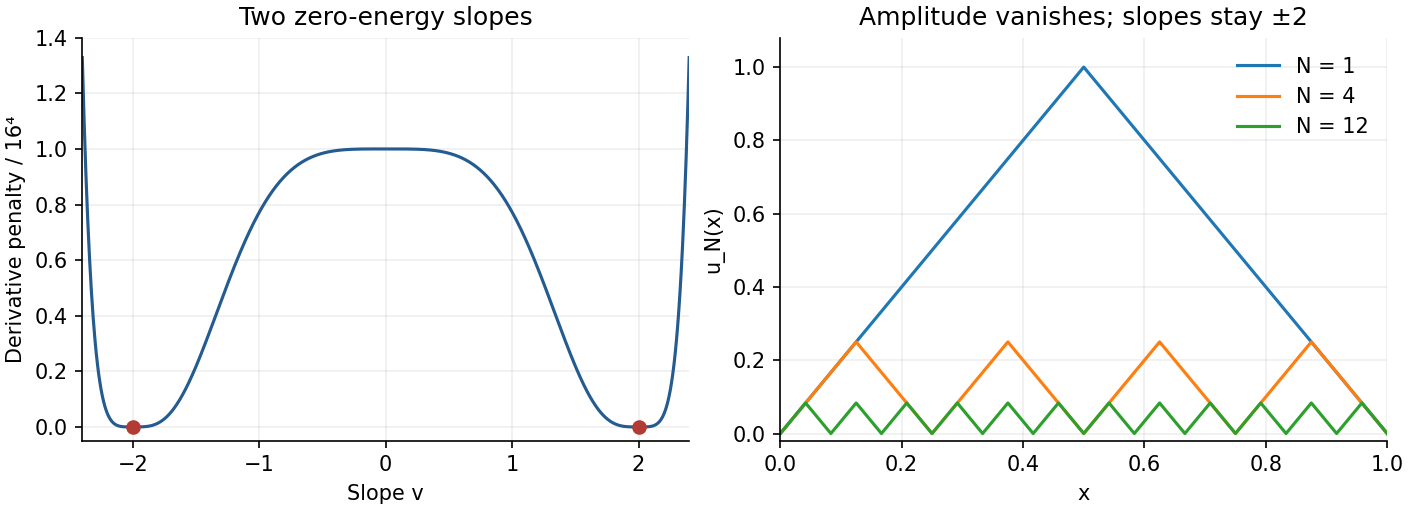

If an admissible attained the infimum, nonnegativity and would force almost everywhere, so its continuous Sobolev representative would be identically zero. Its derivative would then vanish almost everywhere, but the other integrand term would equal . This is impossible. Equivalently, zero energy would simultaneously require and almost everywhere. Thus
For fixed-endpoint variations, the second variation iswith , , evaluated along . The Jacobi equation, written without differentiating separately, isWhen is differentiable this is .
Positive definiteness means for every nonzero admissible variation. Uniform or coercive positivity of a second variation is the stronger assertion that for some fixed . On a fixed-endpoint interval this is equivalent to a positive lower bound in the norm.
The strict Legendre implication uses the uniform interpretation of positivity. If , localized rapidly oscillating variations show : otherwise support them in an interval where , so the derivative term of is negative of order frequency squared, overwhelming its mixed and zero-order terms. Continuity extends the bound to the endpoints, giving on . Under mere positive definiteness this strict conclusion is false: at gives but . In that weaker convention only the ordinary Legendre necessary condition follows. This distinction makes the implication precise.
Under the stated regular condition , a conjugate point to is an endpoint admitting a nonzero Jacobi solution with . The disconjugacy form of the Jacobi positivity criterion says that no such point in exists if and only if there is a Jacobi solution strictly positive on all of .
For the required identity, let that positive solution be and write . Set . The Jacobi equation givesExpanding the second-variation integrand therefore yieldsFor compactly supported , the boundary term vanishes, provingThis is the Jacobi identity for the second variation. The divergence form is also appropriate under the original regularity; with , the Euler-Lagrange equation gives the usual further regularity along the extremal.
At zero, the sixth-power term has zero second derivative, soFor , the Jacobi solution is strictly positive on . The preceding identity gives for nonzero zero-trace .
To control the nonlinear remainder, a uniform lower bound follows directly. Let , , and . Since and by the elementary endpoint estimate,Thus with . Also , soThis is positive for every nonzero admissible sufficiently close to zero in . Therefore zero has positive second variation and is a strict weak local minimizer. No sharp Poincaré inequality has been assumed in this proof.
For every , positivity in the preceding part gives for each fixed admissible . Let to obtainThe sharp constant is attained by , consistently with the first conjugate point occurring at the endpoint for .
Choose any nonzero admissible and set . ThenThe coefficient of is strictly positive, so the energy tends to minus infinity as . Hence
A weak local minimizer of a variational integral is an admissible for which some makes whenever and . Both the function and its derivative are required to be close.
A strong local minimizer of a variational integral is an admissible for which the same conclusion holds whenever . Every strong local minimizer is weak, because Sobolev closeness implies uniform closeness. A global minimizer is both, and the converse implication from weak to strong is not generally valid.
If the integrand is independent of , a weak local minimizer has vanishing first variation:The bounded function therefore has zero distributional derivative, so is constant almost everywhere. For an elementary test-function argument, any smooth compactly supported of integral zero is the derivative of a compactly supported smooth . Hence ; subtracting a fixed unit-integral test function from arbitrary tests shows that agrees with one constant against every test. The fundamental lemma then givesThis is the first integral for a variational integrand independent of the function value.
A point of convexity of a differentiable real function has a globally supporting tangent: for every . The Weierstrass necessary condition for a strong minimum says that is such a point for for almost every . Equivalently, the Weierstrass excess function is nonnegative at every trial slope.
Zero is neither a weak nor a strong local minimizer. Take . It tends to zero in and has zero endpoint values. Since for ,for sufficiently small positive . Thus even weakly close admissible competitors decrease the energy.
Zero is neither a weak nor a strong local minimizer. For any nonzero smooth zero-trace , Taylor expansion givesThe mixed integral by the endpoint values. Writing and , the quadratic coefficient is . The elementary estimate on makes this at most . Thus arbitrarily small variations decrease the energy. The separate coefficient one on is retained in this calculation.
Zero is a strict weak local minimizer, but is not a strong local minimizer. The derivative integrand has expansion , so for small it is at least . Concavity gives for every real . Therefore, when is small,using . This proves strict weak minimality.
For the strong claim, let . Its amplitude tends to zero and its derivative is almost everywhere, so the derivative integrand is the constant . The other integrand term is at most . HenceThis disproves strong minimality. The same obstruction is detected by the Weierstrass necessary condition, since the supporting-tangent inequality at slope zero fails at .
Articles by others on the same topic
There are currently no matching articles.