The two protons are identical spin-one-half fermions, so the total state is antisymmetric under exchange. In the electronic and vibrational ground state, an even rotational has a symmetric spatial wavefunction and therefore uses the antisymmetric nuclear-spin singlet state; odd uses the symmetric triplet state. Thus parahydrogen has one nuclear-spin state, and orthohydrogen has three. Each rotational level also has spatial state degeneracy .
The translational partition functions and all common electronic/vibrational factors cancel in the ratio of equilibrium populations. Using the same zero of energy for the two spin species givesSubtracting the energy separately from all odd levels without restoring that offset in the equilibrium ratio would incorrectly remove the low-temperature preference for parahydrogen. The nuclear spin statistics account for the factor three, independently of the spatial factor .
At low temperature, retain in the even sum and in the odd sum. Their weights are respectively and before the nuclear-spin multiplicity, soEquilibrium hydrogen then becomes almost entirely parahydrogen. At high temperature, many even and odd rotational levels contribute, and their spatial sums have the same leading value. HenceThis is normal hydrogen. Its familiar high-temperature ratio is a nuclear-spin multiplicity ratio, not the ratio of the two lowest levels. Maintaining conversion is essential: a sample cooled without an effective conversion mechanism can retain its earlier composition instead of following . NBS thermodynamic data distinguish equilibrium composition from normal hydrogen and compare the state-sum prediction with spectroscopic and thermal evidence.[ref]
Compilation of Thermal Properties of Hydrogen in Its Various Isotopic and Ortho-Para Modifications by Harold W. Woolley and others. Section III.2, printed pp. 394–395 and table 12: ortho–para equilibrium and its experimental checks
For a fixed number of non-interacting molecules, in the dilute ideal gas limit. The temperature-independent factorial drops out of the internal energy derivative:Differentiate once more at fixed volume to obtainPrimes denote fixed-volume derivatives. If factorizes into translational, rotational and other independent contributions, their heat capacities add. In particular, the three-dimensional translational factor contributes , while a constant spin degeneracy factor contributes zero. The formula also follows from the positive canonical energy variance, .
For a high-temperature linear rigid rotor, up to temperature-independent symmetry/spin factors. Therefore and , givingThis agrees with the equipartition theorem for two quadratic rotational coordinates. It is the rotational contribution; adding free three-dimensional translation gives when vibrations remain unexcited. A constant rotational symmetry number does not affect this derivative.
Apply part (b) to each supplied rotational sum. Multiplying the odd sum by its constant nuclear-spin factor three does not change or . At the specified temperature the dimensionless rotational contributions areThus the rotational heat capacities are for parahydrogen and for orthohydrogen. For the total gas heat capacities, including translation and neglecting vibration,The difference is substantial because the permitted rotational ladders differ. The para ladder starts at and next reaches , separated by ; its excited population is changing appreciably here. The ortho ladder starts at and next reaches , a larger separation of , so much of the ortho population remains in its lowest rotational manifold. A rotational contribution greater than is possible in the intermediate quantum regime and is not a violation of high-temperature equipartition.
For a frozen ortho-para mixture, the mole fractions do not change during the heat measurement, and the molar heat capacity is the composition-weighted average. A high-temperature composition retained on cooling has , , soFor a mixture that continues to interconvert and remain in equilibrium near the specified temperature, use the combined rotational sum and differentiate that sum:ConsequentlyThe equilibrium composition itself is , giving . Its changing composition supplies a further positive heat capacity: warming converts some lower-energy para molecules into higher-energy ortho molecules. One can isolate this term asFor clarity, if a mixture is first equilibrated at this temperature and then its composition is frozen during measurement, the conversion term is absent: its rotational value is and its total value is . This is distinct from the equilibrium heat capacity of interconverting states even though the instantaneous composition is the same. An experiment must specify conversion activity and equilibration time; compare sufficiently slow temperature steps with a conversion catalyst against a composition-preserving sample, while keeping the same thermal background and checking that the sample has reached the stated temperature.
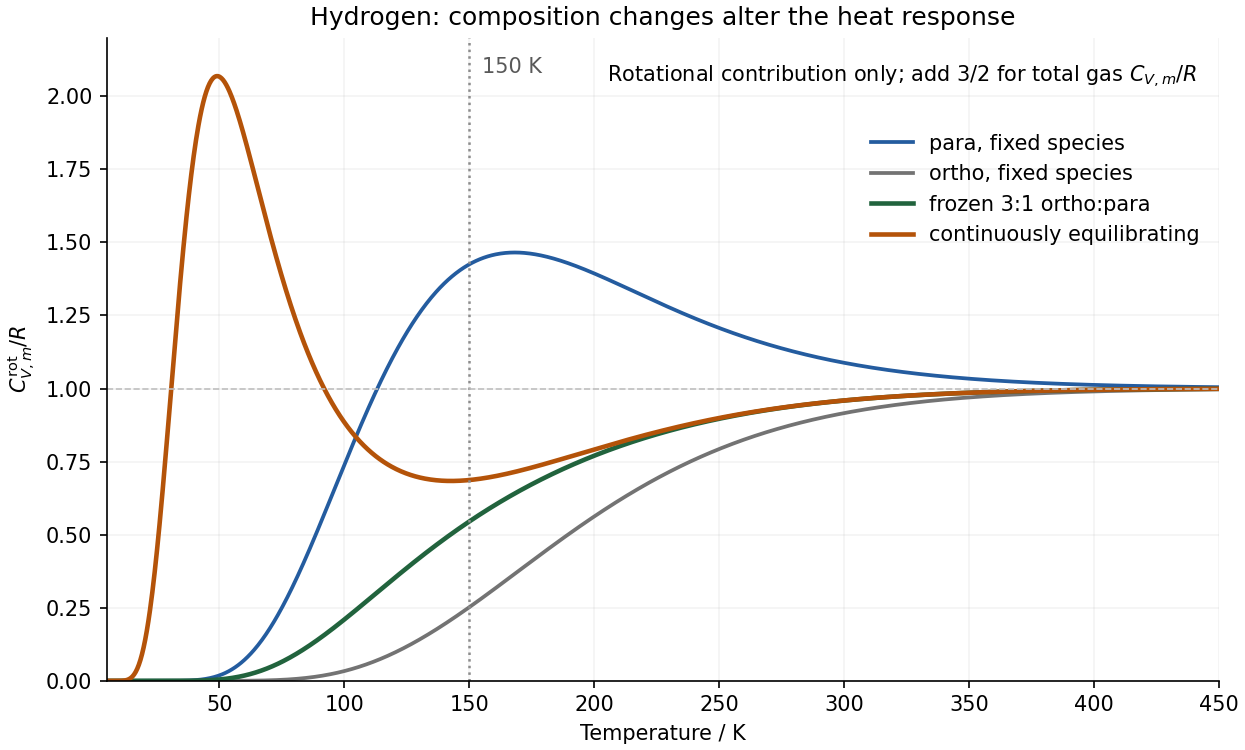
Original ideal-rotor heat capacities showing the difference between frozen normal hydrogen and continuously equilibrating hydrogen
. Details. 
Articles by others on the same topic
There are currently no matching articles.