A typical intrinsic semiconductor has a nearly full valence band ending at and a nearly empty conduction band starting at , separated byAt finite temperature, the equilibrium Fermi level lies near the middle of the gap. In the nondegenerate parabolic-band approximation,where are the two effective density of states values. Equal densities of states put it exactly at midgap; unequal masses or valley multiplicities shift it slightly. The left panel gives the requested energy-level sketch, with doped cases for comparison.
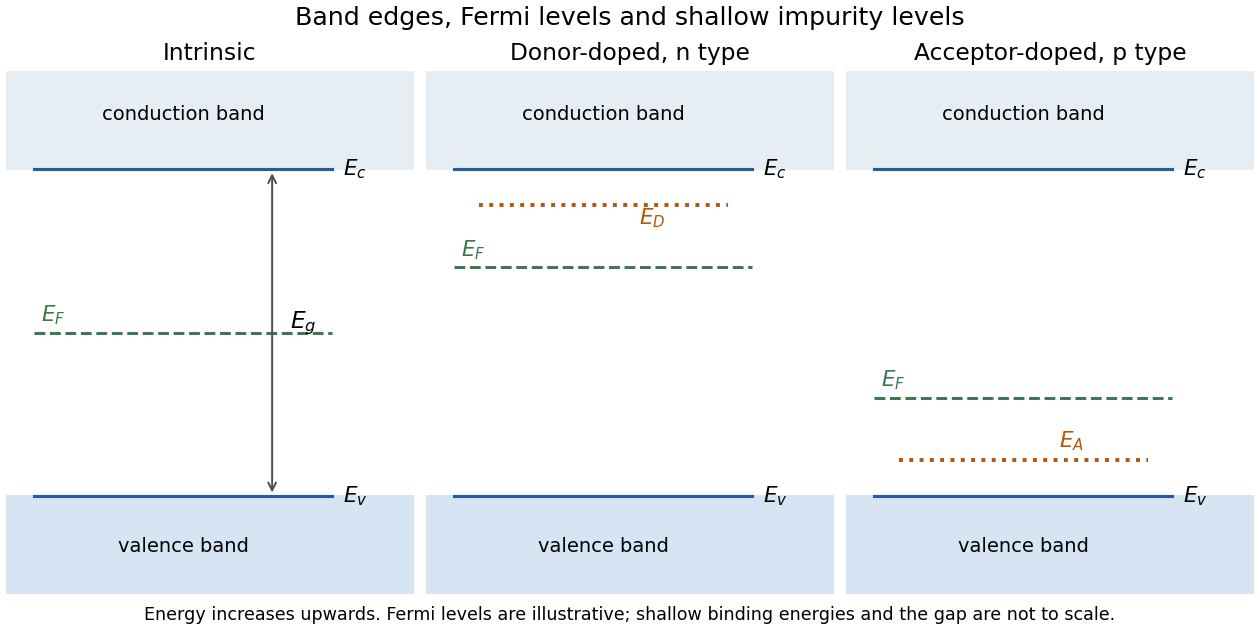
Original schematic energy levels of intrinsic, donor-doped and acceptor-doped semiconductors, including the intrinsic Fermi level and band gap
. Details. 
In a nondegenerate semiconductor, the Fermi-Dirac distribution reduces near the conduction edge to . The corresponding dilute hole probability near the valence edge givesAn intrinsic, neutral sample has . Multiplying the two expressions therefore yieldsEach excitation creates an electron-hole pair; charge neutrality is why the carrier concentration has half the gap in its activation exponent. The electrical conductivity isThus to leading exponential accuracy. The prefactor contains the mobilities and the density-of-states temperature dependence; for fixed parabolic masses, .
Measure conductivity in the intrinsic regime and plot against . If the prefactor is constant or its temperature dependence has been corrected, a slope givesUse the intrinsic branch rather than a donor freeze-out or extrinsic branch. A temperature-dependent gap or mobility changes the apparent activation energy, so a precision extraction must account for those prefactors.
Articles by others on the same topic
There are currently no matching articles.