A typical intrinsic semiconductor has a nearly full valence band ending at and a nearly empty conduction band starting at , separated byAt finite temperature, the equilibrium Fermi level lies near the middle of the gap. In the nondegenerate parabolic-band approximation,where are the two effective density of states values. Equal densities of states put it exactly at midgap; unequal masses or valley multiplicities shift it slightly. The left panel gives the requested energy-level sketch, with doped cases for comparison.
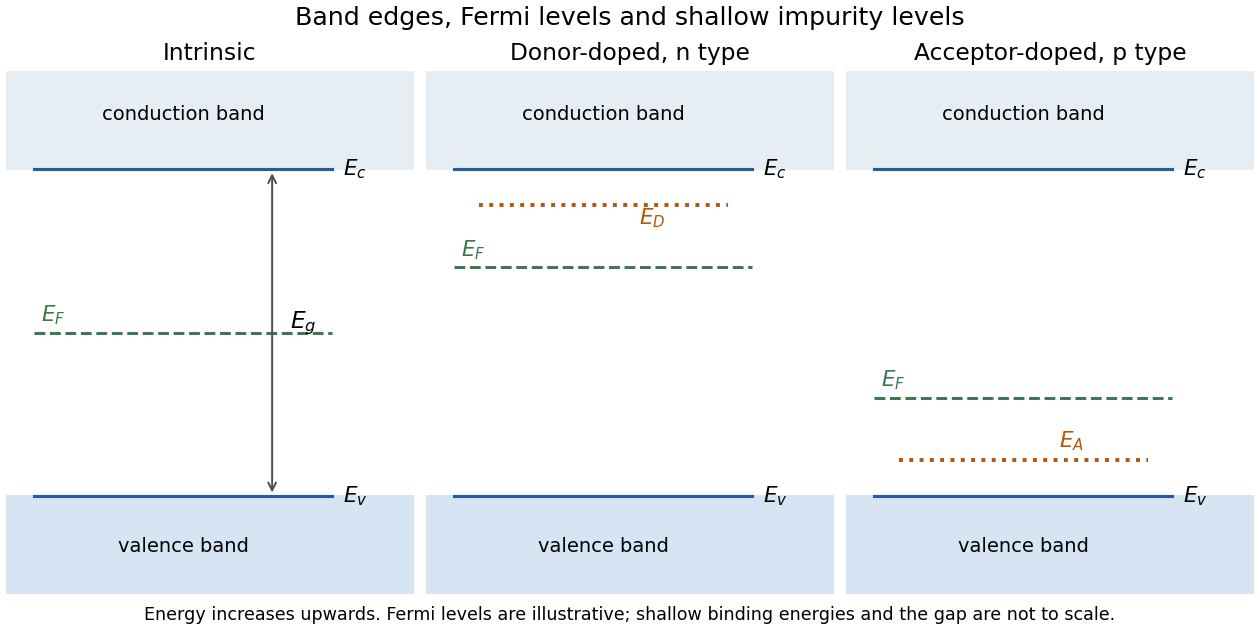
Original schematic energy levels of intrinsic, donor-doped and acceptor-doped semiconductors, including the intrinsic Fermi level and band gap
. Details. 
In a nondegenerate semiconductor, the Fermi-Dirac distribution reduces near the conduction edge to . The corresponding dilute hole probability near the valence edge givesAn intrinsic, neutral sample has . Multiplying the two expressions therefore yieldsEach excitation creates an electron-hole pair; charge neutrality is why the carrier concentration has half the gap in its activation exponent. The electrical conductivity isThus to leading exponential accuracy. The prefactor contains the mobilities and the density-of-states temperature dependence; for fixed parabolic masses, .
Measure conductivity in the intrinsic regime and plot against . If the prefactor is constant or its temperature dependence has been corrected, a slope givesUse the intrinsic branch rather than a donor freeze-out or extrinsic branch. A temperature-dependent gap or mobility changes the apparent activation energy, so a precision extraction must account for those prefactors.
Arsenic has five valence electrons, one more than silicon. As a substitutional donor impurity, it supplies a weakly bound extra electron which is largely thermally released into the conduction band at room temperature, leaving an ionized positive donor.
Consequently the mobile electron density increases far above the intrinsic value, so the conductivity increases substantially even at ppm dopant levels. The crystal remains macroscopically neutral: fixed donor charge compensates the added mobile charge.
There are three useful temperature regimes.
At low temperature, dopant freeze-out keeps most donor electrons bound. Warming ionizes donors and increases conductivity through the rising mobile-electron concentration. For an uncompensated dilute donor system, negligible holes and spin degeneracy two, charge neutrality with partial donor ionization givesDeep in freeze-out, , soThe activation scale is set by the shallow donor binding, rather than the whole band gap.
In the extrinsic regime, donors are largely ionized and is nearly constant. The temperature dependence of conductivity then mainly follows the electron mobility. Increasing phonon scattering can make conductivity fall as temperature rises, even though donors remain ionized; impurity scattering can give a different mobility trend at lower temperature.
At sufficiently high temperature, thermally generated electron–hole pairs overwhelm the dopant population. The intrinsic, gap-activated increase in conductivity returns. The boundaries depend on donor concentration, compensation and scattering, so no one exponential describes the entire doped-sample curve.
The extra electron is bound to an approximately singly charged donor through a dielectric-screened Coulomb attraction. In the isotropic hydrogenic donor state model, replace the vacuum electron mass by and the vacuum permittivity by :At low temperature, the donor is mainly in its state. Allowed electric-dipole transitions to states haveAssign the three printed lines to . Their independently inferred binding energies areThey are mutually close, giving . The hydrogenic impurity absorption series accumulates at the donor-ionization limit. Above about , absorption can place the electron in the conduction-band continuum, explaining the continuous spectrum.
Using the supplied and ,The corresponding effective radius isThese are the parameters inferred from the printed lines within the stipulated scalar model, rather than substituted tabulated material constants. Real impurity spectra can depart from a single hydrogenic ladder through anisotropy and short-distance impurity effects.[ref]
Warming thermally ionizes neutral donors, depleting the occupied bound ground states from which these absorption lines start. Increased scattering can also broaden the lines. Once the donors are predominantly ionized, their bound-to-bound absorption becomes weak or disappears.
The inferred binding provides the natural thermal scale:The first excitation energy similarly corresponds to about . An order-of-magnitude estimate is therefore a temperature of order . This is not a sharp onset: significant ionization can start below that scale because free carriers have a large translational density of states. The precise loss of line strength requires donor density and compensation, as in part (ii), rather than just equating one energy with .
Gallium has three valence electrons, one fewer than silicon, and acts as an acceptor impurity. A neutral acceptor can be described as a negatively charged centre binding an electron hole. Thermal release of these holes gives a p-type semiconductor.
At low temperature, the bound hole can absorb far-IR photons in transitions between acceptor levels. The simplest scalar hydrogenic acceptor state model predictsso one expects a discrete bound-hole absorption series followed by a photoionization continuum. In that idealization, the first lines would be at , and , with threshold .
The hole effective mass is not supplied, so the electron mass cannot be reused to give numerical Ga line positions. In a real valence band, multiple hole bands, anisotropic masses and spin-orbit effects can split and complicate the series; acceptor spectra are generally less accurately described by one scalar hydrogenic ladder.[ref]
Optical Properties of Solids by Mildred S. Dresselhaus. Section 7.3, printed p. 79: departures from the hydrogenic model for degenerate valence bands and acceptors
Articles by others on the same topic
There are currently no matching articles.