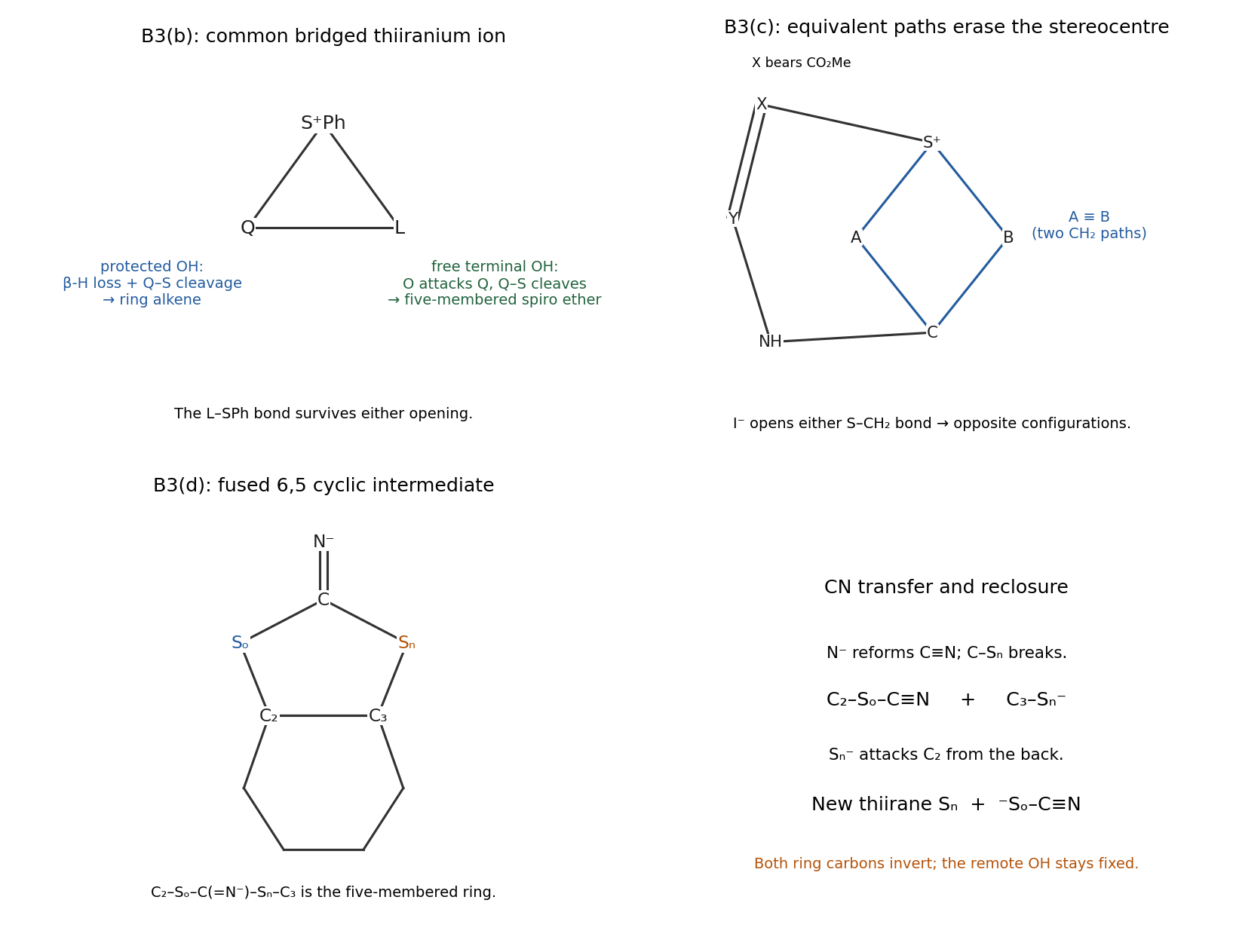
protonation of the secondary OH permits water departure. The neighbouring phenylthio sulfur can assist this departure by forming a bond to the adjacent alcohol carbon, generating a thiiranium ion spanning that carbon and the original sulfur-bearing cyclohexane carbon. Label the latter Q and the former L. The temporary Q–S–L bridge transfers the phenylthio attachment from Q to L when its Q–S bond subsequently breaks. sulfur attack opposite the departing OH accounts for the new C–S stereochemistry without requiring a freely rotating carbocation.
For the protected terminal alcohol, no free tethered OH is available to trap the bridge. Removal of a beta hydrogen from a cyclohexane carbon adjacent to Q forms the ring alkene while Q–S breaks. sulfur remains bonded to L, giving the allylic phenyl thioether. acid is regenerated by the deprotonation, so the catalyst need not be consumed.
For the free terminal alcohol, its oxygen attacks Q intramolecularly, opening Q–S instead. Count the new ether ring: O–CH2–CH(Me)–L–Q, a five-membered ring sharing Q with the cyclohexane. deprotonation gives the spirocyclic ether. This is capture of the same neighbouring-group-stabilized intermediate rather than migration of the methyl group. The pre-existing methyl-bearing carbon retains its configuration; its wedge/dash appearance changes when the product is redrawn in a different ring projection. The two substrates differ in whether a suitably placed oxygen nucleophile is available for intramolecular trapping.

Articles by others on the same topic
There are currently no matching articles.