Number the OH-bearing carbon C1 and the adjacent brominated carbon C2. In the trans bromohydrin, base generates an alkoxide. A chair conformation can place O at C1 and Br at C2 trans-diaxial, aligning the oxygen nucleophile for backside attack at C2. Intramolecular SN2 closure expels bromide and inverts C2: the retained C1–O bond and the newly formed C2–O bond are both on the original OH face, giving the epoxide shown. ring inversion can provide the reactive chair even if it is not the dominant ground-state conformer.
The cis bromohydrin cannot place OH and Br trans-diaxial: one is axial when the other is equatorial. In the chair with Br axial, the hydrogen on C1 can instead be antiperiplanar to C2–Br. An alkoxide-assisted semipinacol pathway moves the C1–H bonding pair to C2 while the oxygen lone pair forms C1=O and bromide departs. hydride migration gives the ketone without changing the carbon skeleton. The hydrogen is transferred to C2 rather than expelled as a free hydride. The original phenyl-bearing stereocentre is not involved in either bond-reorganization sequence. Configuration controls which properly aligned displacement or migration can occur; a flat ring drawing alone conceals that distinction.
protonation of the secondary OH permits water departure. The neighbouring phenylthio sulfur can assist this departure by forming a bond to the adjacent alcohol carbon, generating a thiiranium ion spanning that carbon and the original sulfur-bearing cyclohexane carbon. Label the latter Q and the former L. The temporary Q–S–L bridge transfers the phenylthio attachment from Q to L when its Q–S bond subsequently breaks. sulfur attack opposite the departing OH accounts for the new C–S stereochemistry without requiring a freely rotating carbocation.
For the protected terminal alcohol, no free tethered OH is available to trap the bridge. Removal of a beta hydrogen from a cyclohexane carbon adjacent to Q forms the ring alkene while Q–S breaks. sulfur remains bonded to L, giving the allylic phenyl thioether. acid is regenerated by the deprotonation, so the catalyst need not be consumed.
For the free terminal alcohol, its oxygen attacks Q intramolecularly, opening Q–S instead. Count the new ether ring: O–CH2–CH(Me)–L–Q, a five-membered ring sharing Q with the cyclohexane. deprotonation gives the spirocyclic ether. This is capture of the same neighbouring-group-stabilized intermediate rather than migration of the methyl group. The pre-existing methyl-bearing carbon retains its configuration; its wedge/dash appearance changes when the product is redrawn in a different ring projection. The two substrates differ in whether a suitably placed oxygen nucleophile is available for intramolecular trapping.
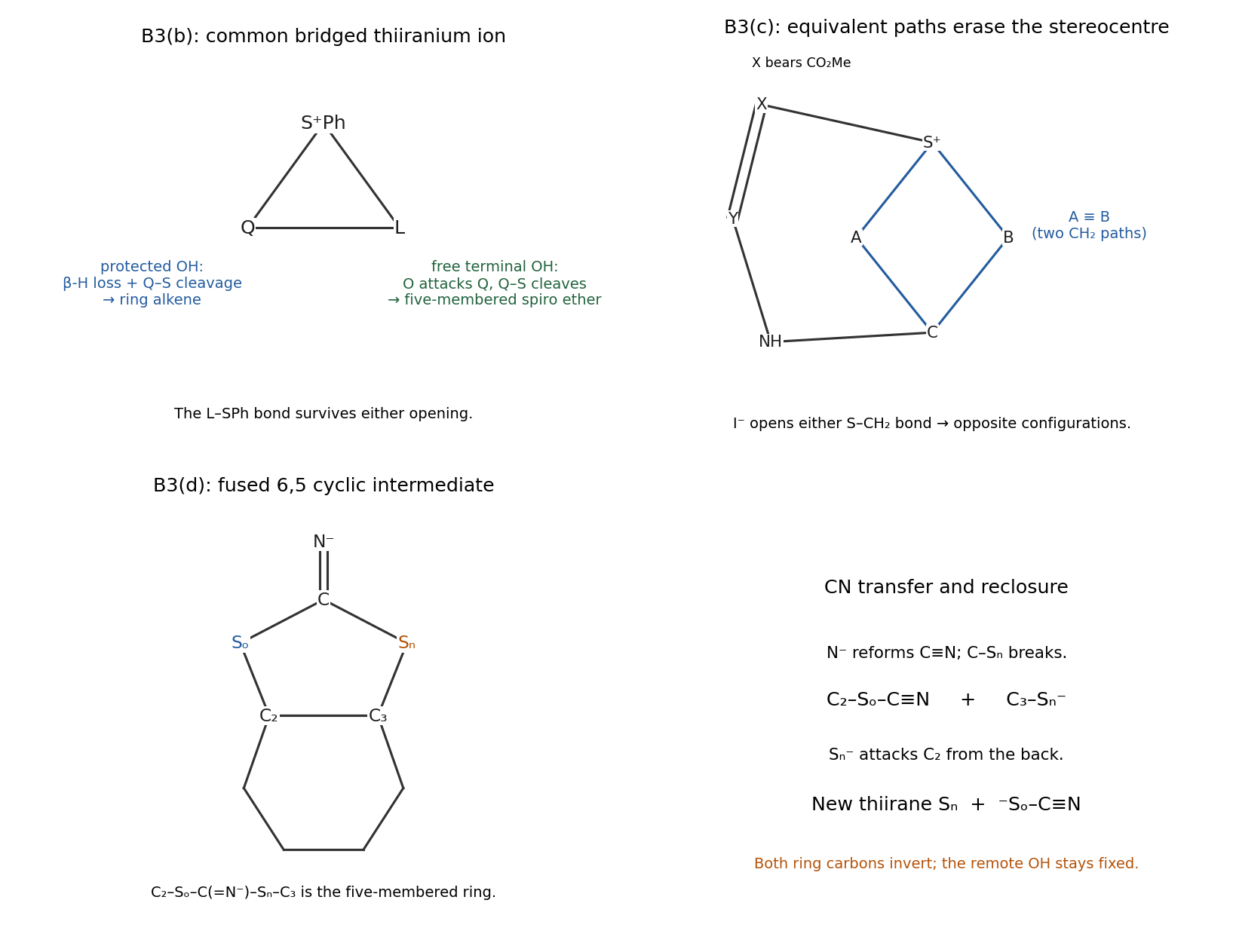
Original local atom maps of sulfur participation, the equivalent paths of the bridged thietanium ion, and the five-membered intermediate in thiirane sulfur exchange
. Details. 
Direct iodide attack at the terminal CH2–OMs would replace the leaving group without disturbing the adjacent stereocentre, so it cannot by itself explain racemization. sulfur participation produces an intermediate with two equivalent methylene paths. Label the original S-adjacent methylene A, the stereogenic carbon C, and its CH2–OMs substituent B. The thioether sulfur attacks B intramolecularly and expels mesylate, forming a four-membered thietanium circuit S–A–C–B–S. The rest of the original six-membered ring remains as the other path between S and C.
In this bridged sulfonium ion, A and B are both CH2 groups joining the same S and C centres. Exchanging them no longer changes the labelled molecular connectivity: the distinction that made C stereogenic has been removed. iodide can open the strained intermediate by backside attack at either A or B. Opening one S–CH2 bond gives one configuration of the six-membered product, while opening its equivalent partner exchanges which methylene is in the ring and which is the iodomethyl substituent, giving the opposite configuration.
The carbon iodinated in each opening is a methylene; racemization appears at the adjacent carbon through exchange of equivalent paths. It is not inversion at a CH2 stereocentre, nor does the mesylate carbon have to form a primary free carbocation. An achiral intermediate in an achiral medium gives equal mirror-related outcomes. nitrogen participation alone in a simple terminal displacement would not provide this specific equivalent-path explanation.
Distinguish the original thiirane sulfur from the sulfur supplied by thiocyanate. sulfur attack by at one thiirane carbon opens its C– bond with inversion. This produces a thiolate at the neighbouring carbon and a C––CN group at the attacked carbon. The OH-bearing remote carbon is unaffected.
The original thiolate now attacks the nitrile carbon intramolecularly. Shift one C≡N pi pair onto nitrogen. The resulting cyclic imidodithiocarbonate has the five-membered sequence ring carbon––C(=N)––adjacent ring carbon; its two carbon atoms are also part of the original six-membered carbocycle, exactly giving the hinted bicyclic intermediate.
Collapse can reform C≡N while breaking the nitrile-carbon– bond. This transfers the CN group to and generates as the thiolate on the other ring carbon. That thiolate attacks the remaining C– bond from the back, expelling and reclosing the thiirane. Each thiirane carbon has undergone one inversion, so the new sulfur bridge lies on the opposite face; the OH configuration is retained. The thiocyanate sulfur has entered the ring and the original ring sulfur has left as thiocyanate. This atom-labelled exchange mechanism explains how the same elemental formula can conceal sulfur replacement; isotope labelling would be needed to test that exchange experimentally. A single epimerization at the OH carbon would give the wrong stereochemical outcome.
Articles by others on the same topic
There are currently no matching articles.