P is a tetrahedron of four phosphorus atoms, with a P–P bond along every edge. Each P has three P–P sigma bonds and one lone pair. The P–P–P angles are , so these are strained, bent bonds rather than four independent tetrahedral electron-pair arrangements with ideal bond angles. This molecular unit is characteristic of white phosphorus.
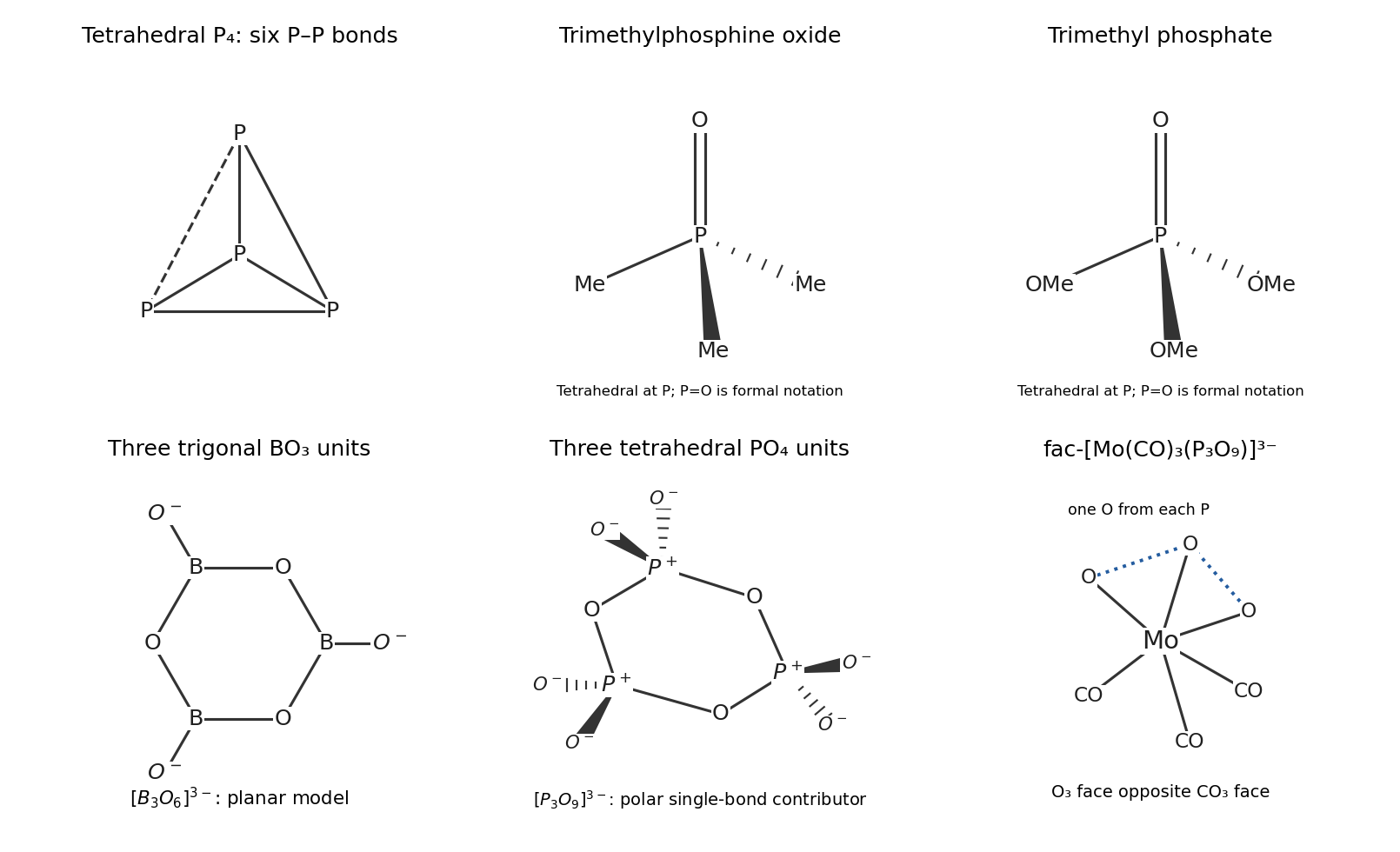
Original structures of P4, the two phosphoryl compounds, cyclic triborate and trimetaphosphate
. Details. 
The phosphorus centre is approximately tetrahedral, with three P–C sigma bonds and one short terminal P–O bond. Both and are useful Lewis contributors; the bond is strongly polar and has additional multiple-bond character. oxygen lone-pair donation into suitable P–C antibonding combinations provides a description of the additional stabilization without requiring a substantial localized phosphorus-3d/oxygen-2p pi bond. A combined diffraction and orbital study illustrates this sigma-bond/negative-hyperconjugation description.[ref]
Computational and experimental approaches to the molecular structure of the HCl adduct of Me3PO by Andreas Orthaber and others. §3.2 and Fig. 2a–c, orbital analysis of free Me3PO
Compared with the phosphate triester, this compound's methyl substituents are less electron withdrawing. The comparison of the two terminal P–O stretching force constants and the appropriate experimental control is given with the triester below.
also has approximately tetrahedral molecular geometry at phosphorus, now with three P–O–C sigma linkages and a terminal phosphoryl O. Only the latter is being compared with the terminal O of MePO; the three P–O–C bonds are chemically distinct.
The electronegative alkoxy substituents withdraw electron density from P and improve its capacity to accept donation from terminal O into the surrounding antibonding framework. The elementary substituent argument therefore predicts a stronger, stiffer terminal P–O bond in than in . A description invoking polar bonding and negative hyperconjugation avoids assigning a literal localized d-orbital double bond solely because the formula is written P=O.
Measure the terminal P–O stretching vibration by infrared or Raman spectroscopy under comparable, non-hydrogen-bonding conditions. In an approximate local-mode comparison the reduced mass is the same, so a larger terminal stretching wavenumber indicates a larger force constant, . Mode assignment can be checked by O substitution at the terminal oxygen or by a normal-mode calculation; otherwise an alkoxy P–O–C vibration could be compared by mistake. X-ray diffraction can supply a supporting bond-length comparison, but neither bond length nor a single coupled vibrational frequency directly measures an isolated bond-dissociation enthalpy.
Articles by others on the same topic
There are currently no matching articles.