P is a tetrahedron of four phosphorus atoms, with a P–P bond along every edge. Each P has three P–P sigma bonds and one lone pair. The P–P–P angles are , so these are strained, bent bonds rather than four independent tetrahedral electron-pair arrangements with ideal bond angles. This molecular unit is characteristic of white phosphorus.
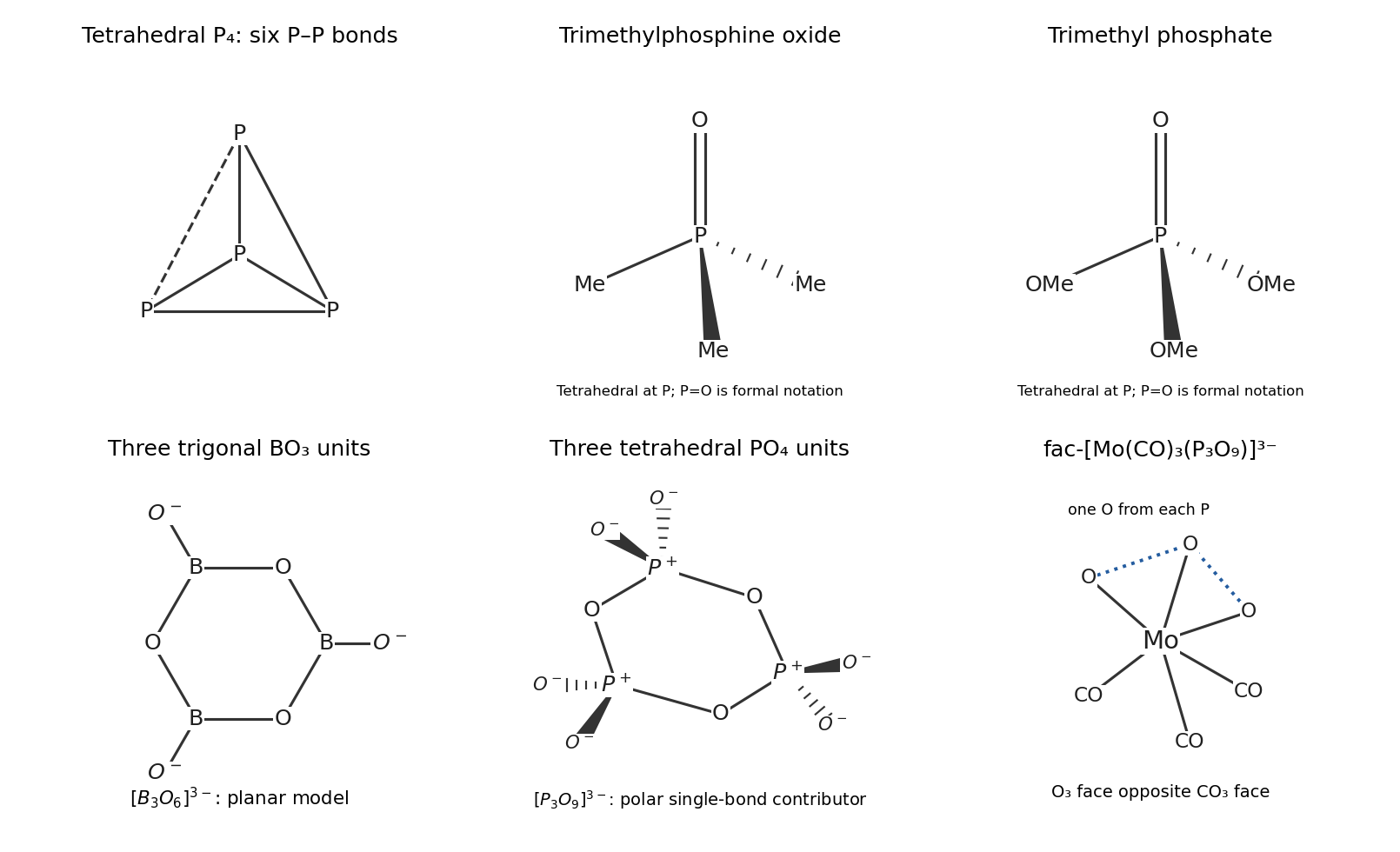
Original structures of P4, the two phosphoryl compounds, cyclic triborate and trimetaphosphate
. Details. 
The phosphorus centre is approximately tetrahedral, with three P–C sigma bonds and one short terminal P–O bond. Both and are useful Lewis contributors; the bond is strongly polar and has additional multiple-bond character. oxygen lone-pair donation into suitable P–C antibonding combinations provides a description of the additional stabilization without requiring a substantial localized phosphorus-3d/oxygen-2p pi bond. A combined diffraction and orbital study illustrates this sigma-bond/negative-hyperconjugation description.[ref]
Computational and experimental approaches to the molecular structure of the HCl adduct of Me3PO by Andreas Orthaber and others. §3.2 and Fig. 2a–c, orbital analysis of free Me3PO
Compared with the phosphate triester, this compound's methyl substituents are less electron withdrawing. The comparison of the two terminal P–O stretching force constants and the appropriate experimental control is given with the triester below.
also has approximately tetrahedral molecular geometry at phosphorus, now with three P–O–C sigma linkages and a terminal phosphoryl O. Only the latter is being compared with the terminal O of MePO; the three P–O–C bonds are chemically distinct.
The electronegative alkoxy substituents withdraw electron density from P and improve its capacity to accept donation from terminal O into the surrounding antibonding framework. The elementary substituent argument therefore predicts a stronger, stiffer terminal P–O bond in than in . A description invoking polar bonding and negative hyperconjugation avoids assigning a literal localized d-orbital double bond solely because the formula is written P=O.
Measure the terminal P–O stretching vibration by infrared or Raman spectroscopy under comparable, non-hydrogen-bonding conditions. In an approximate local-mode comparison the reduced mass is the same, so a larger terminal stretching wavenumber indicates a larger force constant, . Mode assignment can be checked by O substitution at the terminal oxygen or by a normal-mode calculation; otherwise an alkoxy P–O–C vibration could be compared by mistake. X-ray diffraction can supply a supporting bond-length comparison, but neither bond length nor a single coupled vibrational frequency directly measures an isolated bond-dissociation enthalpy.
The larger value for the carbonyl bond means that its dissociation costs more for the supplied comparison. A carbonyl combines a strong sigma bond with efficient pi overlap between spatially compatible C 2p and O 2p orbitals. This gives a substantial localized multiple-bond contribution.
The short P–O linkage in a phosphine oxide is also strong, but it is more polar, with a substantial contribution. P 3p and O 2p orbitals have less favourable radial and energy matching than C 2p/O 2p for a simple localized pi bond. oxygen donation into P–R antibonding orbitals adds stabilization, but it is not identical to the carbonyl pi bond. Therefore the formal double-bond notation does not imply equal bond strength. A substantial P-3d contribution is not needed to explain the bonding. The stated bond-dissociation values compare complete dissociation processes, so their magnitudes should not be derived solely from one overlap integral or from the two atoms' electronegativity difference.
Join three trigonal BO units corner to corner. The resulting alternating six-membered B–O ring has one terminal oxygen on each boron:The superscript records the total charge; the three explicit O labels each carry one share of it. Atom counting gives three B, three bridging O and three terminal O. Boron is three-coordinate and approximately trigonal planar. The original structure diagram shows the ring connectivity and terminal atoms.
A planar arrangement permits the perpendicular empty boron p orbitals to accept pi donation from suitable oxygen lone pairs. The terminal oxygens can donate effectively toward one boron, giving their B–O linkages more multiple-bond character and explaining why they are shorter than bridging B–O linkages. A bridging oxygen shares its interactions between two boron centres. An approximately planar ring is therefore expected from the trigonal units and favourable orbital alignment. This reasoning does not require describing the entire anion as benzene-like with an assumed six-electron aromatic ring; the oxygen lone pairs and terminal donations must actually be counted before making an aromaticity claim.
Three PO tetrahedra share corners in a ring. Each phosphorus has two ring-bridging oxygens and two terminal oxygens, sois one conventional Lewis representation of trimetaphosphate. Its three P and nine O atoms consist of three bridging and six terminal O atoms. Within each phosphate unit the two terminal bonds have delocalized character; drawing one P=O and one P–O is not a claim that every free anion has permanently different terminal oxygens.
A puckered six-membered P–O ring is expected. The tetrahedral phosphorus geometry and P–O–P torsional preferences allow folding without losing a required continuous perpendicular-p orbital system. This differs from the planar trigonal-boron arrangement. Tetrahedral P alone is not a geometrical proof of nonplanarity, since its two ring bonds could lie in a plane; the argument is that puckering is energetically accessible and relieves conformational strain without sacrificing a strong planar pi-conjugation benefit. The precise chair-like or boat-like distortion depends on environment and counterions.
A reasonable product is sodium facial trimetaphosphate–molybdenum tricarbonyl, with the anionOne terminal O from each phosphorus binds Mo; the three O donors occupy one octahedral face, while the three carbonyls occupy the opposite face. The ring bridges remain P–O–P bridges and are not replaced by Mo–P bonds. Mo remains Mo(0), , and electrons. Overall,acetonitrile can transiently replace CO during heating, but it is not required in the final six-coordinate proposal. The same anion has been structurally characterized with a different counterion: that primary study independently supports the facial O/CO connectivity, without establishing identical solubility or yield for the sodium salt.[ref]
Synthesis and characterization of the trimetaphosphate molybdenum tricarbonyl anion [(P3O9)Mo(CO)3]3- as its tris(bis(triphenylphosphine)iminium) salt by Christopher R. Clough and others. pp. 195–196, Scheme 2 and Fig. 1; §4.3 for Mo(CO)6 in refluxing acetonitrile
Articles by others on the same topic
There are currently no matching articles.