tert-Butoxide removes the acidic hydrogen from . The resulting carbon anion is stabilized by the nitrile group and the phenyl substituent. It attacks the aromatic carbon bearing fluorine, giving a Meisenheimer addition intermediate. Ring pi bonds shift toward the para nitro group, where the negative charge can be delocalized onto oxygen.
Loss of fluoride restores aromaticity and gives . This is an addition–elimination nucleophilic aromatic substitution. The phenoxy group remains attached to the incoming carbon. The ipso aromatic carbon already has a leaving group, so rearomatization can occur by fluoride departure without removing phenoxide. Acid workup neutralizes residual anions; it is not a separate step that replaces the aryl fluoride.
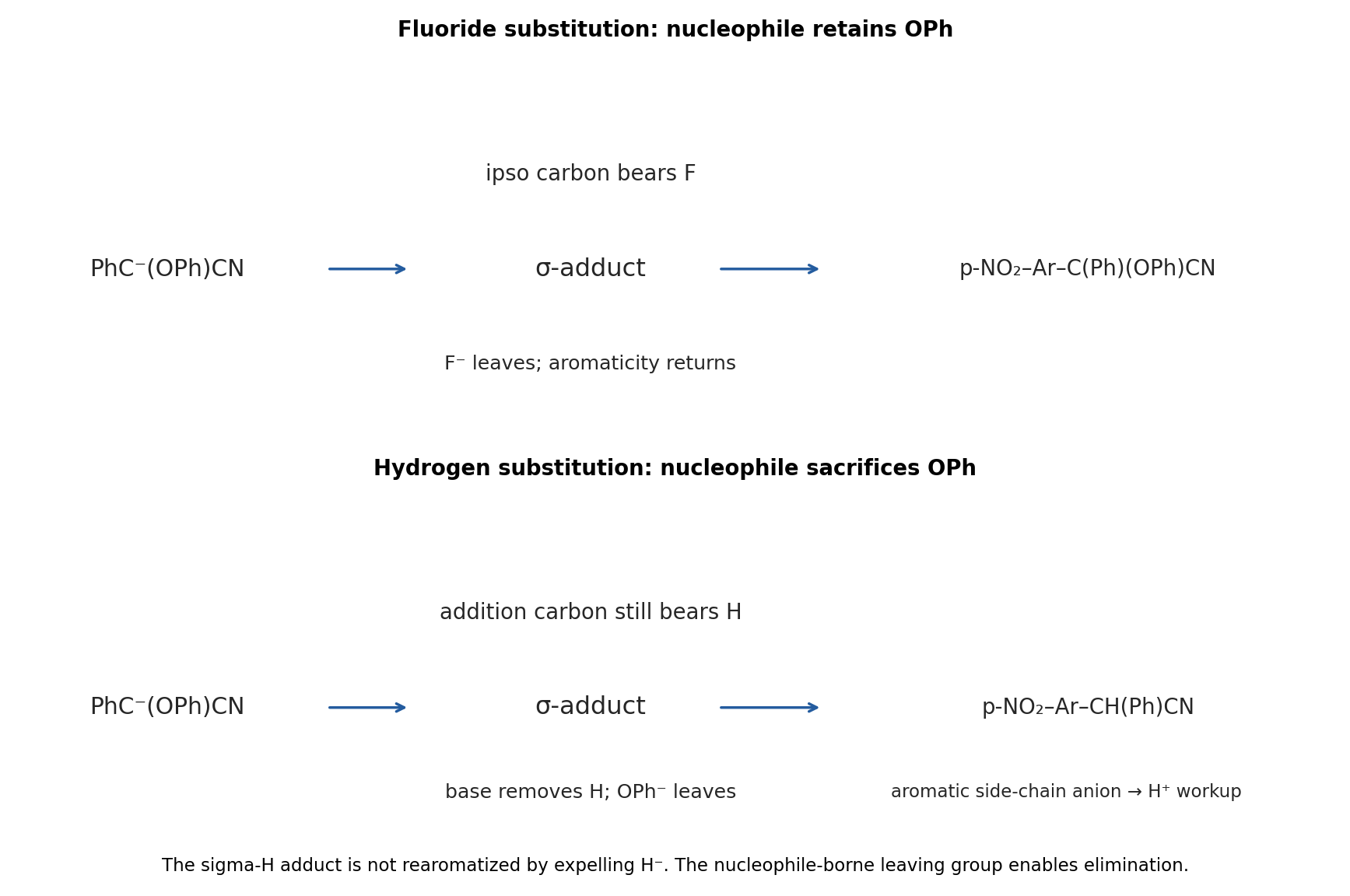

The same base first makes . This time addition occurs at a carbon bearing hydrogen para to the nitro group, giving a sigma-H adduct. The attacked carbon temporarily bears both its original H and the new carbon substituent. Negative charge is again delocalized through the ring toward the nitro oxygens.
A further base removes the hydrogen on that aromatic addition site. Its C–H electrons form an exocyclic bond toward the incoming carbon, while that carbon expels phenoxide. This is a base-induced elimination across the new ring–side-chain bond. Redistribution of the nitronate/quinoid pi system restores an aromatic ring and gives the side-chain carbanion . protonation during acidic workup yields .
This is vicarious nucleophilic substitution: the ring loses hydrogen while the nucleophile sacrifices its phenoxy leaving group. hydrogen is not expelled as hydride, and the product's side-chain hydrogen can be supplied on workup rather than moving directly from the ring in a compulsory hydride shift. Base and isotope experiments in the primary mechanistic work support reversible addition followed by base-induced elimination, while not uniquely choosing every E2/E1cb limit.[ref]
Reaction of organic anions. Part 108. On the mechanism of the vicarious nucleophilic substitution of hydrogen in nitroarenes by Mieczysław Mąkosza and Tomasz Glinka. 1983, pp. 3860–3861, isotope effects, base dependence and hydrogen/halogen competition
The displayed para product is consistent with access to the less crowded activated position. Articles by others on the same topic
There are currently no matching articles.