In the strongly acidic nitrating mixture, the dimethylamino nitrogen is predominantly protonated. The substituent is therefore during aromatic substitution, rather than the neutral electron-donating group. Its lone pair is unavailable for conjugation. Ortho or para attack would generate a sigma-complex contributor with positive ring charge at the carbon attached to an already positive nitrogen; meta attack avoids that especially unfavorable contributor.
Sulfuric acid protonates nitric acid, and loss of water produces the nitronium ion. Aromatic attack at a meta position forms a Wheland intermediate; deprotonation restores aromaticity. The bicarbonate workup then returns the amino group to its neutral form. is 3-nitro-N,N-dimethylaniline.
There are six inequivalent aromatic carbons in this unsymmetrical meta-disubstituted ring and one carbon environment for the two equivalent N-methyl groups, giving seven carbon NMR signals. The para isomer would have only four aromatic environments plus the methyl environment. An ortho isomer could also give seven signals, so signal counting supports but does not alone establish the meta assignment; protonation-dependent directing effects are essential.
tert-Butoxide removes the acidic hydrogen from . The resulting carbon anion is stabilized by the nitrile group and the phenyl substituent. It attacks the aromatic carbon bearing fluorine, giving a Meisenheimer addition intermediate. Ring pi bonds shift toward the para nitro group, where the negative charge can be delocalized onto oxygen.
Loss of fluoride restores aromaticity and gives . This is an addition–elimination nucleophilic aromatic substitution. The phenoxy group remains attached to the incoming carbon. The ipso aromatic carbon already has a leaving group, so rearomatization can occur by fluoride departure without removing phenoxide. Acid workup neutralizes residual anions; it is not a separate step that replaces the aryl fluoride.
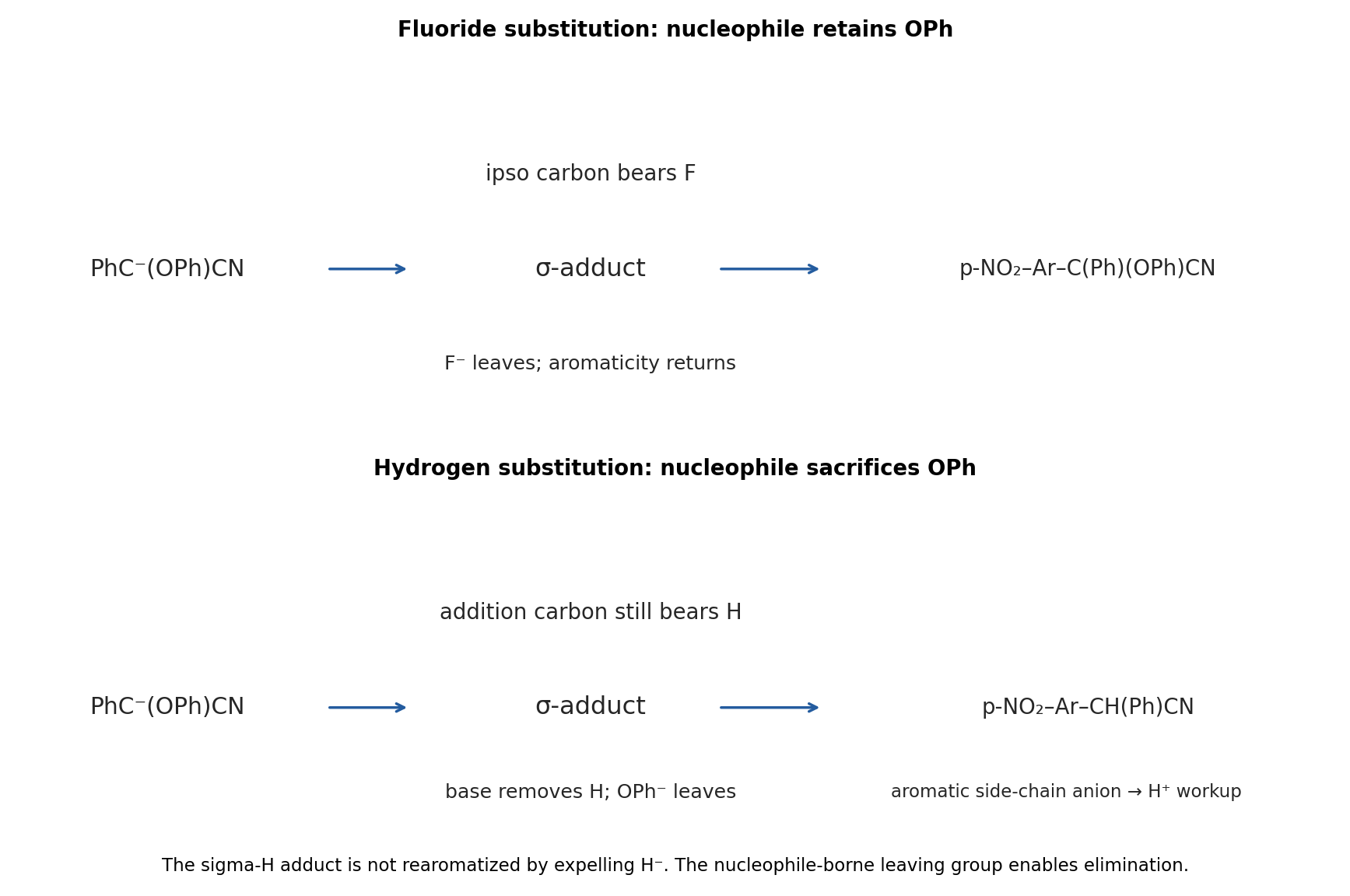
The same base first makes . This time addition occurs at a carbon bearing hydrogen para to the nitro group, giving a sigma-H adduct. The attacked carbon temporarily bears both its original H and the new carbon substituent. Negative charge is again delocalized through the ring toward the nitro oxygens.
A further base removes the hydrogen on that aromatic addition site. Its C–H electrons form an exocyclic bond toward the incoming carbon, while that carbon expels phenoxide. This is a base-induced elimination across the new ring–side-chain bond. Redistribution of the nitronate/quinoid pi system restores an aromatic ring and gives the side-chain carbanion . protonation during acidic workup yields .
This is vicarious nucleophilic substitution: the ring loses hydrogen while the nucleophile sacrifices its phenoxy leaving group. hydrogen is not expelled as hydride, and the product's side-chain hydrogen can be supplied on workup rather than moving directly from the ring in a compulsory hydride shift. Base and isotope experiments in the primary mechanistic work support reversible addition followed by base-induced elimination, while not uniquely choosing every E2/E1cb limit.[ref]
Reaction of organic anions. Part 108. On the mechanism of the vicarious nucleophilic substitution of hydrogen in nitroarenes by Mieczysław Mąkosza and Tomasz Glinka. 1983, pp. 3860–3861, isotope effects, base dependence and hydrogen/halogen competition
The displayed para product is consistent with access to the less crowded activated position.Hydroxide initially deprotonates a little thiophenol, generating the reactive thiolate . Number the extended conjugated system , where C1–C2–C3 is the ring enone and C4=C5 is the attached vinyl group. sulfur attacks the terminal delta carbon C5. The pi bonds relay toward oxygen, generating an extended enolate.
proton transfer at C4, either directly from thiophenol or through solvent-mediated enolization, gives the product retaining the conjugated ring enone. The product is 3-[2-(phenylsulfanyl)ethyl]cyclohex-2-en-1-one, drawn below. Its side chain is ; the ring C2=C3 double bond remains. This is net sulfur/hydrogen addition to the terminal part of the extended system, proceeding through 1,6-Conjugate addition and protonation of the extended enolate.
The terminal site is less crowded than the ring beta carbon, and the isolated product retains favorable carbonyl–alkene conjugation. Reversible proton transfers and conjugate addition under thiolate catalysis can favor that product over an unconjugated enone-derived alternative. Transfer of a proton from another PhSH molecule regenerates PhS, explaining why a catalytic quantity of hydroxide suffices. The net balance is one thiophenol added, ; carbonyl 1,2 addition would instead produce a different functional group and is not favored for this soft sulfur nucleophile.
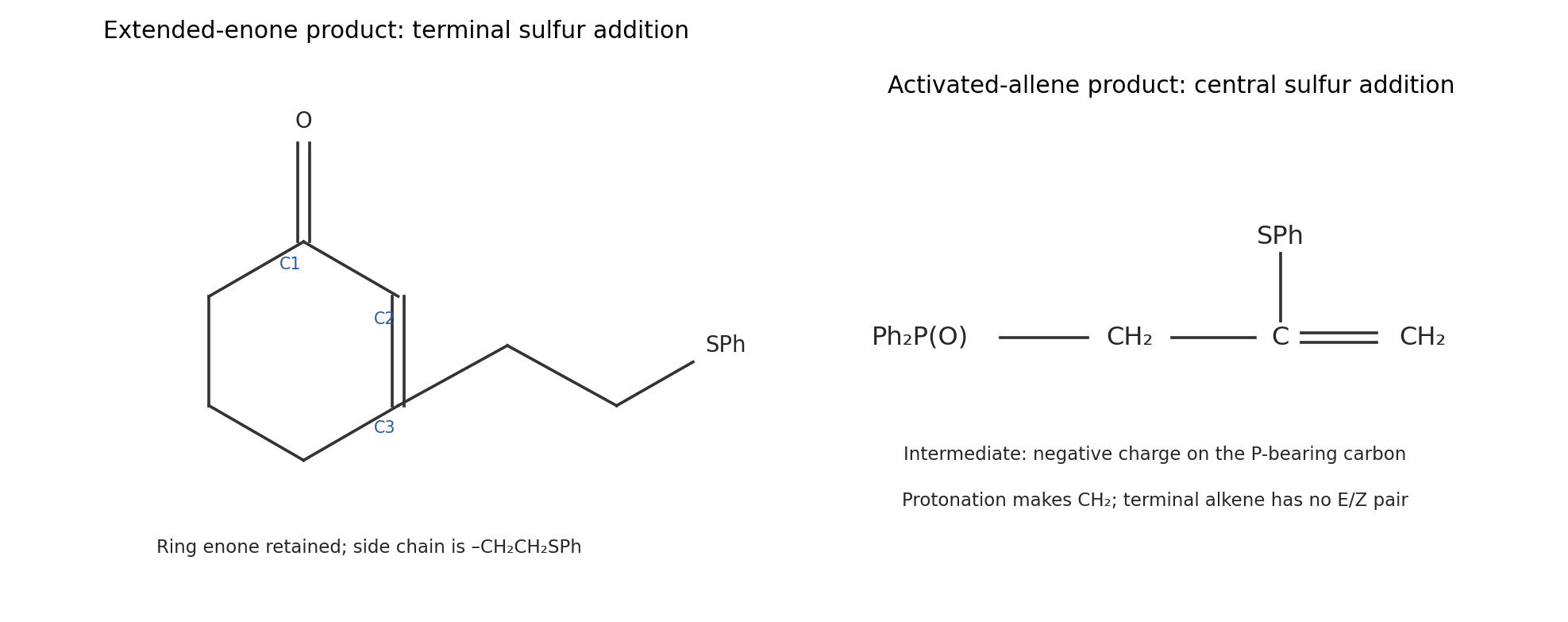


Base again generates catalytically. In , attack at the central allene carbon moves the adjacent C=C pi electrons onto the phosphorus-bearing carbon. This makes the stabilized alpha-phosphoryl carbanionprotonation at that carbon gives , the second product drawn above. The remaining double bond is terminal, so no E/Z pair is possible. The new sulfur bond is at the central carbon of the original allene, not at the terminal methylene.
This regiochemistry places the developing negative charge beside the electron-withdrawing phosphine-oxide group, instead of at a less stabilized vinylic position. It is an ionic addition/proton-transfer cycle, rather than radical thiol–ene chemistry. proton donation by another thiophenol molecule regenerates thiolate. One thiophenol is incorporated without loss of atoms, giving .
Articles by others on the same topic
There are currently no matching articles.