Hydroxide initially deprotonates a little thiophenol, generating the reactive thiolate . Number the extended conjugated system , where C1–C2–C3 is the ring enone and C4=C5 is the attached vinyl group. sulfur attacks the terminal delta carbon C5. The pi bonds relay toward oxygen, generating an extended enolate.
proton transfer at C4, either directly from thiophenol or through solvent-mediated enolization, gives the product retaining the conjugated ring enone. The product is 3-[2-(phenylsulfanyl)ethyl]cyclohex-2-en-1-one, drawn below. Its side chain is ; the ring C2=C3 double bond remains. This is net sulfur/hydrogen addition to the terminal part of the extended system, proceeding through 1,6-Conjugate addition and protonation of the extended enolate.
The terminal site is less crowded than the ring beta carbon, and the isolated product retains favorable carbonyl–alkene conjugation. Reversible proton transfers and conjugate addition under thiolate catalysis can favor that product over an unconjugated enone-derived alternative. Transfer of a proton from another PhSH molecule regenerates PhS, explaining why a catalytic quantity of hydroxide suffices. The net balance is one thiophenol added, ; carbonyl 1,2 addition would instead produce a different functional group and is not favored for this soft sulfur nucleophile.
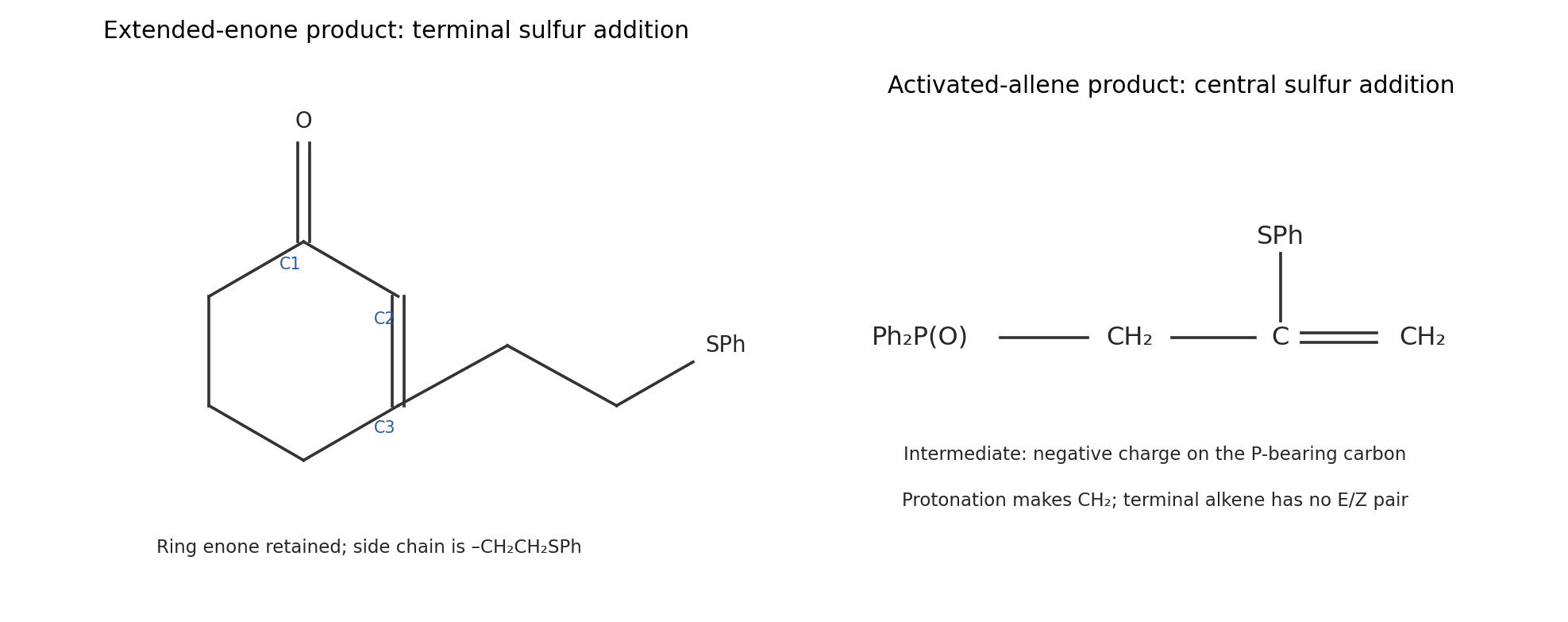

Base again generates catalytically. In , attack at the central allene carbon moves the adjacent C=C pi electrons onto the phosphorus-bearing carbon. This makes the stabilized alpha-phosphoryl carbanionprotonation at that carbon gives , the second product drawn above. The remaining double bond is terminal, so no E/Z pair is possible. The new sulfur bond is at the central carbon of the original allene, not at the terminal methylene.
This regiochemistry places the developing negative charge beside the electron-withdrawing phosphine-oxide group, instead of at a less stabilized vinylic position. It is an ionic addition/proton-transfer cycle, rather than radical thiol–ene chemistry. proton donation by another thiophenol molecule regenerates thiolate. One thiophenol is incorporated without loss of atoms, giving .
Articles by others on the same topic
There are currently no matching articles.