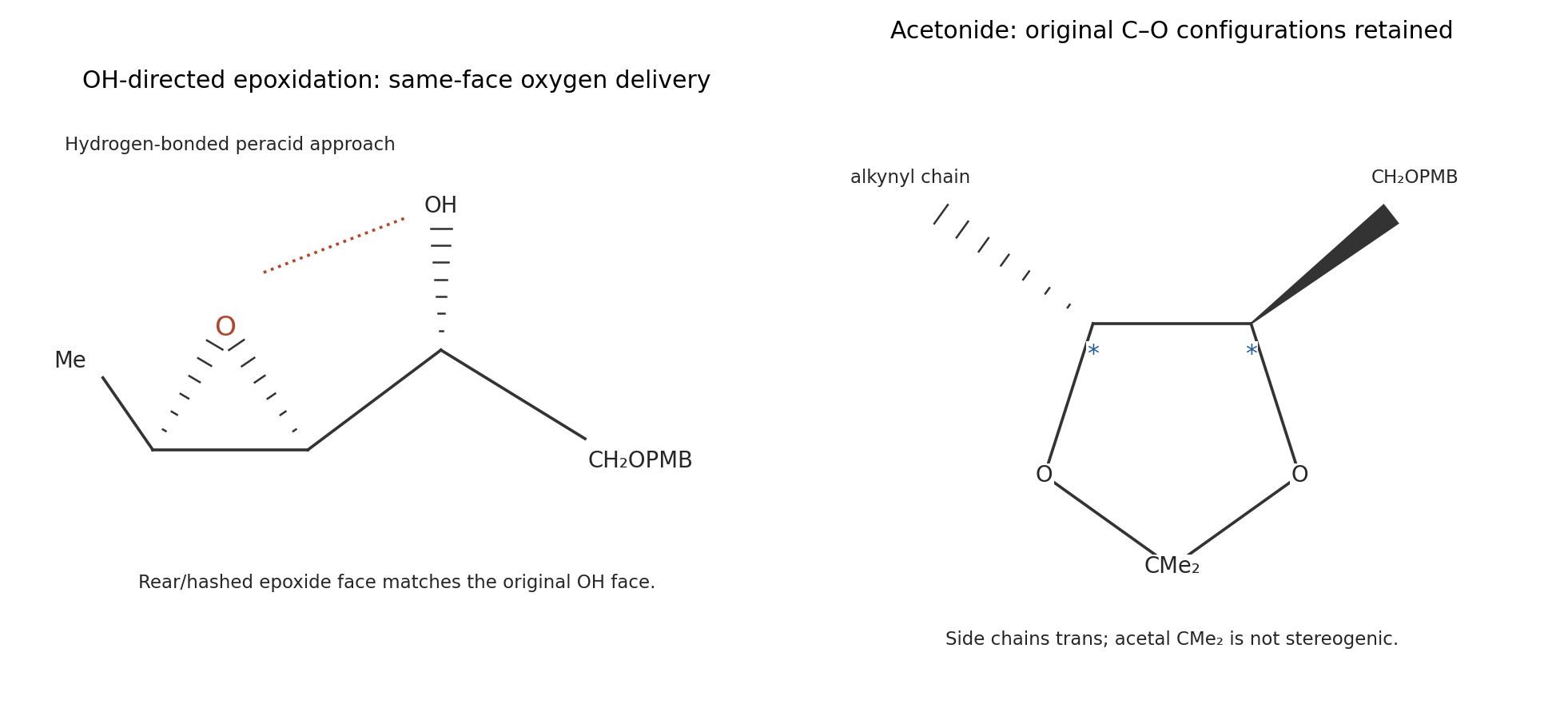
The alkene undergoes concerted oxygen transfer from the terminal peroxide oxygen of mCPBA. In the cyclic electron-flow description, the alkene pi bond begins one C–O bond, the peroxide oxygen supplies the second, O–O breaks, and proton transfer/carboxyl rearrangement gives m-chlorobenzoic acid. Both C–O bonds are installed from the same alkene face, so the alkene's relative substituent geometry is retained in the epoxide. There is no freely rotating carbocation intermediate.
The neighboring free OH hydrogen-bonds to the approaching peracid and favors a cyclic, organized transition-state geometry. oxygen is delivered from the OH-directed face, giving the indicated syn relationship between epoxide oxygen and the allylic hydroxyl. In the supplied projection, the epoxide C–O bonds and the original C–OH bond are on the rear/hashed face. Steric interactions still influence the preferred hydrogen-bonded conformer, but “attack from the least hindered face” alone misses the positive directing role of OH. The distant benzyl ether is not the directing free hydroxyl.
The classical experimental comparison of allylic alcohols and protected derivatives established this directing principle; it supports the mechanistic interpretation without itself measuring the selectivity of this acyclic substrate.[ref]

Acid protonates one methoxy group of 2,2-Dimethoxypropane. methanol departure gives the oxocarbenium species , which is captured by one diol oxygen. After proton transfer, protonation and loss of the remaining methoxy group generate a second oxocarbenium center. Intramolecular attack by the other diol oxygen closes the five-membered ring; deprotonation regenerates acid. The net transacetalization exchanges two methoxy groups for the two diol oxygens, releasing two methanol molecules.
The two starred carbon centers retain their original configurations, and the two carbon side chains on the acetonide are trans. No C–O bond at either original stereocenter is broken; reaction takes place at the reagent-derived CMe acetal carbon. The apparent change in wedge/dash presentation comes from redrawing the backbone into the five-membered ring, not inversion at a starred center. In the planar pentagon used in the diagram, draw the alkynyl-bearing side chain behind and the side chain in front. The unstarred methyl-bearing center also retains its configuration. The acetal carbon itself is not stereogenic because its two methyl substituents are identical.
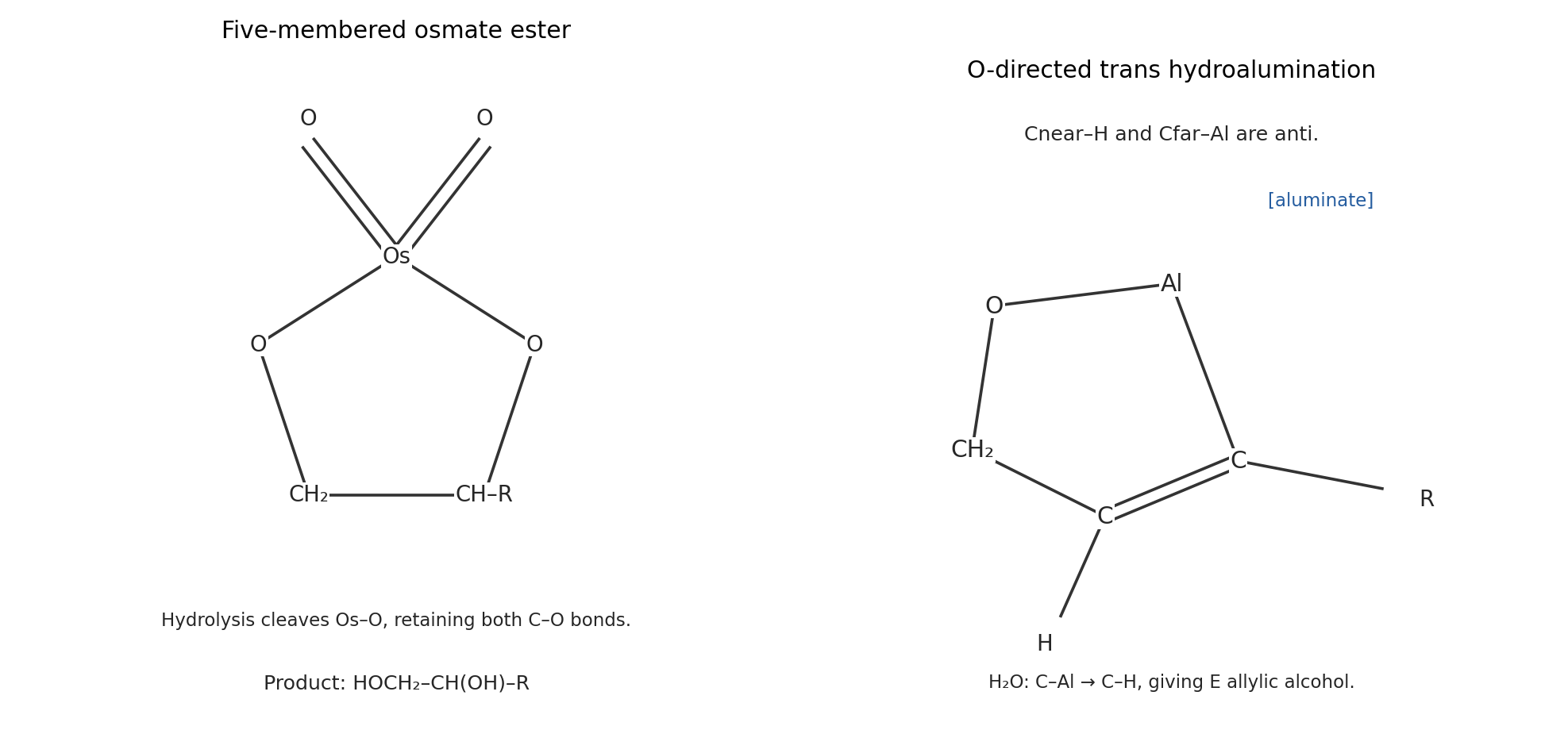
The reacting alkene pi bond and two Os=O units undergo a concerted cycloaddition to give a five-membered cyclic osmate ester. Both new carbon–oxygen bonds form on the same face. Hydrolysis and proton transfer cleave the Os–O attachments, releasing the vicinal diol and a reduced osmium-containing species.
This is syn dihydroxylation of the terminal alkene. The terminal carbon becomes , and the adjacent carbon becomes ; the remote vinyl chloride remains as drawn. The protected region denoted by is a spectator for this local mechanism. No explanation of alkene chemoselectivity is required here. Since no terminal reoxidant is specified, do not invent a catalytic regeneration step for Os(VIII); osmium reduction and product release suffice for the stated transformation.
The free propargylic OH first reacts with an aluminium hydride, releasing hydrogen and forming an O–Al bond. Coordination of the nearby alkyne to this aluminium center organizes a five-membered O–C–C–C–Al unit. Hydride addition from the opposite side of the activated alkyne gives a cyclic alkenyl aluminate: aluminium bonds to the distal alkyne carbon, while hydride is delivered to the carbon nearer .
The key step is directed trans hydroalumination. The new C–H and C–Al bonds are anti. Aqueous workup protonolyzes C–Al with retention of its alkene geometry and hydrolyzes the O–Al attachment. Replacing that C–Al bond by C–H therefore produces the E allylic alcohol, with and the rest of the chain on opposite alkene sides. A generic syn hydroalumination drawing followed by simple protonation would predict the wrong geometry.
The free OH provides the directing tether; the silyl-protected oxygen is not equivalently available. Primary electrophile-trapping studies of Red-Al-treated propargylic alcohols support the alkenyl-alanate description.[ref]
trans-Hydroalumination/Alkylation: One-Pot Synthesis of Trisubstituted Allylic Alcohols by Neil F. Langille and Timothy F. Jamison. 2006, pp. 3761–3764, trans-hydroalumination and trapping of alkenyl alanates
Cyclic intermediates in osmium dihydroxylation and directed trans hydroalumination
. Details. 
The alcohol oxygen attacks sulfur of methanesulfonic anhydride. Cleavage of the anhydride S–O bond releases methanesulfonate, and the amine base removes the O–H proton, giving the corresponding mesylate. This activation preserves the substrate C–O bond while replacing the poor hydroxide leaving group by .
The base then removes a hydrogen from the adjacent methylene on the side toward the vinyl chloride. In a favorable antiperiplanar arrangement, C–H electrons form the new C=C bond while the C–OMs bond breaks. An E2 elimination creates the alkene between the former alcohol carbon and that methylene. It links the two neighboring unsaturated regions into the extended conjugated triene segment, while the pre-existing carbon skeleton and vinyl chloride are retained.The left-hand polyenoate portion is unchanged. The base is diisopropylethylamine; it accepts acid during mesylation and promotes elimination. The product's E/Z mixture concerns the newly formed alkene, and no single geometry needs to be assigned.
Articles by others on the same topic
There are currently no matching articles.