The free propargylic OH first reacts with an aluminium hydride, releasing hydrogen and forming an O–Al bond. Coordination of the nearby alkyne to this aluminium center organizes a five-membered O–C–C–C–Al unit. Hydride addition from the opposite side of the activated alkyne gives a cyclic alkenyl aluminate: aluminium bonds to the distal alkyne carbon, while hydride is delivered to the carbon nearer .
The key step is directed trans hydroalumination. The new C–H and C–Al bonds are anti. Aqueous workup protonolyzes C–Al with retention of its alkene geometry and hydrolyzes the O–Al attachment. Replacing that C–Al bond by C–H therefore produces the E allylic alcohol, with and the rest of the chain on opposite alkene sides. A generic syn hydroalumination drawing followed by simple protonation would predict the wrong geometry.
The free OH provides the directing tether; the silyl-protected oxygen is not equivalently available. Primary electrophile-trapping studies of Red-Al-treated propargylic alcohols support the alkenyl-alanate description.[ref]
trans-Hydroalumination/Alkylation: One-Pot Synthesis of Trisubstituted Allylic Alcohols by Neil F. Langille and Timothy F. Jamison. 2006, pp. 3761–3764, trans-hydroalumination and trapping of alkenyl alanates
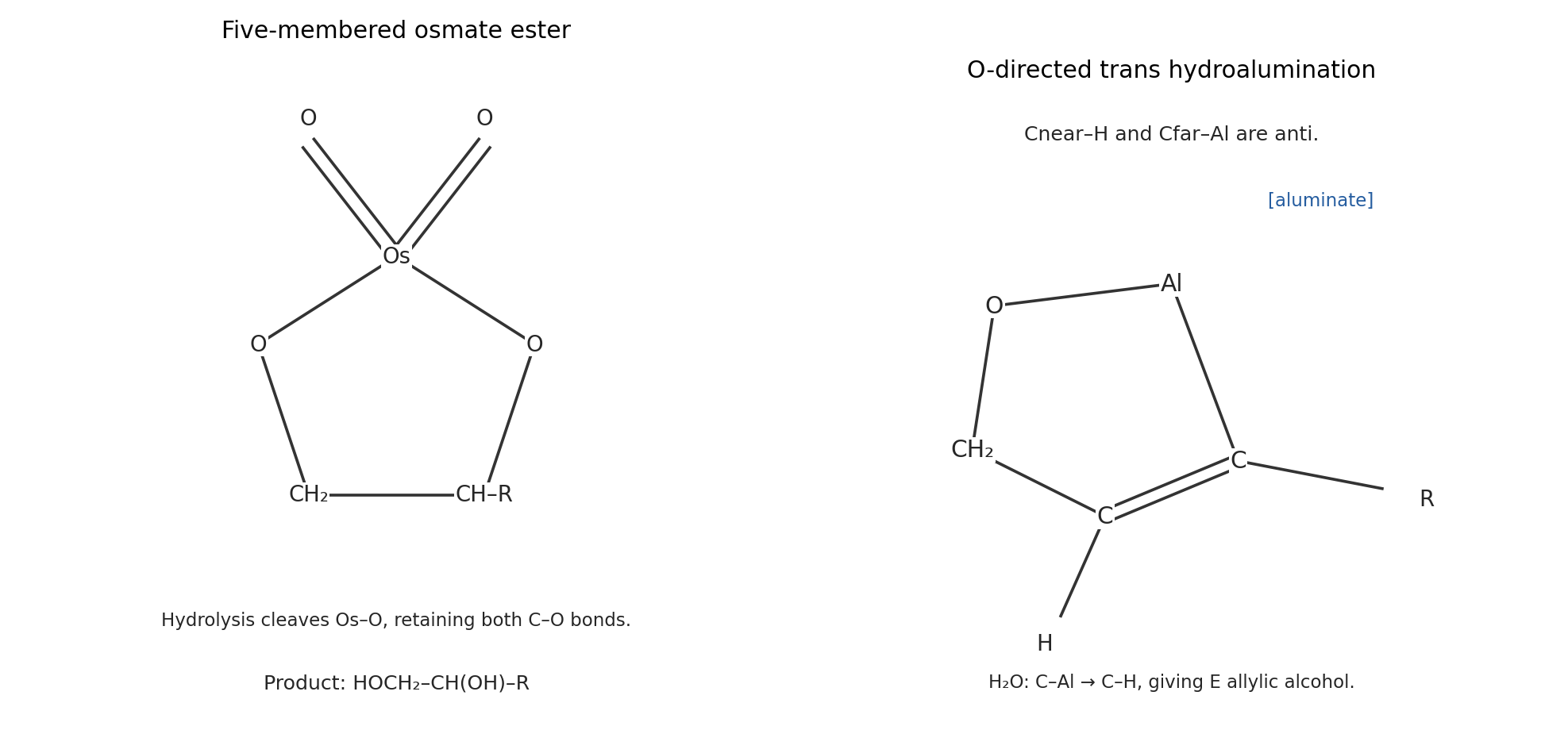
Cyclic intermediates in osmium dihydroxylation and directed trans hydroalumination
. Details. 
Articles by others on the same topic
There are currently no matching articles.