Pyrrolidine and 2-methylcyclohexanone first form an enamine, through carbonyl addition, carbinolamine formation, dehydration to an iminium ion, and alpha deprotonation. The less hindered enamine carbon is on the side opposite the methyl-bearing alpha carbon. It attacks the terminal beta carbon of methyl vinyl ketone, while the conjugated system shifts to oxygen. Protonation gives an alkylated iminium species; aqueous acid then hydrolyses it back to the ketone.
The result is a Michael addition product: the previously unsubstituted alpha carbon bears . In drawing the arrows, start the new C–C bond at the enamine carbon, not at nitrogen. The iminium bond is restored during addition and removed by hydrolysis. The sequence is an enamine-mediated conjugate addition, rather than direct addition to the methyl vinyl ketone carbonyl.
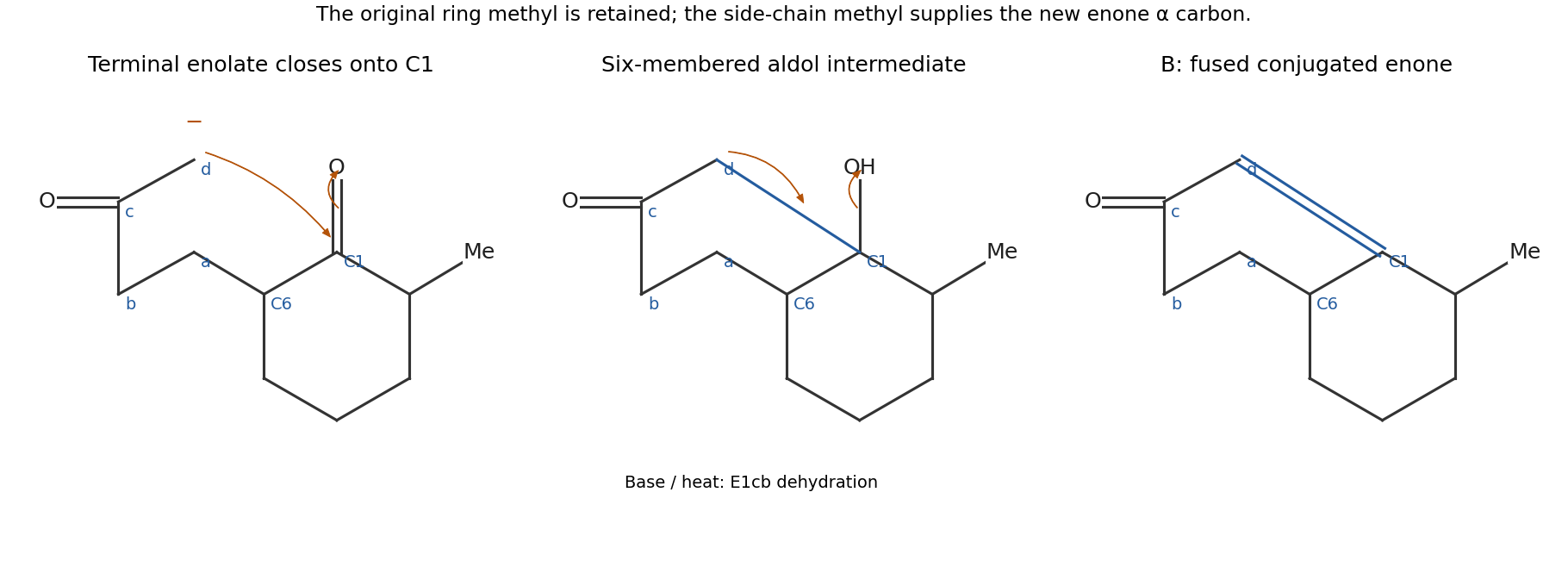
A undergoes a Robinson annulation. For an unambiguous connectivity description, call the original ring carbonyl carbon C1 and the side-chain-bearing alpha carbon C6. Label the appended chain , where d is initially methyl. Base makes the enolate at d, which attacks C1 intramolecularly to close the six-membered ring . The carbonyl electrons move to oxygen, and protonation gives the beta-hydroxy ketone.
An E1cb elimination then removes the proton on d and the hydroxy group on C1, giving the conjugated enone with C1=d and a carbonyl at c. The original ring methyl remains on the carbon next to C1 on the other side. The two rings share the C1–C6 bond. The molecular formula is consistent with loss of one water molecule from the diketone.

Articles by others on the same topic
There are currently no matching articles.