Pyrrolidine and 2-methylcyclohexanone first form an enamine, through carbonyl addition, carbinolamine formation, dehydration to an iminium ion, and alpha deprotonation. The less hindered enamine carbon is on the side opposite the methyl-bearing alpha carbon. It attacks the terminal beta carbon of methyl vinyl ketone, while the conjugated system shifts to oxygen. Protonation gives an alkylated iminium species; aqueous acid then hydrolyses it back to the ketone.
The result is a Michael addition product: the previously unsubstituted alpha carbon bears . In drawing the arrows, start the new C–C bond at the enamine carbon, not at nitrogen. The iminium bond is restored during addition and removed by hydrolysis. The sequence is an enamine-mediated conjugate addition, rather than direct addition to the methyl vinyl ketone carbonyl.
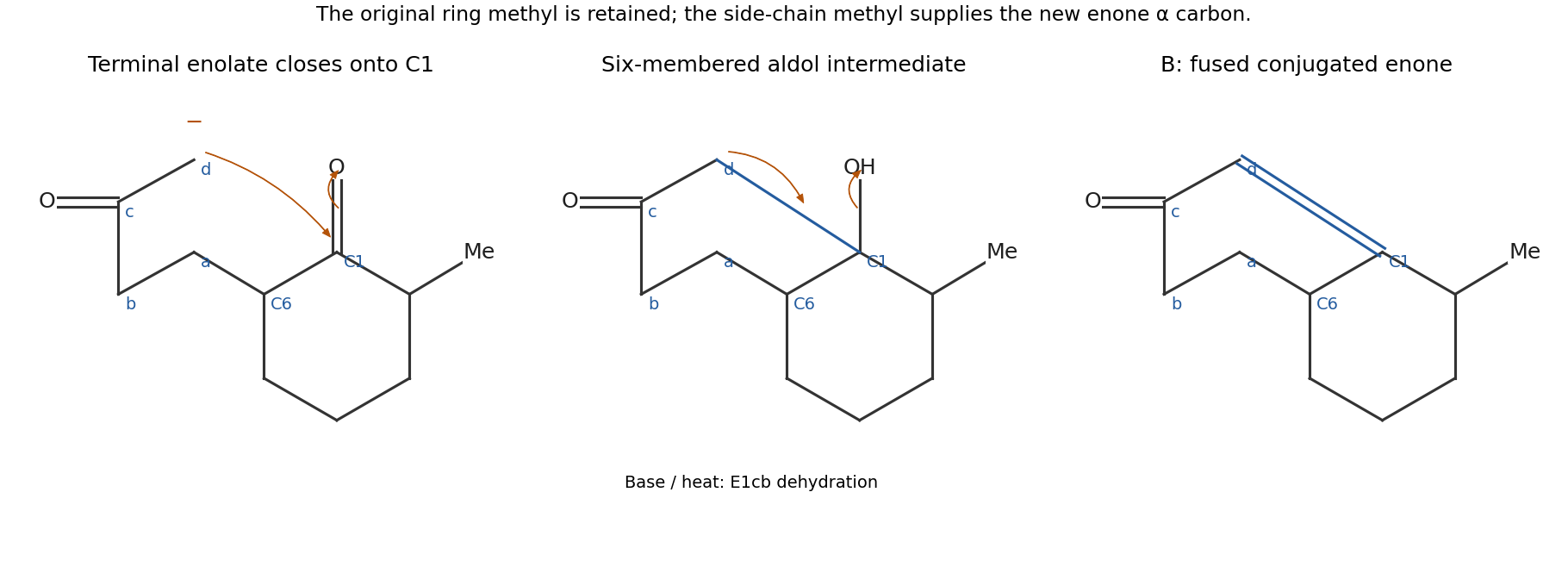
A undergoes a Robinson annulation. For an unambiguous connectivity description, call the original ring carbonyl carbon C1 and the side-chain-bearing alpha carbon C6. Label the appended chain , where d is initially methyl. Base makes the enolate at d, which attacks C1 intramolecularly to close the six-membered ring . The carbonyl electrons move to oxygen, and protonation gives the beta-hydroxy ketone.
An E1cb elimination then removes the proton on d and the hydroxy group on C1, giving the conjugated enone with C1=d and a carbonyl at c. The original ring methyl remains on the carbon next to C1 on the other side. The two rings share the C1–C6 bond. The molecular formula is consistent with loss of one water molecule from the diketone.
The aniline nitrogen attacks the ipso carbon bearing fluorine. The aromatic electrons shift to give a Meisenheimer complex, with negative charge delocalized to the positions ortho and para to the attacked carbon. At either nitro substituent, that charge can be delocalized further onto nitro oxygen. Subsequent proton transfer and fluoride elimination restore aromaticity and give the diarylamine.
Both the ortho and para nitro groups stabilize the addition intermediate in 1-fluoro-2,4-dinitrobenzene. The para-mononitro compound lacks the additional ortho stabilization, so addition is less favourable and generally slower under the stated conditions. This comparison concerns stabilization of the addition pathway; the presence of fluorine does not make the reaction an ordinary aliphatic SN2 reaction.
The qualitative nucleophilicity order is -OMe -Me H -Cl -NO, matching the product-yield order at the stated stopping time. Electron donation raises the availability of the aniline lone pair for attack. A para methoxy group donates by resonance, while methyl is a weaker donor. Chlorine withdraws inductively and gives an aniline less nucleophilic than the unsubstituted compound. A para nitro group strongly withdraws by resonance: electron flow from nitrogen through the ring into the nitro group stabilizes a charge-separated form and greatly reduces nucleophilicity.
The key arrows for the nitroaniline comparison move the nitrogen lone pair into its own aromatic ring, shift the ring bonds toward the para nitro group, and shift a nitro N=O bond toward oxygen. The methoxy donor produces the opposite electronic bias. These are finite-time yields, so they support a kinetic explanation qualitatively; they are not by themselves measured rate constants or equilibrium constants.
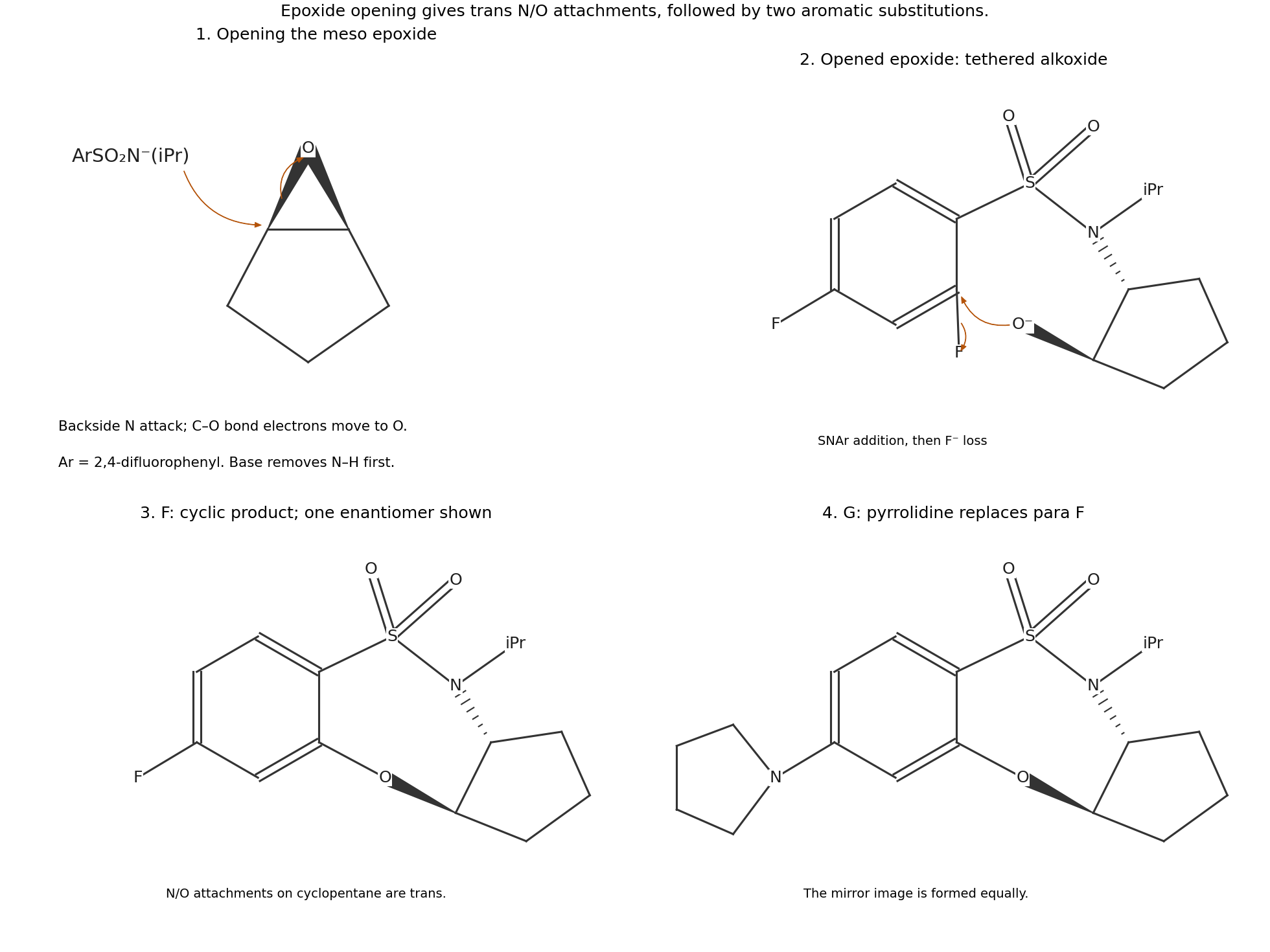
Base deprotonates the sulfonamide. Its nitrogen attacks one epoxide carbon from the back, breaking the C–O bond at that carbon and producing an adjacent alkoxide. The nitrogen and oxygen attachments on the cyclopentane are therefore trans. The alkoxide then attacks the aromatic carbon bearing the fluorine ortho to the sulfonyl group. Intramolecular nucleophilic aromatic substitution expels fluoride and closes a seven-membered heterocycle with the path . The para fluorine remains.
This tandem epoxide-opening/ring-closing pathway is required by the formula of F: simple epoxide addition would retain both fluorines, whereas F contains only one. In the second stage, pyrrolidine replaces the remaining para fluorine by another nucleophilic aromatic substitution, producing G. The mass balance is F plus pyrrolidine minus HF, as required by the given formula of G.


Articles by others on the same topic
There are currently no matching articles.