The relevant quantity is the H–C–C–H dihedral angle, through the Karplus relation, rather than the labels cis and trans alone. Couplings tend to be larger near eclipsed or antiperiplanar arrangements and smaller nearer a right angle. The observed value averages the accessible conformations.
In A, the saturated five-membered ring is puckered. A preferred envelope-like conformation can place the trans hydrogens closer to an antiperiplanar arrangement, giving a slightly larger coupling than the cis pair. In B, the double bond restricts ring geometry toward a flatter arrangement: the cis hydrogens are more nearly eclipsed, whereas the trans pair has an oblique dihedral angle. The cis coupling is then larger. Approximate Newman projections illustrate these trends; exact angles cannot be recovered from four coupling constants without a calibrated relation and conformational populations.
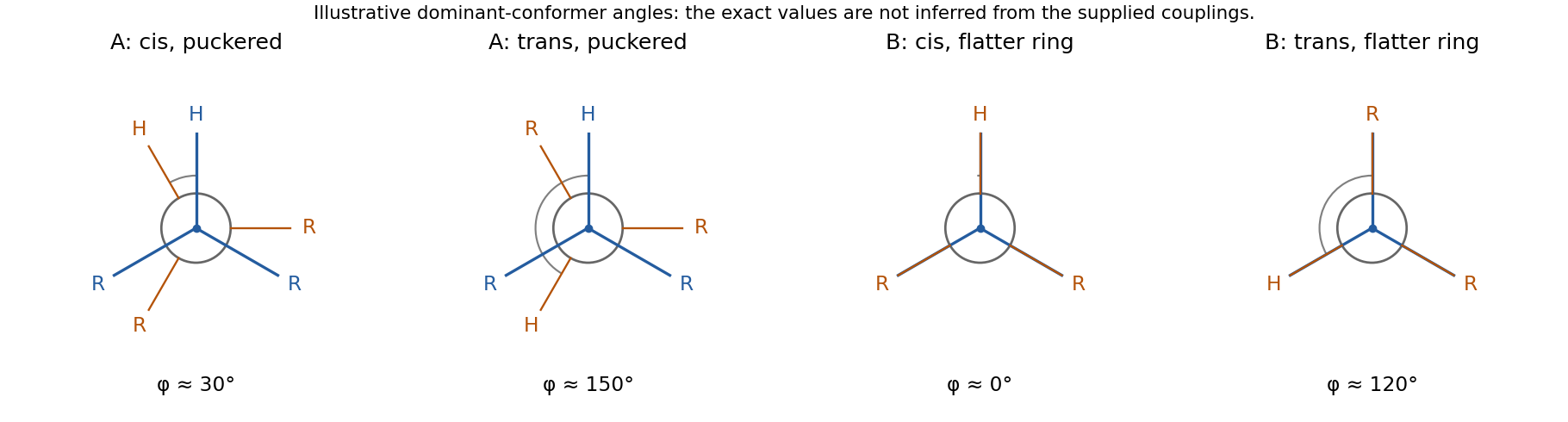
Illustrative Newman projections explaining why cis/trans coupling order depends on five-membered ring geometry
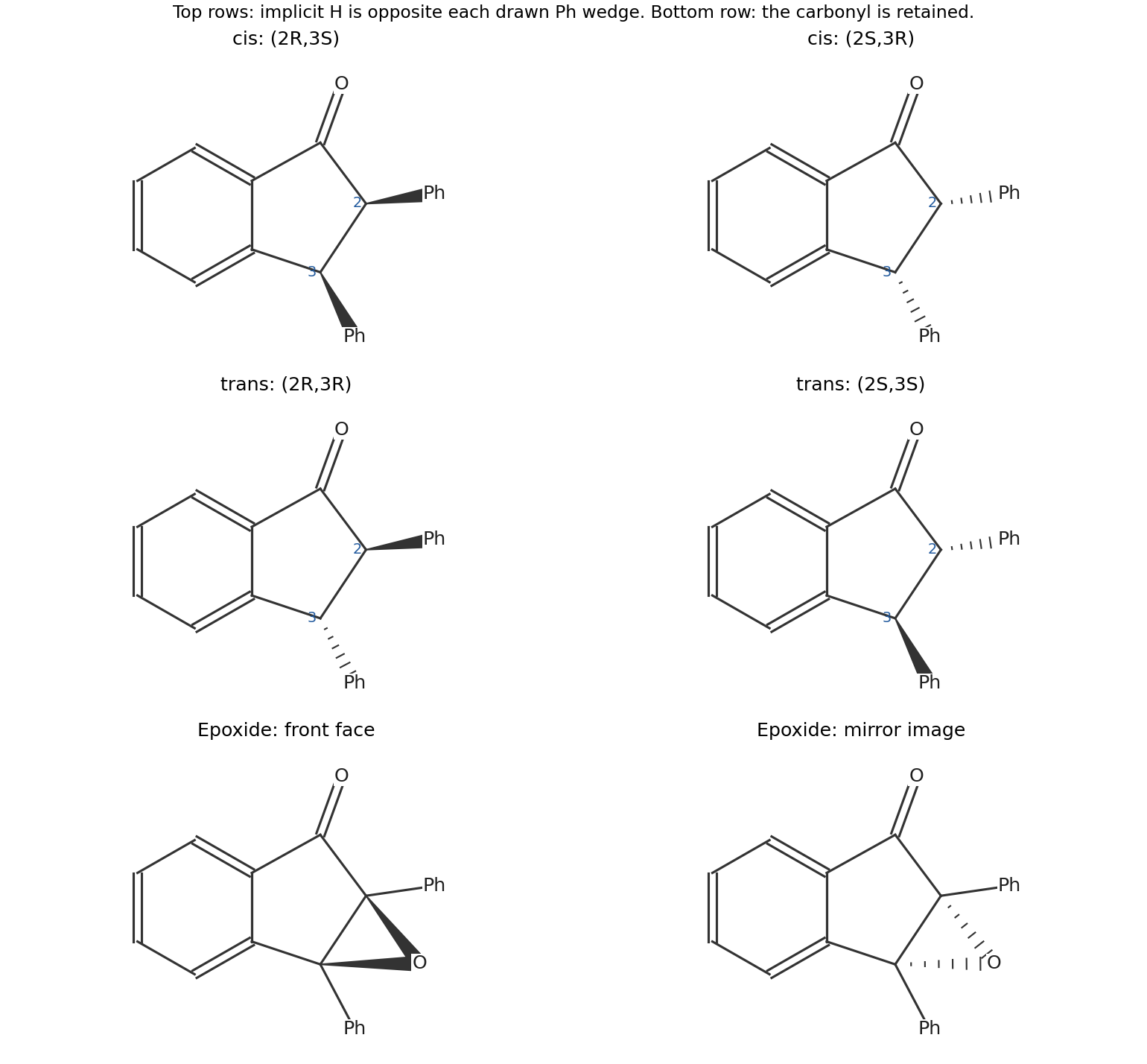
. Details. Reduction makes stereogenic centres at C2 and C3 of the indan-1-one framework. The four products are the cis pair and , and the trans pair and . Each pair consists of enantiomers; any cis member is diastereomeric to either trans member. There is no meso product because the carbonyl-containing and aromatic sides of the ring do not make C2 and C3 symmetry-equivalent.
For checking the Cahn-Ingold-Prelog priority rules, at C2 the order is carbonyl-side carbon phenyl C3 H. At C3 it is fused aromatic carbon phenyl C2 H. The fused aromatic path outranks the separate phenyl path because it reaches the carbonyl-containing part of the framework.


At 400 MHz, a separation in ppm corresponds to Hz. The two multiplets near 5.10 and 4.47 ppm each have a quoted separation of 0.02 ppm, giving Hz. The multiplets near 4.625 and 3.865 ppm each have separation 0.01 ppm, giving Hz. These are approximate values from the rounded peak labels.
The fused unsaturated/aromatic framework restricts the five-membered ring, as in the comparison in (a). Assign the larger coupling to cis and the smaller to trans. Matching equal couplings and integrals pairs the 5.10/4.47 signals with one another, and the 4.625/3.865 signals with one another. The integral ratio isWith an achiral substrate and achiral catalytic environment, each diastereomer is expected as a racemic enantiomeric pair: cis and trans . The reported spectrum requires both diastereomers; the reagent label alone cannot override that evidence. Their ratio does not establish whether the selectivity arose in the initial surface addition or after product epimerization.
Only the low-coupling pair remains, so the detected product is the trans diastereomer, with approximate coupling 4 Hz. The reaction is highly diastereoselective within the spectrum's detection limit. Its possible absolute configurations are and .
A conventional proton NMR spectrum in an achiral environment cannot distinguish those enantiomers: they have the same shifts and couplings. Thus a chiral catalyst plus one set of resonances does not establish an enantiomeric excess or an absolute configuration. Chiral chromatography, an appropriate chiral NMR method, or a calibrated stereochemical comparison would be needed.
The products are the two mirror-image 2,3-epoxy-2,3-diphenylindan-1-ones, shown in the bottom row of the stereoisomer diagram. The original carbonyl remains, and an additional oxygen bridges the former double bond, giving the stated formula.
In the Weitz-Scheffer epoxidation, hydroperoxide anion adds conjugatively to the enone. The resulting enolate closes onto the attached peroxide oxygen with O–O bond cleavage and loss of hydroxide. Attack on the two faces of the achiral planar substrate gives the two enantiomers in equal amounts. This is a racemic epoxide pair, rather than a one-to-one mixture of different diastereomeric epoxide connectivities.
Articles by others on the same topic
There are currently no matching articles.