Protonation of a spiroacetal oxygen makes the adjacent C–O bond easier to cleave. Reversible opening gives an oxocarbenium ion, in which the spiro carbon is locally planar. The tethered alcohol can attack either face; deprotonation closes the acetal and regenerates acid. Repetition interconverts the spiro epimers while retaining the other stereogenic centres. Methanol can participate in reversible proton transfer or trapping, but there is no need to invert the remote carbon centres.
The diagnostic feature is the large vicinal coupling characteristic of an axial–axial relationship in a chair. The td patterns for and contain two large couplings to neighbouring axial hydrogens, so both are axial. The ddd patterns for and also include a large ring vicinal coupling, with the smaller values reflecting the other ring hydrogen and the side chain. The assignments areThe chemical shifts alone do not determine this assignment. In particular, three unequal splittings of a methine are not a geminal-coupling pattern.
Use the upper-ring chair placing or axial. The aryl ester substituent on that carbon is then equatorial. Use a lower-ring chair placing or axial, with the attached side chain equatorial. The spiro configuration distinguishes the two structures: in A, the lower-ring oxygen bond is axial with respect to the upper ring, while the upper-ring oxygen bond is equatorial with respect to the lower ring. In B, those roles reverse.
Thus the oxygen placements at the shared spiro carbon are axial/equatorial for A and equatorial/axial for B. Side-chain conformations are unnecessary, but changing the lower chair without tracking its substituent positions would change this conclusion.
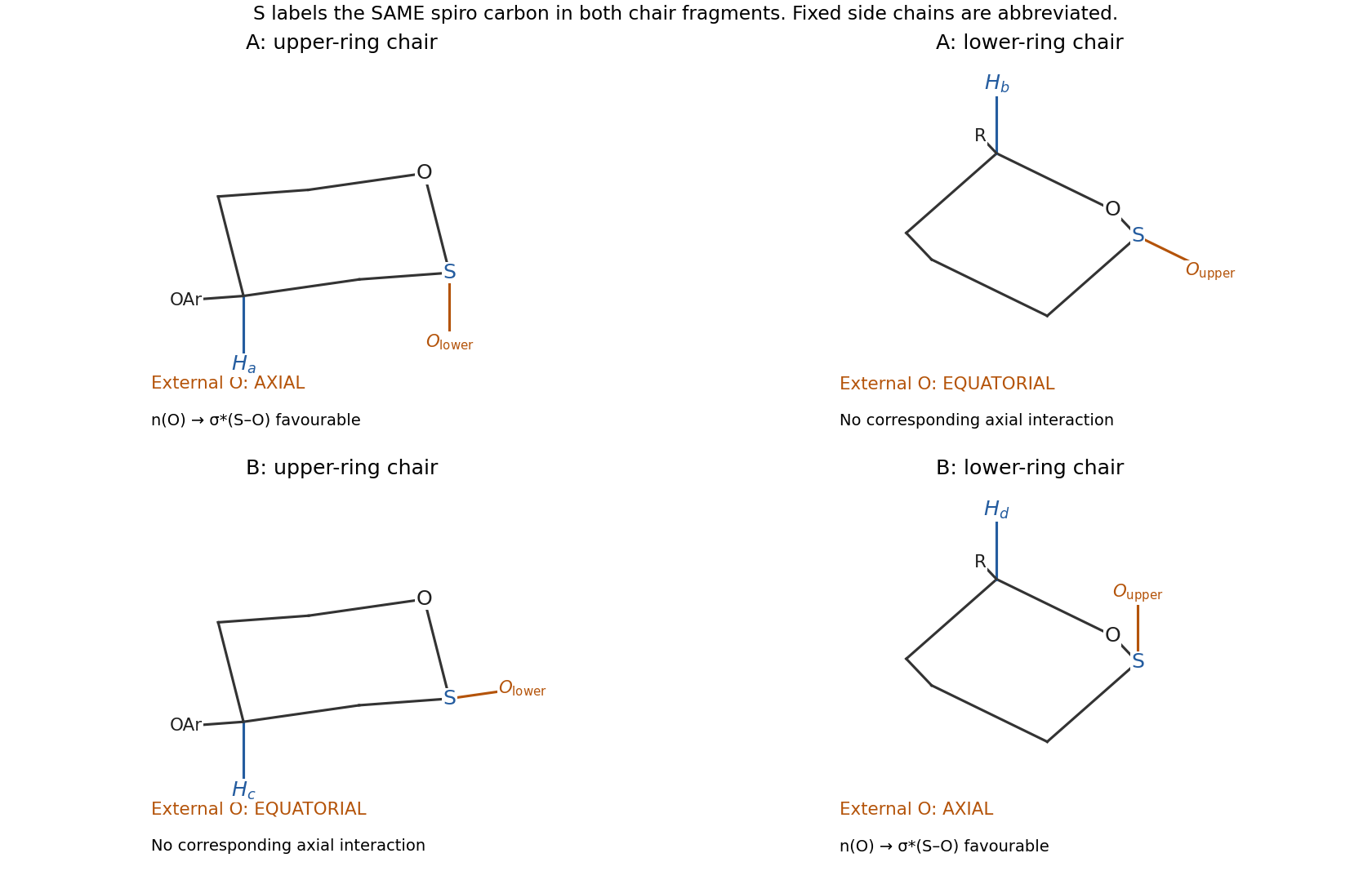
Chair assignments for the two spiroacetals: axial reporter hydrogens and one axial exocyclic oxygen in each isomer
. Details. 
The anomeric effect is the preference, in suitable cyclic acetals, for an electronegative substituent at an anomeric carbon to occupy an axial position even when simple steric reasoning favours equatorial. An important orbital contribution is donation from an endocyclic oxygen lone pair into the antibonding orbital of the adjacent exocyclic C–O bond, . The chair's axial arrangement supplies favourable antiperiplanar overlap. Electrostatic and solvation contributions can also affect the observed conformational preference.
Each isomer has one favourable anomeric interaction. A has the favourable axial exocyclic oxygen in the upper-ring chair; B has it in the lower-ring chair. The NMR-constrained conformations therefore do not provide a doubly anomeric versus non-anomeric comparison.
Both can keep important carbon substituents equatorial and each obtains one anomeric stabilization. Appreciable amounts of both are therefore a reasonable prediction, rather than a strong preference based solely on counting anomeric interactions. The environments of the two ring oxygens are not identical, so this argument does not determine an exact one-to-one equilibrium ratio; quantitative preference would require further energetic information.
Articles by others on the same topic
There are currently no matching articles.