With the forward direction defined as cis-to-trans, the elementary steps have rates and . One trans molecule is gained per forward event and lost per reverse event, soEach rate constant has units , and the right side has units of concentration per unit time. This net rate can have either sign, even though the individual event rates are nonnegative.
At chemical equilibrium, the forward and reverse event rates are equal, rather than both reactions stopping:For the dilute-solution concentration model,The ratio is dimensionless because both concentrations and both rate constants have matching units. An exact thermodynamic equilibrium constant uses activities; here the common standard concentration and ideal-solution activity coefficients cancel.
Let , which is conserved for this closed one-to-one isomerization at fixed volume. Substitute into the equilibrium ratio:ThereforeThe equilibrium split is independent of having started with pure cis, provided equilibration is complete and no side reaction changes the total concentration.
The forward and reverse pathways pass through the same transition state. Measured from the cis minimum, the forward barrier is ; measured from the trans minimum, the reverse barrier is . Since , the trans minimum lies below the cis minimum in the elementary energy-profile model:The absolute barrier heights cannot be deduced from their difference. The following original profile uses an arbitrary transition-state height and labels that distinction explicitly.
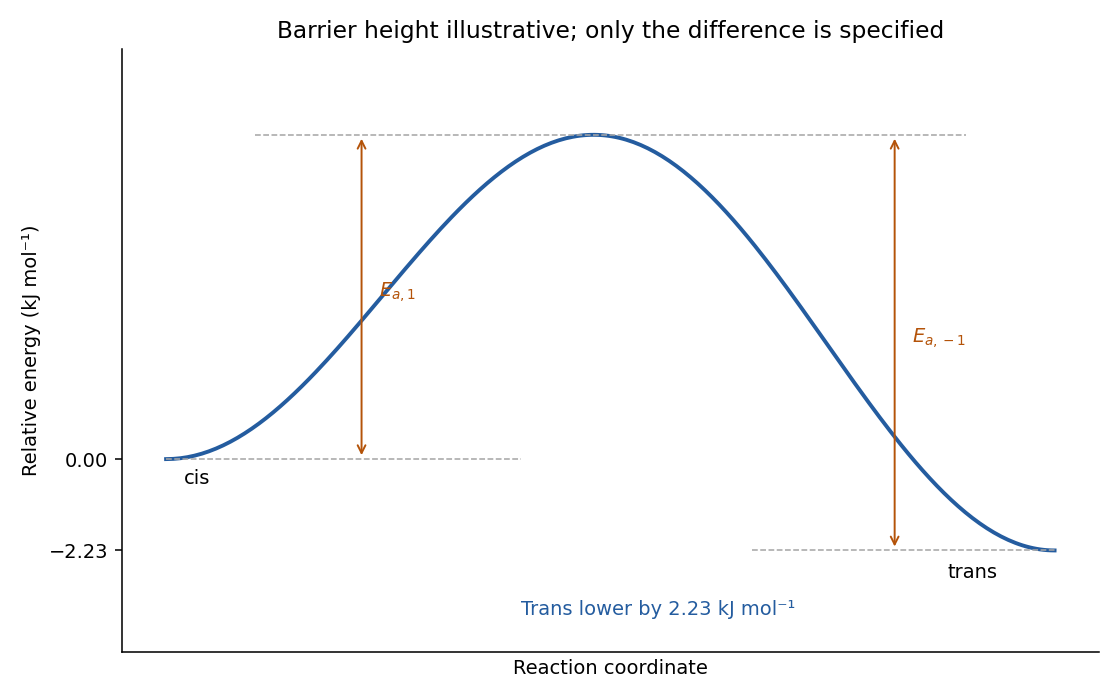
Original elementary energy profile with trans below cis and the reverse barrier larger by 2.23 kJ per mole
. Details. 
The equal Arrhenius prefactors cancel in the ratio:Hence , favouring trans, with trans fraction . The factor 1000 converting the barrier difference from kilojoules to joules is essential.
At the higher temperature the same equilibrium rate balance givesThis is a reverse first-order rate constant, not the net relaxation rate, which includes both elementary directions.
The temperature increase shifts the equilibrium towards cis. The ratio decreases from about to , so the trans fraction falls from to . Trans remains the more abundant isomer; “favours cis” describes the direction of the change, rather than requiring cis to become the majority.
Integrating the Van't Hoff equation with approximately constant reaction enthalpy givesUsing the full calculated yieldsThe negative sign agrees with the decrease of on heating. This is the two-temperature estimate from the supplied equilibrium data. It is not exactly the implied by treating equal prefactors and a fixed activation-energy difference as exact throughout the interval: that stricter model predicts rather than . The data and idealizations are therefore only approximately mutually consistent; no rounding of intermediate calculations can make both numerical enthalpy estimates identical.
Eliminate cis using :ThusBoth directions restore the perturbed distribution: an excess of trans both increases its reverse consumption and reduces cis available for forward formation. This explains why the chemical relaxation time is , rather than the reciprocal of only one rate constant.
Take the rapid temperature jump to occur at . Neglect thermal expansion as in the stated constant- model. The composition is initially unchanged, so the curve is continuous through , withIt is horizontal at the first value before the jump, then decreases exponentially towards the lower second plateau, without overshoot:The initial post-jump slope is negative, and the curve is concave upward. A discontinuous vertical step in the composition would incorrectly make a finite reaction happen instantaneously.
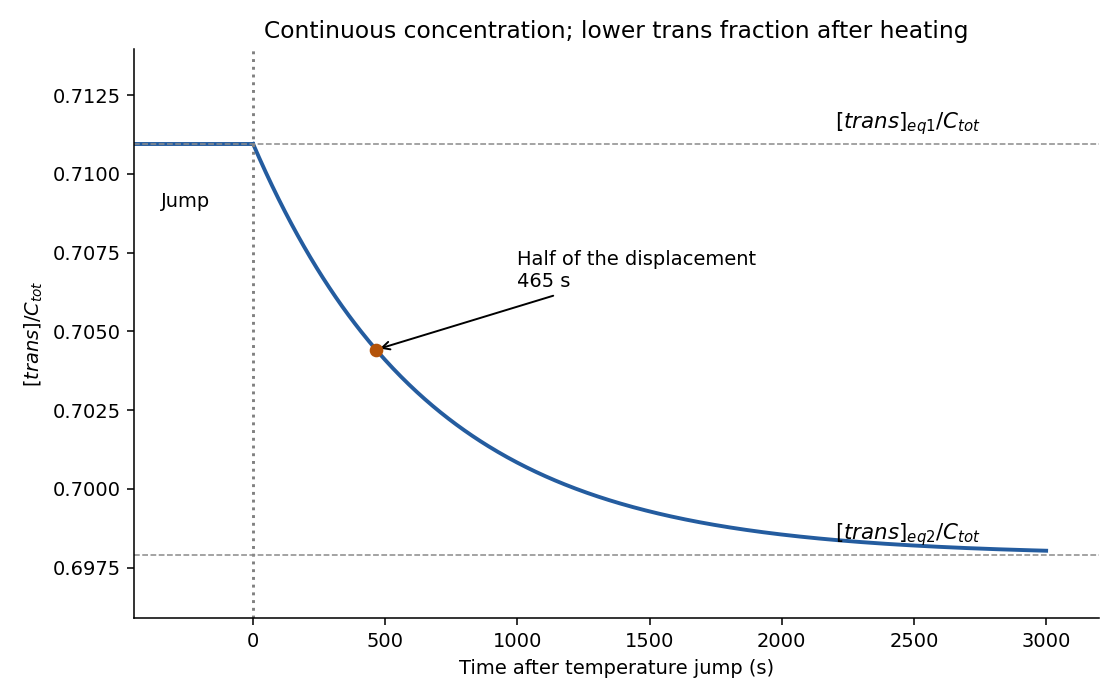
Original normalized trans-concentration relaxation curve, continuous at the temperature jump and approaching its new lower plateau
. Details. 
Subtract the new equilibrium concentration and divide by the initial displacement:At the halfway concentration this ratio is , soThis is the half-time of the displacement from equilibrium. It is not the time for the absolute trans concentration to fall to half its initial value; that value lies far below the attainable new equilibrium plateau. The corresponding chemical relaxation time is s.
Articles by others on the same topic
There are currently no matching articles.