
An ideal solution is a chemical solution whose component chemical potentials depend on composition throughHere is an amount of substance, its mole fraction, the molar gas constant, and the pure-component liquid reference at the same temperature and pressure . This model applies to every component across the composition range; it is stronger than an approximation valid only near a pure solvent.[ref]
With this pure-liquid standard state convention, the thermodynamic activity satisfies , so an ideal solution has , or activity coefficient .[ref]
ideal mixture. IUPAC Compendium of Chemical Terminology, fifth edition (Gold Book) by International Union of Pure and Applied Chemistry; Ideal mixture, definition: activities equal mole fractions, equivalently unit activity coefficients; I02938, online version 5.0.0
This statement concerns the liquid. Assuming that a coexisting vapor is an ideal gas mixture is an additional approximation. Its mole fractions generally differ from the liquid mole fractions .For an original two-component example, stipulate and pure-component vapor pressures and . A and B are invented distinguishable components; these numbers are chosen model inputs, not material data. Combine an ideal solution with an ideal gas vapor, neglect the pure-liquid reference's pressure correction, and exclude other gases. At liquid mole fractions and , Raoult's law and addition of partial pressures giveThus the coexisting vapor contains about A by amount of substance, although the liquid contains only . The total pressure is neither pure-component vapor pressure, and cannot be substituted for . This enrichment is the basis of distillation.
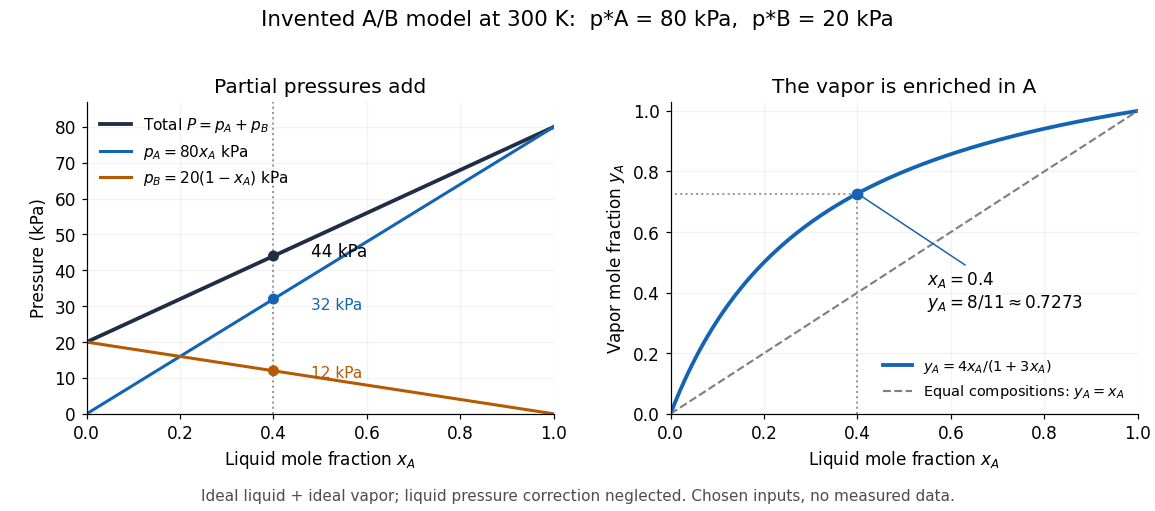
The usefulness of the ideal solution is that one composition law connects chemical potentials, vapor-liquid equilibrium, entropy of mixing and Gibbs free energy of mixing. Its liquid components can interact strongly: the defining condition is their composition dependence, rather than the absence of all interactions as in an ideal gas model.


An ideal solution is a theoretical concept in chemistry, particularly in the study of solutions, where the solute and solvent do not interact in a way that alters their individual properties. In an ideal solution, the following characteristics are observed: 1. **Raoult's Law**: The vapor pressure of each component in the solution is directly proportional to its mole fraction. This means that the total vapor pressure of the solution can be calculated as the sum of the partial pressures of each component.
New to topics? Read the docs here!