The four terminal methyl groups form ordinary Al–C sigma bonds, with formal bond order one. Each of the two bridging methyl carbons connects the two aluminium centres through a three-centre two-electron bond. One occupied bonding combination extends over Al–C–Al; the other combinations are unoccupied in the simple electron-deficient bridge model. A single shared pair therefore supplies one bond in total across the two contacts, giving formal Al–C bridge bond order per contact, compared with one for terminal Al–C.
Each aluminium has approximately tetrahedral, -like orbital directions. A terminal methyl carbon uses -like orbitals for its three C–H bonds and its Al–C bond. A bridging methyl carbon still uses three directed orbitals for C–H bonding, while its remaining approximately hybrid overlaps with orbitals on both aluminium atoms. This shared bridge avoids placing five independent ordinary two-electron bonds around carbon. The hybrid labels are idealized and the bridge geometry is distorted; the four occupied C–H/bridge orbital directions are not equivalent to five localized carbon bonds.
The total valence count provides a useful check: electrons. Eighteen C–H bonds use 36, four terminal Al–C bonds use eight, and two three-centre bridges use four. A description assigning a full two-electron bond to each of the four bridging contacts would require too many electrons.
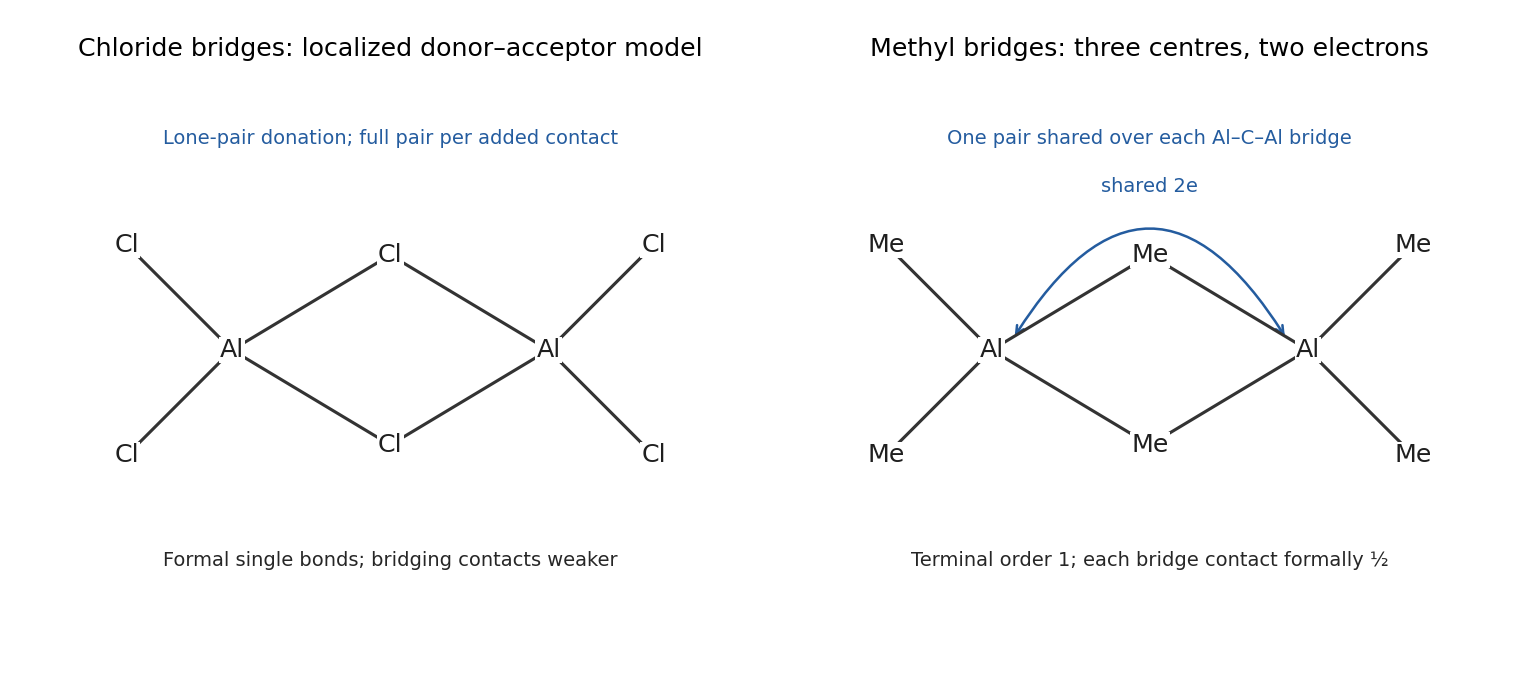
Original comparison of chloride lone-pair bridges and electron-deficient methyl bridges, with their different electron accounting
. Details. 
At low temperature the four terminal methyl groups contain 12 equivalent protons and the two bridging methyls contain six, giving the pair of singlets. On warming, terminal and bridging positions interchange rapidly on the NMR timescale. A methyl group then samples both environments during the observation, producing a single population-weighted resonance, . This Chemical exchange in NMR is not merely faster rotation of each methyl about its own Al–C direction, which cannot turn a terminal site into a bridge.
The concentration independence argues against a rate-limiting collision between two intact dimers. An intramolecular bridge-opening and reclosing rearrangement can exchange which methyls are bridges; a unimolecular dissociation followed by rapid reassociation is another mechanism whose observed rate could be concentration independent. The spectra establish rapid site exchange, but not a unique elementary exchange pathway. A variable-temperature line-shape analysis or exchange experiment would be needed to distinguish detailed mechanisms. Primary organoaluminium studies describe the same low-temperature resolution and warm-temperature averaging, while considering dimer dissociation.[ref]
Organoaluminium compounds. XIII. Association through aryl and phenylethynyl bridges by E. A. Jeffery and others. 1968, printed p. 137, introduction: separate methyl environments and temperature-induced averaging
Articles by others on the same topic
There are currently no matching articles.