In molecular boron trichloride, boron uses three approximately hybrids to form three equivalent B–Cl sigma bonds in a trigonal plane. Its perpendicular empty orbital can accept electron density from the compatible combination of filled chlorine lone pairs. The resulting pi donation is delocalized over the three B–Cl connections.
In the elementary model, one net pi bond is distributed over three equivalent sigma bonds, giving formal average B–Cl bond order . The corresponding resonance contributors each put a B=Cl connection in a different position, with formal negative boron and positive donating chlorine. They do not mean one experimentally distinct double bond and two single bonds. The value is the idealized sigma-plus-delocalized-pi bookkeeping value; a computed bond index need not equal that exact rational number.
The dimer has four terminal chlorides and two bridging chloride ligands. Each aluminium is approximately tetrahedrally surrounded by two terminal and two bridging chlorines. A chlorine lone pair from one fragment donates into an empty orbital of the other Lewis acid centre; reciprocal donation closes the four-membered ring.
The localized coordinate covalent bond model has single Al–Cl bonds, formal bond order one, for both terminal and bridging connections. Donation describes the origin of a pair, not half an electron-pair bond. A bridge chlorine has two bonded pairs and two remaining lone pairs in this all-single-bond Lewis accounting; the original terminal chlorines have three lone pairs. Bridging contacts are longer and weaker than terminal ones, so equal formal order does not imply equal strength or equal numerical quantum-chemical bond indices. In particular, these chloride bridges should not be assigned the electron-deficient methyl-bridge half-bonds of (b).
Dimerization lowers enthalpy by letting the coordinatively unsaturated aluminium centres accept chlorine lone-pair donation. Effective intramolecular Cl-to-Al pi stabilization of the monomer is relatively weak, while aluminium's larger size accommodates four-coordinate geometry and two chloride bridges. At room temperature this bonding gain can outweigh the entropy penalty of associating two molecules.
In boron trichloride, the compact short B–Cl framework supports appreciable ligand-to-boron pi donation, stabilizing the planar monomer. Its smaller boron centre also makes the crowded four-coordinate bridged arrangement less favourable. Thus dimerization must be assessed from the balance of monomer stabilization, bridge-bond formation, structural strain and entropy; merely counting six electrons around each monomeric centre would incorrectly predict identical association for both. orbital overlap depends on radial extent, bond length and energy matching, not just whether two orbitals share the same principal quantum number.
Heating increases the monomer fraction through . Dissociation breaks the bridge interactions and gains translational entropy by making two gas molecules from one. Its enthalpy cost becomes easier to offset at higher temperature. The qualitative statement concerns the molecular gas-phase equilibrium at the stated conditions, rather than every solid or liquid phase of aluminium chloride.
The four terminal methyl groups form ordinary Al–C sigma bonds, with formal bond order one. Each of the two bridging methyl carbons connects the two aluminium centres through a three-centre two-electron bond. One occupied bonding combination extends over Al–C–Al; the other combinations are unoccupied in the simple electron-deficient bridge model. A single shared pair therefore supplies one bond in total across the two contacts, giving formal Al–C bridge bond order per contact, compared with one for terminal Al–C.
Each aluminium has approximately tetrahedral, -like orbital directions. A terminal methyl carbon uses -like orbitals for its three C–H bonds and its Al–C bond. A bridging methyl carbon still uses three directed orbitals for C–H bonding, while its remaining approximately hybrid overlaps with orbitals on both aluminium atoms. This shared bridge avoids placing five independent ordinary two-electron bonds around carbon. The hybrid labels are idealized and the bridge geometry is distorted; the four occupied C–H/bridge orbital directions are not equivalent to five localized carbon bonds.
The total valence count provides a useful check: electrons. Eighteen C–H bonds use 36, four terminal Al–C bonds use eight, and two three-centre bridges use four. A description assigning a full two-electron bond to each of the four bridging contacts would require too many electrons.
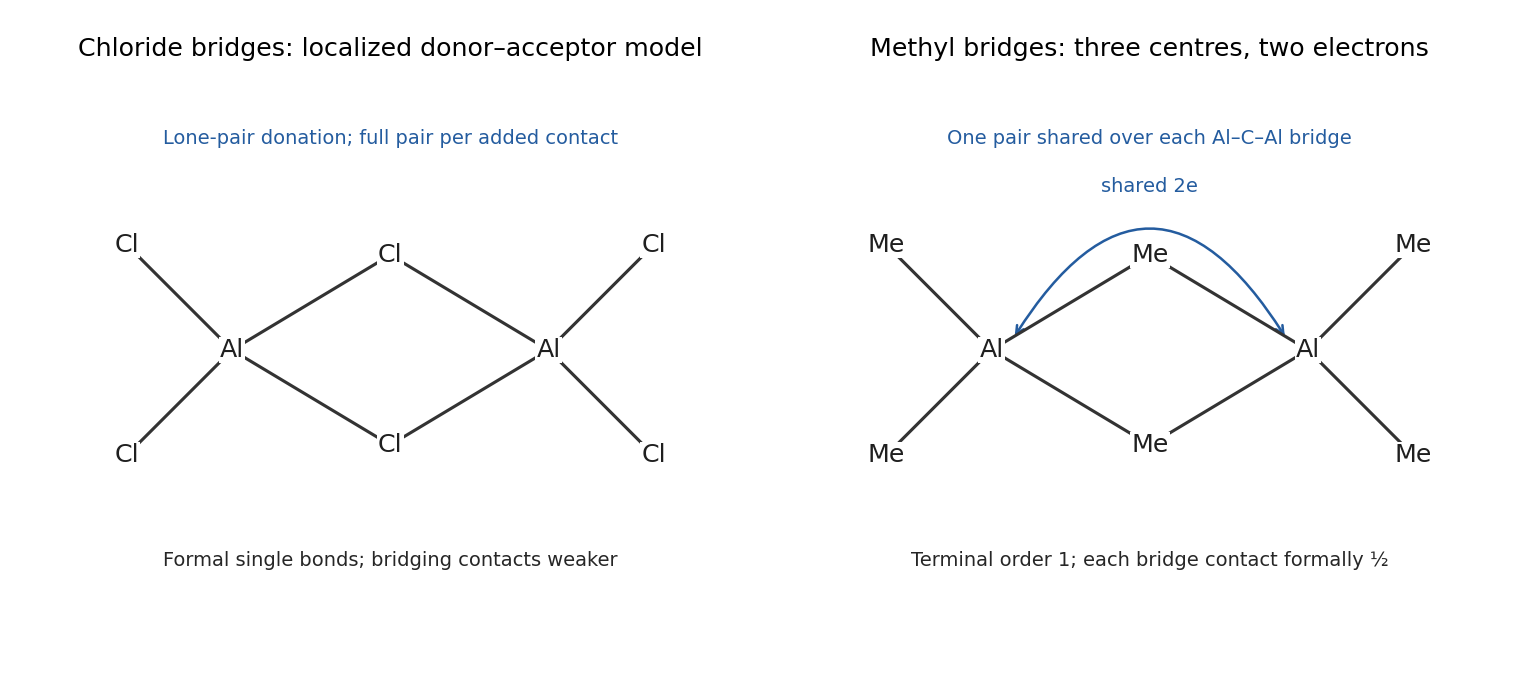
Original comparison of chloride lone-pair bridges and electron-deficient methyl bridges, with their different electron accounting
. Details. 
At low temperature the four terminal methyl groups contain 12 equivalent protons and the two bridging methyls contain six, giving the pair of singlets. On warming, terminal and bridging positions interchange rapidly on the NMR timescale. A methyl group then samples both environments during the observation, producing a single population-weighted resonance, . This Chemical exchange in NMR is not merely faster rotation of each methyl about its own Al–C direction, which cannot turn a terminal site into a bridge.
The concentration independence argues against a rate-limiting collision between two intact dimers. An intramolecular bridge-opening and reclosing rearrangement can exchange which methyls are bridges; a unimolecular dissociation followed by rapid reassociation is another mechanism whose observed rate could be concentration independent. The spectra establish rapid site exchange, but not a unique elementary exchange pathway. A variable-temperature line-shape analysis or exchange experiment would be needed to distinguish detailed mechanisms. Primary organoaluminium studies describe the same low-temperature resolution and warm-temperature averaging, while considering dimer dissociation.[ref]
Organoaluminium compounds. XIII. Association through aryl and phenylethynyl bridges by E. A. Jeffery and others. 1968, printed p. 137, introduction: separate methyl environments and temperature-induced averaging
The simplest assignment is two phenylethynyl bridges and four equivalent terminal methyl groups, represented as . All 12 methyl protons then occupy the same class of environment, accounting for the single nonaromatic singlet without requiring methyl bridge/terminal averaging. The phenyl protons account for the aromatic-region signals; the metal-bound acetylide has no terminal acetylenic hydrogen.
An alkynyl bridge has electronic possibilities unavailable to a saturated methyl: in addition to sigma attachment from its carbon end to one Lewis acid centre, its occupied C≡C pi system can donate to the other aluminium. A delocalized sigma/pi description stabilizes the phenylethynyl-bridged arrangement while keeping the methyl groups terminal. One must not draw an unchanged localized triple bond plus two independent full ordinary Al–C bonds at the same carbon and count all of them as separate two-electron bonds. The exact distribution of sigma and pi donation requires structural or orbital evidence; this NMR observation alone does not supply a numerical bridge bond order.
The absence of concentration or temperature dependence is consistent with this preferred arrangement throughout the measured range. It is not proof that the molecule has no motion: exchange between symmetry-equivalent terminal positions, or exchange remaining fast throughout that range, could be spectroscopically invisible. Phenylethynyl bridging in this particular dimethylaluminium dimer has independent primary NMR precedent.[ref]
Organoaluminium compounds. XIII. Association through aryl and phenylethynyl bridges by E. A. Jeffery and others. 1968, printed p. 137, summary: phenylethynyl groups bridge dimethyl(phenylethynyl)aluminium dimers
Articles by others on the same topic
There are currently no matching articles.