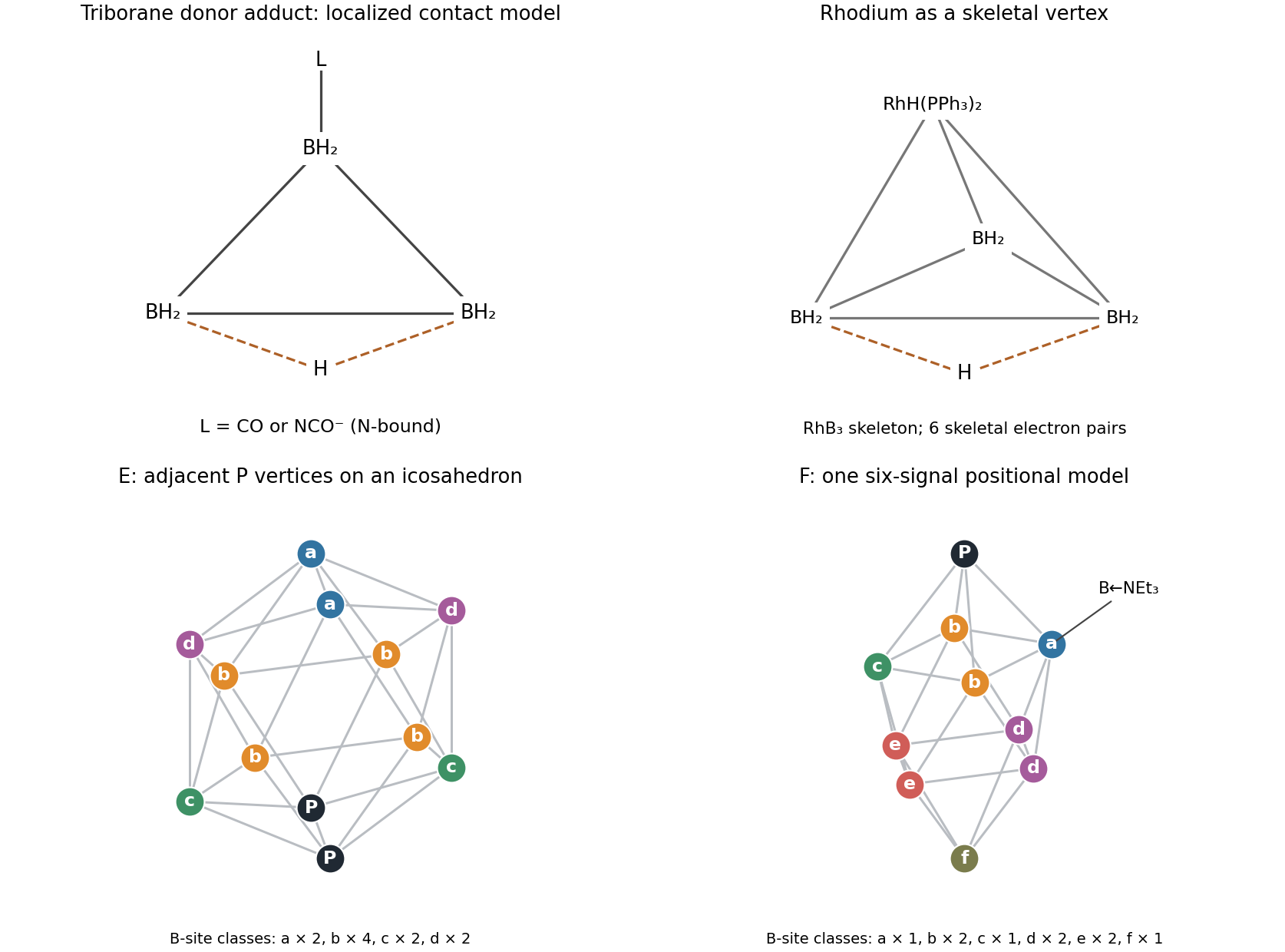
For the CO and NCO cases, the added fragment acts as a Lewis base at boron, rather than becoming a new skeletal vertex. Both have a triangular framework. A useful localized drawing has three groups, one B–H–B bridge between two of them, and the donor attached to the third boron. The boron–boron framework includes three-centre two-electron bonds; its edges should not all be read as ordinary independent two-electron single bonds.
For the neutral carbonyl adduct, attach CO through carbon, giving at the donor-bearing site. For the anionic isocyanate adduct, attach through nitrogen, giving a B–N=C=O connectivity and the overall charge. In both drawings the hydrogen count is . Weak or asymmetric additional B–H contacts can distort this idealized drawing; a hydrogen-rich borane is not fully characterized by a polygon alone. The carbonyl triborane structure was established in the original borane study.[ref]
Boranes. XXXVII. Reactions of triborane(7) and the structure of triborane(7) carbonyl by James D. Glore and others. 1973, pp.2175–2178, structural assignment of the carbonyl adduct
The rhodium fragment is instead a skeletal building block. Its neutral electron count is , so it contributes two skeletal electrons, like a BH vertex. Combining it with gives skeletal electrons, or six pairs, for four vertices. A consistent low-vertex structure is a tetrahedral skeleton, with the fragment capping the boron triangle. Keep the terminal Rh–H ligand distinct from the seven hydrogens on the borane portion. The latter can again be represented by three terminal groups and a B–H–B bridge. The total formula then contains eight hydrogens outside the phenyl groups. Treating Rh as a pendant one-centre Lewis base would miss its skeletal role.
Neutral counting assigns five electrons to cyclopentadienyl ligand and two to CO. Thus each fragment has valence electrons and contributes three skeletal electrons; each fragment has sixteen and contributes four:For A the six-pair four-vertex count is the nido count derived from a five-vertex trigonal bipyramid. Removing an axial vertex leaves a tetrahedron: the three equatorial vertices plus the remaining axial vertex. For B the corresponding arachno fragment is obtained by removing both axial vertices from that same parent, leaving a three-metal triangle. Small clusters require specifying the parent and removed vertices; mechanically calling every nido fragment a square pyramid is wrong.
The Fe tetramer is indeed known to have a tetrahedral core, with four face-capping CO groups. The carbon atoms of those carbonyls and the iron atoms form interpenetrating tetrahedra, giving a cubane-like Fe–C connectivity. Bridging rather than terminal CO changes the distribution of local donation, not the total electron count above.[ref]
Structural Characterization of the Cyclopentadienyliron Carbonyl Tetramer, Fe4(eta5-C5H5)4(CO)4. A Cubane-Type Structure Containing a Completely Bonding Tetrametal Cluster Unit by Melvin A. Neuman and others. 1972, pp.3383–3388, tetrahedral iron core and face-capping carbonyls
For a neutral borane with one terminal B–H bond assigned to each vertex, the skeletal electron number is ; an overall charge adds electrons. Suitable twelve-electron correspondences areFor C, four BH contributions plus four additional hydrogens give electrons. For D, three BH contributions plus five additional hydrogens and the negative charge give . They map to the tetrahedral and triangular low-vertex skeletons respectively. The neutral formal alternative for D is , also with twelve skeletal electrons.
The electron counting correspondence alone must not be read as evidence that the neutral boranes are isolable stable bulk materials. Low-vertex hydrogen-rich boranes can be transient; the triangular octahydrotriborate anion is the established practical three-boron example, whereas neutral is a formal analogy rather than an equally established preparative product. The requested skeletal correspondence should be distinguished from a claim about comparable stability or isolation conditions.[ref]
Reactions of the octahydrotriborate(1-) anion, B3H8-, with some complexes of cobalt(I), cobalt(II), rhodium(I), and iridium(I), and the characterization of the borallyl complex IrIII(eta3-B3H7)(CO)H(PPh3)2 by Norman N. Greenwood and others. 1980, pp.196–200, reactions of the preparatively accessible octahydrotriborate anion
For E, each BH supplies two skeletal electrons and each phosphorus vertex supplies three after retaining a lone pair. Hence electrons, or thirteen pairs, matching a twelve-vertex closo cluster. Place the two adjacent P vertices on a regular icosahedron. The remaining ten boron vertices fall into four symmetry classes: two sites adjacent to both P vertices, four adjacent to exactly one, two adjacent to neither but opposite the common-neighbour pair, and two opposite the P pair. The populations are , so four boron resonances are expected. Interchanging the identical phosphorus vertices is allowed when determining chemical equivalence.
For F, a ten-vertex bicapped square antiprism offers a consistent closo model. There are eight BH vertices, one B vertex bearing the donor instead of H, and one P vertex. Their skeletal contributions are respectively , and , giving 22 electrons, eleven pairs. The donor-bearing B contribution follows from B plus the donated lone pair minus the exoskeletal B–N bond, .
One explicit arrangement consistent with six boron signals puts P at one axial cap and the substituent on one B vertex of the nearer square. The remaining mirror plane through that B, the opposite vertex of its square, and the cap axis leaves three B sites individually fixed: the donor-bearing B, its opposite square vertex and the other axial cap. The other six B sites form three exchanged pairs. Thus the nine borons give three singleton environments and three two-site environments, six signals in all. The original compound has a crystallographically characterized positional assignment; the spectrum alone asks for a compatible structure and does not establish a unique positional isomer. A single-crystal X-ray diffraction determination or assigned heteronuclear correlations would distinguish alternatives.[ref]
Synthesis of polyhedral phosphaboranes: crystal structure of 6-(C2H5)3N·2-PB9H8 by John L. Little and others. 1989, pp.1087–1091, synthesis of diphosphaborane and crystallographic characterization of the amine-containing side product

Articles by others on the same topic
There are currently no matching articles.