Number the four sites of the cyclobutadienyl dianion cyclically and apply the Hückel method. The orthonormal pi basis givesA convenient real orthonormal eigenbasis isThus one bonding and two degenerate nonbonding orbitals are filled, and the antibonding orbital is empty. There are six pi electrons, including the two added by the dianion charge. Rotating the two occupied nonbonding orbitals within their degenerate subspace changes their individual sketches but not the total density matrix.
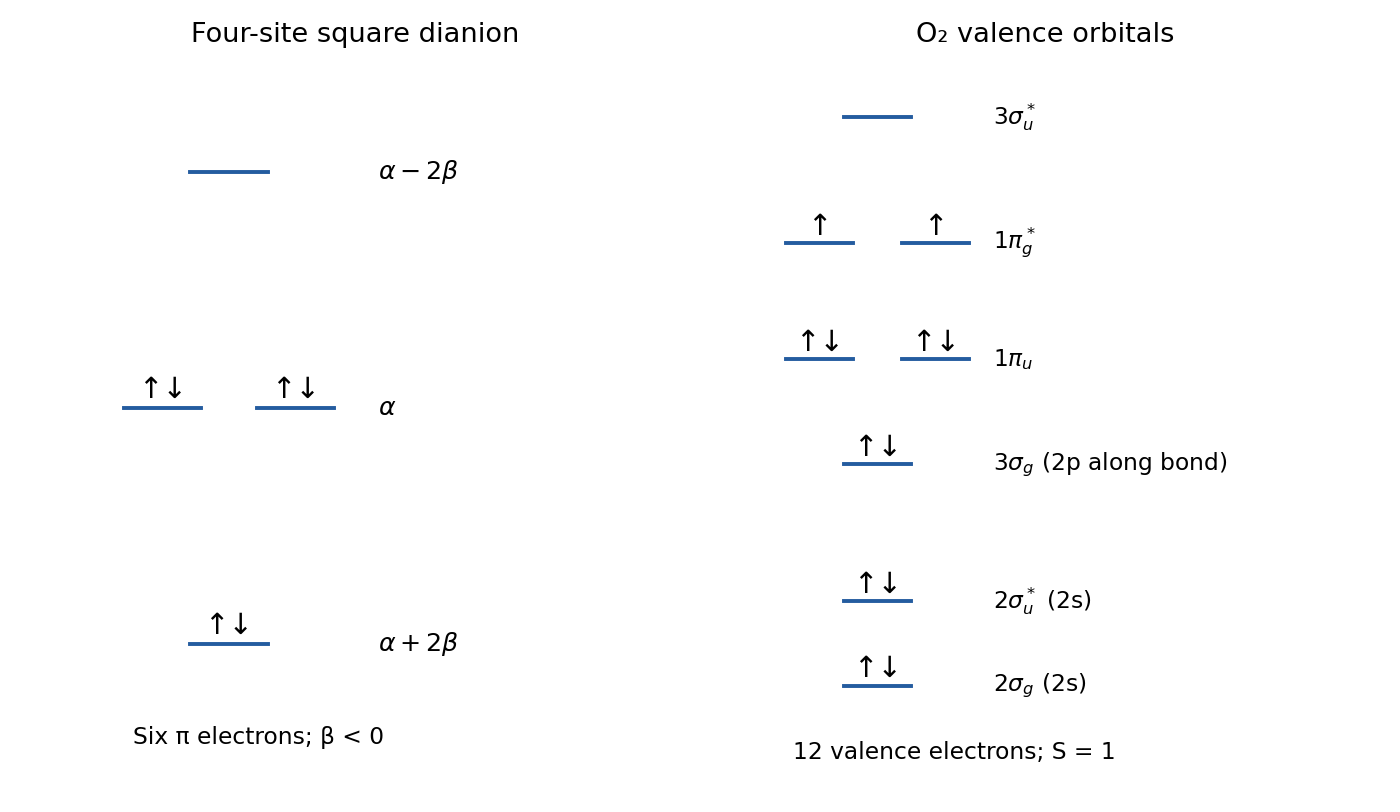
Original orbital levels and occupations for the four-site dianion and valence O2
. Details. 
The Hückel orbital charge density and Hückel pi bond order giveEach site receives electron from the lowest orbital and one from the occupied nonbonding subspace, so at every carbon, summing to six. Relative to one neutral pi electron per carbon this is a pi charge of at each site.
For adjacent sites, only the lowest orbital contributes, giving . For opposite sites the nonbonding contribution reverses the sign: . These non-neighbour negative density-matrix entries are not extra sigma bonds or extra resonance integrals in the Hamiltonian. If only skeletal nearest-neighbour pi bond orders are requested, the four values are the relevant ones.
Articles by others on the same topic
There are currently no matching articles.