Using mass for the dominant lithium isotope gives a transition wavenumber . Inserting the thermal speed into the stated Doppler broadening expression givesThe supplied formula is the Gaussian half width at half maximum; the corresponding full width is about . Meanwhile exponential population decay with lifetime produces a natural linewidth expressed as a full widthHere must be in in the second expression. Equivalently the fine-structure separation is about GHz, the Doppler half width about GHz, and the natural linewidth expressed as a full width about MHz. The natural linewidth is therefore negligible compared with thermal broadening; low density also makes collision broadening less important.
The doublet is resolvable in principle, but only marginally against the Doppler width. The separation exceeds one Doppler full width, so two components can survive, although their profiles overlap strongly. The and upper levels have different statistical weights, so the weaker member need not make an equally conspicuous maximum. A spectral resolving power is the basic instrumental requirement; a width well below and adequate signal would make the test more convincing. An arbitrarily fine spectrometer cannot remove the physical Doppler overlap. This conclusion uses the stipulated thermal, optically thin picture; additional photospheric velocity fields or optical-depth effects would require more information.
Use the D3h molecular point group for phosphorus pentafluoride, with along the two axial P–F bonds. For each symmetry operation, only atoms left in place contribute to the character of the Cartesian displacement representation; each contributes the trace of the corresponding spatial matrix. In the class order this givesFor example a fixes P and one equatorial F, and each fixed atom has Cartesian trace , giving . reflection in the equatorial plane fixes four atoms, each with trace , giving . Reduction with the character table givesSubtract translations and rotations to obtainIts dimension is , as required for a nonlinear six-atom molecule. Thus there are eight symmetry-distinct fundamental frequencies in the harmonic picture, with each E mode doubly degenerate. This analysis concerns vibrations about one trigonal-bipyramidal minimum; it does not treat large-amplitude rearrangements between minima.
The octahedral splitting separates the metal and orbital sets. The Racah parameter characterizes interelectronic repulsion and hence the spacing of many-electron d-shell terms; it is not another name for . A Tanabe-Sugano diagram plots term excitation energies against , for specified values of the other repulsion-parameter ratios. Each ordinate is measured relative to whichever term is the ground state at that field strength. The original many-electron treatment diagonalizes the relevant d-shell energy matrices rather than identifying every absorption with a one-electron gap.[ref]
On the Absorption Spectra of Complex Ions. I by Yukito Tanabe and Satoru Sugano. 1954, pp. 753–766, d-shell energy matrices in a cubic field
The ground state changes from high-spin , , to low-spin , . The larger splitting eventually compensates the additional pairing cost. Because all plotted excitation energies are re-referenced to the new ground state, the branches change slope at the crossover. The break is not an infinite physical excitation energy or a discontinuity of the underlying Hamiltonian.
Here , so the ground term is . There are no spin-allowed d–d bands in the displayed manifold under the spin selection rule: the excited terms shown have doublet or quartet rather than sextet multiplicity. Very weak spin-forbidden absorptions can still gain intensity through spin–orbit coupling, and even spin-allowed d–d transitions would be forbidden by the Laporte rule in ideal centrosymmetric coordination. Thus a strong ordinary d–d spectrum should not be predicted simply by multiplying the splitting by a numerical factor. For scale, the lowest quartet branches read roughly at this abscissa, corresponding to weak features around , and if such forbidden intensity is detectable. These are graphical estimates, not precision assignments of every weak line.
Now and the ground term is . Spin-conserving transitions to the labelled doublet excited terms are possible. Reading the diagram gives approximatelyThe first two upper terms are coincident or unresolved at this diagram's resolution. These doublet transitions should dominate over the spin-forbidden transitions to sextet or quartet levels. Their intensity still depends on vibronic or other relaxation of the Laporte rule. The plotted curves justify only approximate wavenumbers, not several-digit band positions.
Let and treat the quencher concentration as a constant reservoir. Weak steady excitation, one emitting population, and the three specified processes giveDividing the fluorescence photon-production rate by the absorbed photon rate therefore givesThis assumes no saturation, photochemical loss, reabsorption, static association or additional excited-state decay, and that each counted absorbed photon reaches the stated population. In this restricted scheme and the unquenched lifetime is .
Rearrangement gives the Stern-Volmer equationThus a straight-line plot against has unit intercept and slope . Determine using an independently measured unquenched lifetime, or use known in the restricted model. Yield measurements alone do not separate two unknown rate constants. Equivalently the slope of is .
Use the absorbed intensity rather than incident intensity to normalize samples, and correct solvent/background signals, quencher absorption and fluorescence reabsorption. Under dynamic fluorescence quenching the lifetime ratio should follow the same straight line as the yield ratio. A reduced intensity without the corresponding lifetime change suggests static fluorescence quenching or an optical artefact; curvature can also indicate multiple populations or more complicated kinetics.
A quencher-independent intersystem-crossing rate adds to the unquenched decay rate:The normalized Stern-Volmer equation retains the same form, so intersystem crossing does not bias if the actual unquenched lifetime is used. It reduces below one and changes the slope through ; assuming would then give the wrong result. A quencher that itself changes intersystem crossing or returns triplet population to the singlet requires a larger kinetic scheme.
Writing and , the normalized determinant isIts two spin orbitals are orthogonal because , even if the spatial atomic functions have nonzero overlap. Exchanging both the spatial and spin coordinates of the two electrons reverses the sign, as required for fermionic antisymmetry.
At this separation the orbital overlap and interatomic two-electron exchange integrals are negligible. Each localized electron then contributes essentially the isolated hydrogen energy, while the interatomic electrostatic terms cancel to leading order for neutral fragments. Including nuclear repulsion in the molecular energy givesThe closed-shell RHF determinant instead doubly occupies . It retains ionic configurations with both electrons on the same atom, even at dissociation. Using atomic units and the Hartree energy in the stated unrelaxed hydrogenic 1s basis, the same-atom two-electron Coulomb integral is . Consequently at infinite separationwhere energies and integrals inside the first expression are in atomic units. It is much too high compared with two neutral atoms. Retaining the leading intersite Coulomb term at gives , still about above UHF. The numerical RHF estimates specify the supplied fixed 1s basis; a larger optimized orbital space changes them. If nuclear repulsion is excluded by an electronic-energy convention, subtract the same from both quoted total molecular energies. The restricted/unrestricted comparison and their dissociation behaviour are unchanged.[ref]
XXXIV. Notes on the molecular orbital treatment of the hydrogen molecule by Charles Alfred Coulson and Inga Fischer-Hjalmars. 1949, pp. 386–393, minimal atomic-1s molecular-orbital treatment
The fixed localized determinant is unsuitable near equilibrium. It does not develop the correct shared bonding orbital and is not a pure singlet: for one alpha and one beta orbital, , which is nonzero unless the occupied spatial orbitals coincide. At dissociation it is an equal singlet/triplet mixture, though their energies become degenerate there. Near equilibrium the physical ground state is a bonding singlet. An optimized UHF calculation can recover the restricted, spin-pure solution by making its two occupied spatial orbitals equal; that does not rescue the particular fixed atomic-orbital determinant written here. A spin-adapted multideterminant description is needed to combine good bonding near equilibrium with correct singlet dissociation.
Number the four sites of the cyclobutadienyl dianion cyclically and apply the Hückel method. The orthonormal pi basis givesA convenient real orthonormal eigenbasis isThus one bonding and two degenerate nonbonding orbitals are filled, and the antibonding orbital is empty. There are six pi electrons, including the two added by the dianion charge. Rotating the two occupied nonbonding orbitals within their degenerate subspace changes their individual sketches but not the total density matrix.
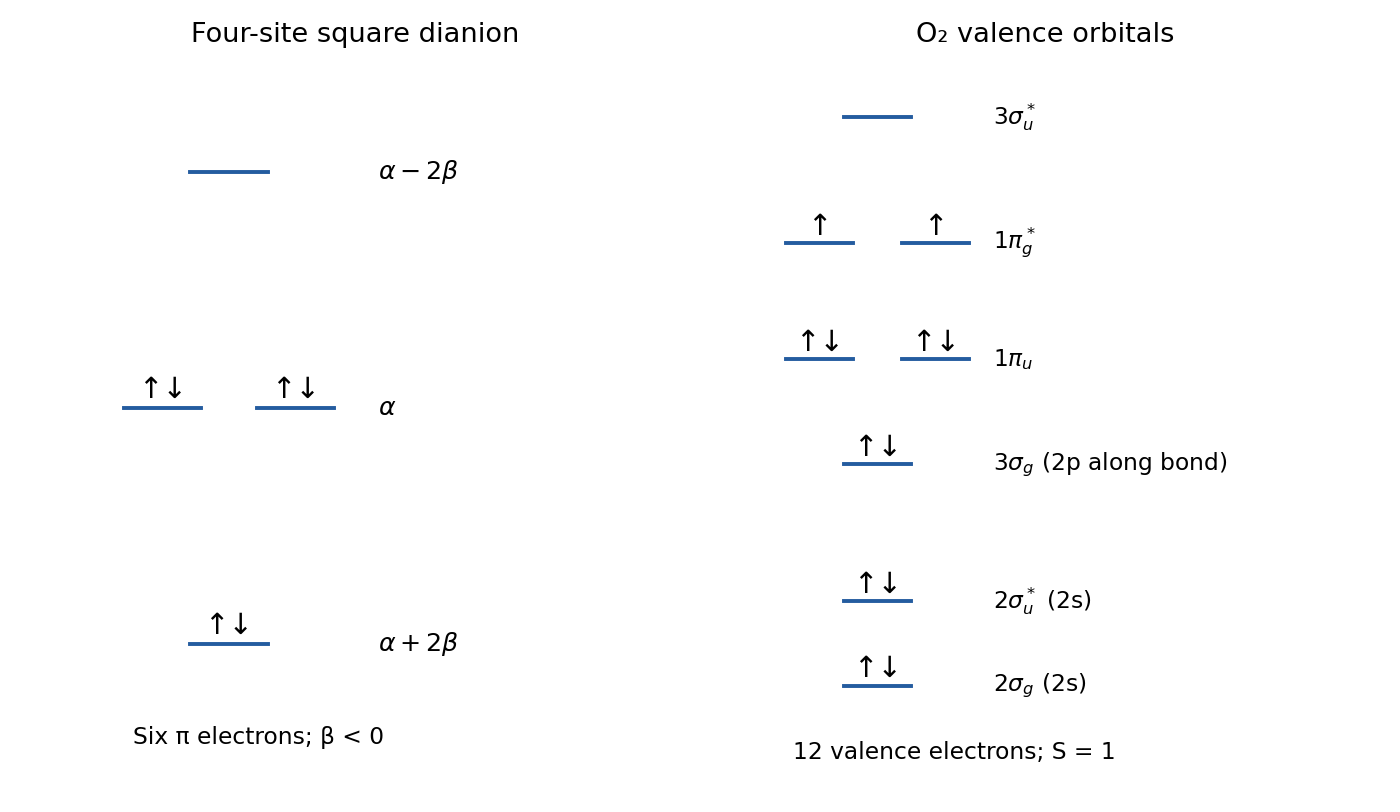
Original orbital levels and occupations for the four-site dianion and valence O2
. Details. 
The Hückel orbital charge density and Hückel pi bond order giveEach site receives electron from the lowest orbital and one from the occupied nonbonding subspace, so at every carbon, summing to six. Relative to one neutral pi electron per carbon this is a pi charge of at each site.
For adjacent sites, only the lowest orbital contributes, giving . For opposite sites the nonbonding contribution reverses the sign: . These non-neighbour negative density-matrix entries are not extra sigma bonds or extra resonance integrals in the Hamiltonian. If only skeletal nearest-neighbour pi bond orders are requested, the four values are the relevant ones.
configuration interaction with singles and doubles (CISD) uses a linear combination of the reference Slater determinant and singly and doubly excited determinants. Its many-electron trial state is therefore not restricted to one determinant; the orbitals may be held fixed while the configuration coefficients are varied.
Kohn-Sham equations in density functional theory use an auxiliary one-electron Hamiltonian whose effective potential depends on the density. Its orbitals construct a density representing an interacting electronic system; this is distinct from explicitly diagonalizing a large many-electron determinant Hamiltonian.[ref]
Self-Consistent Equations Including Exchange and Correlation Effects by Walter Kohn and Lu Jeu Sham. 1965, pp. A1133–A1135, ground-state effective one-electron formulation
molecular mechanics evaluates a parametrized potential of atomic positions, with terms such as bond stretching, angle bending, torsion and nonbonded interactions. electrons are represented implicitly through the fitted force field, rather than by electronic orbitals, a density or an electronic wavefunction. This example is different from both preceding electronic methods.
For conventional CISD, the leading matrix-vector contraction scales as in occupied and virtual orbital dimensions. If both grow proportionally to a system-size parameter , the familiar estimate is work per iteration; the iteration count and integral-storage strategy add implementation-dependent costs.
Calculated potential energy surfaces can predict equilibrium geometries and harmonic force constants, permitting comparison with diffraction-derived structures, rotational constants and vibrational spectra. Calculating several roots or different charge states can also estimate excitation or ionization energies. Such predictions depend on basis and truncation quality; truncated CI is not generally size extensive and is not automatically reliable for strongly multiconfigurational bond breaking. The quoted polynomial scaling is for CISD, not full configuration interaction, whose determinant space grows combinatorially.
An alternant hydrocarbon has a pi-site graph that can be divided into two sets so that every retained neighbouring resonance interaction joins different sets. Equivalently, the graph is bipartite. A chain and an even ring satisfy this condition; an odd ring does not. The classification refers to the model's coupling graph, rather than simply to which bonds are drawn double in one Lewis structure.
Write with the same carbon diagonal parameter throughout, and define to have entries on one sublattice and on the other. Bipartite connectivity impliesThus implies . This proves energy pairing about , , and equal site-probability magnitudes in each paired pair, since . This is the Coulson-Rushbrooke pairing property.[ref]
Note on the method of molecular orbitals by Charles Alfred Coulson and G. S. Rushbrooke. 1940, pp. 193–200, alternant-system pairing and density properties
For the usual neutral half-filled closed-shell occupation, the lower member of each pair is doubly occupied. Combining paired coefficients with completeness of the orthonormal basis gives one pi electron per carbon, so the model predicts no net pi charge separation. The same argument makes off-diagonal pi bond orders between sites on the same sublattice zero. These statements assume a neutral half-filled density and do not apply unchanged to the charged six-electron four-site ion considered separately.
An imbalance of sublattice sizes also guarantees at least nonbonding orbitals at energy , because the rectangular coupling block has insufficient rank to remove all its null space. None of the spectral pairing, equal paired densities, neutral charge uniformity or sublattice bond-order restrictions is required for a non-alternant graph. Long-range same-sublattice couplings or unequal diagonal parameters can likewise destroy the simple proof.
Articles by others on the same topic
There are currently no matching articles.