The coarse spacing is about , so . The two groups near 1.5 and therefore have and , respectively. For positive , increasing moves a component to lower wavenumber. The assignments areWithin one group, successive separations scale as . The observed gaps follow that pattern to their printed precision. There are distinct components because in the lower state; the and members remain coincident without an applied field. A high-resolution feature here is therefore not simply assigned to an arbitrary magnetic sublevel.
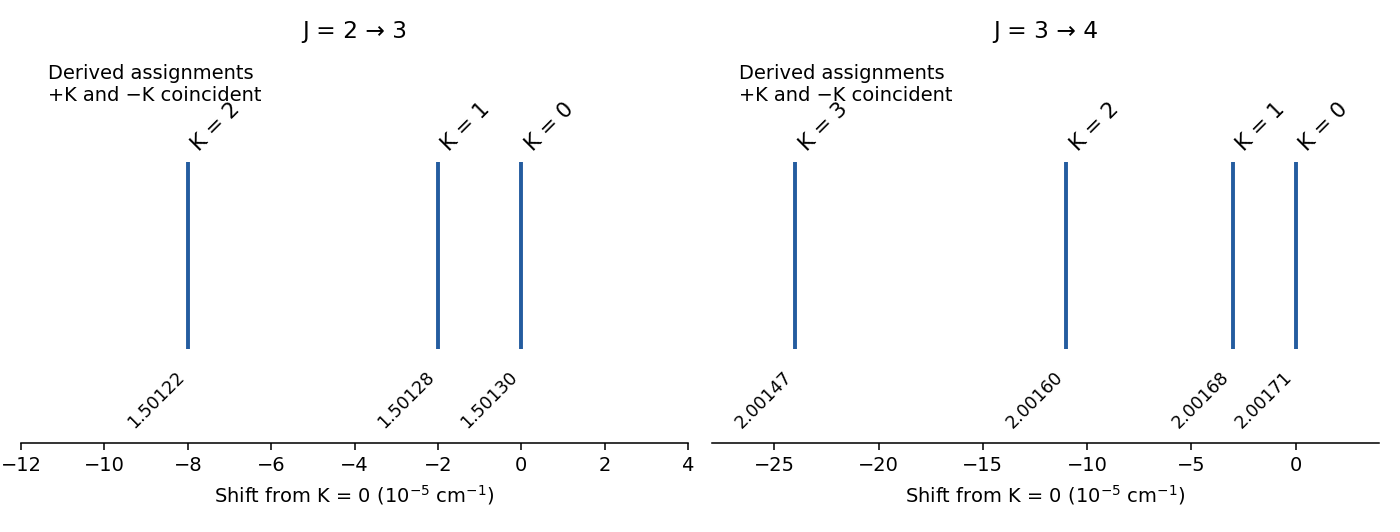

The lines give two equations independent of :Solving yields and . The small distortion is obtained by subtracting close numbers, so its precision is considerably worse than that of .
For components in a fixed group,For example the displacement gives , while gives . Both give ; the smaller gaps are consistent after rounding. The pure rotational transitions have , so the and terms cancel. Neither nor can be determined from these zero-field lines.
A spectral component shifts by the difference between its upper- and lower-level Stark shifts. With , and , the supplied energy formula givesFor radiation polarized parallel to the static field, , soThus the assigned feature has no first-order splitting, whereas the features acquire symmetrically arranged magnetic-sublevel components with spacings proportional to . With perpendicular radiation, gives the corresponding different allowed pattern. Recording field-dependent spectra with specified polarization would test both the J values and the K sequence; using an individual level's shift alone would not predict the observed line positions. Higher-order shifts of the nominally unsplit feature are outside this first-order test.
The largest applied field givesFor parallel polarization, adjacent allowed M values in a component are separated byAlready at this is for and for . Both exceed the stated resolution, and larger gives larger first-order spacings. The spectrometer should resolve suitable Stark components, provided their physical linewidths and signal-to-noise permit it. This predicts resolvable splittings rather than incorrectly comparing the maximum level shift directly with instrumental resolution.
Articles by others on the same topic
There are currently no matching articles.