The coarse spacing is about , so . The two groups near 1.5 and therefore have and , respectively. For positive , increasing moves a component to lower wavenumber. The assignments areWithin one group, successive separations scale as . The observed gaps follow that pattern to their printed precision. There are distinct components because in the lower state; the and members remain coincident without an applied field. A high-resolution feature here is therefore not simply assigned to an arbitrary magnetic sublevel.
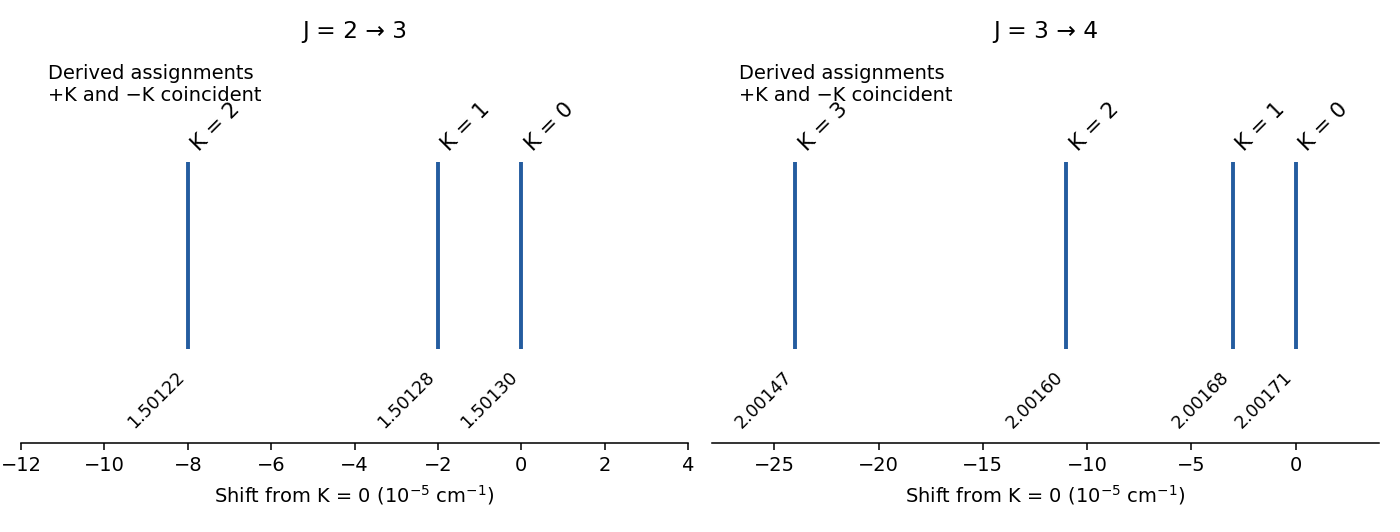
The lines give two equations independent of :Solving yields and . The small distortion is obtained by subtracting close numbers, so its precision is considerably worse than that of .
For components in a fixed group,For example the displacement gives , while gives . Both give ; the smaller gaps are consistent after rounding. The pure rotational transitions have , so the and terms cancel. Neither nor can be determined from these zero-field lines.
A spectral component shifts by the difference between its upper- and lower-level Stark shifts. With , and , the supplied energy formula givesFor radiation polarized parallel to the static field, , soThus the assigned feature has no first-order splitting, whereas the features acquire symmetrically arranged magnetic-sublevel components with spacings proportional to . With perpendicular radiation, gives the corresponding different allowed pattern. Recording field-dependent spectra with specified polarization would test both the J values and the K sequence; using an individual level's shift alone would not predict the observed line positions. Higher-order shifts of the nominally unsplit feature are outside this first-order test.
The largest applied field givesFor parallel polarization, adjacent allowed M values in a component are separated byAlready at this is for and for . Both exceed the stated resolution, and larger gives larger first-order spacings. The spectrometer should resolve suitable Stark components, provided their physical linewidths and signal-to-noise permit it. This predicts resolvable splittings rather than incorrectly comparing the maximum level shift directly with instrumental resolution.
A regularly repeated set of sharp features is characteristic of the unresolved Q subbranches of a perpendicular rovibrational band. The transition dipole is perpendicular to the symmetry axis, giving ; for the Q branch . Holding the rotational constants fixed between vibrational states cancels the term, leavingMany J transitions therefore coincide within each K-changing Q subbranch in this approximation. The different K subbranches are separated byThe P and R branches have and , respectively. Their extra J-dependent terms spread many transitions across a broad background at modest resolution. A parallel band, with , would not generate this repeated Q-subbranch spacing under the stated assumptions.
The subbranch spacing gives , hence . Rotation about the C–I symmetry axis has momentC and I lie on this axis, so only the three hydrogens contribute to . If is the I–C–H angle, their perpendicular distances are . Taking integer hydrogen mass givesThe molecular arrangement selects the obtuse solution, so . The supplementary acute angle describes the opposite axial direction, not the bond angle to iodine. This is a rigid-geometry estimate based on an effective rotational constant and the stipulated bond length, rather than a precision equilibrium-structure measurement.
In the Condon approximation the intensity from to contains the Franck-Condon factorThe lower ground-state vibrational wavefunction is localized near its equilibrium bond length. If the two equilibrium lengths are similar, it overlaps strongly with the upper wavefunction, but its overlap with highly excited upper vibrational states is usually small or suffers oscillatory cancellation. If the equilibrium lengths differ enough that a vertical excitation reaches the outer portion of the upper well, high- transitions can be strong while the overlap is small. Thus the two ends of a long progression are not normally both intense. This is an overlap argument, not a ban on either set of transitions; anharmonicity, a varying electronic transition moment and unusual wavefunctions can modify the intensity envelope.
Write the upper Morse oscillator term values in wavenumber units asThe spacing is . A Birge-Sponer plot therefore falls linearly in this model and can be extrapolated to zero spacing. If its horizontal coordinate is , the plotted line is . Its area from to its zero givesEquivalently a plot against has intercept and triangle area ; subtracting recovers . These conventions distinguish dissociation from the potential minimum and from the lowest vibrational level.
Measured consecutive members fix a local slope and intercept, so unobserved members can be supplied by extrapolation under an explicit spacing law. The upper-state limit on the absorption scale is . A local high-v fit can likewise estimate the remaining energy above an observed member without knowing its absolute v index. Near dissociation a real potential need not remain Morse-like, so an extrapolated triangle has model uncertainty; missing lines must not be silently assumed consecutive.
Successive differences remove the unknown absolute origin and the unknown initial vibrational quantum number. The five spacings are , , , and . Plot them at relative mid-indices . A straight-line fit givesThe curve reaches zero spacing at . Since a quadratic Morse progression has a spacing equal to its derivative at the interval midpoint, integrating the fitted line from the first observed relative level to estimates the energy still needed to reach the continuous limit:Thus the appropriate graphical conclusion is , not a many-digit threshold. Directly fitting a quadratic to the six measured transition positions puts its vertex at about , which checks the arithmetic but not the physical extrapolation law. The slight variation of second differences shows that extrapolating a constant anharmonicity beyond the observed range is approximate. No assignment of the arbitrary index n to an absolute upper-state v is needed.
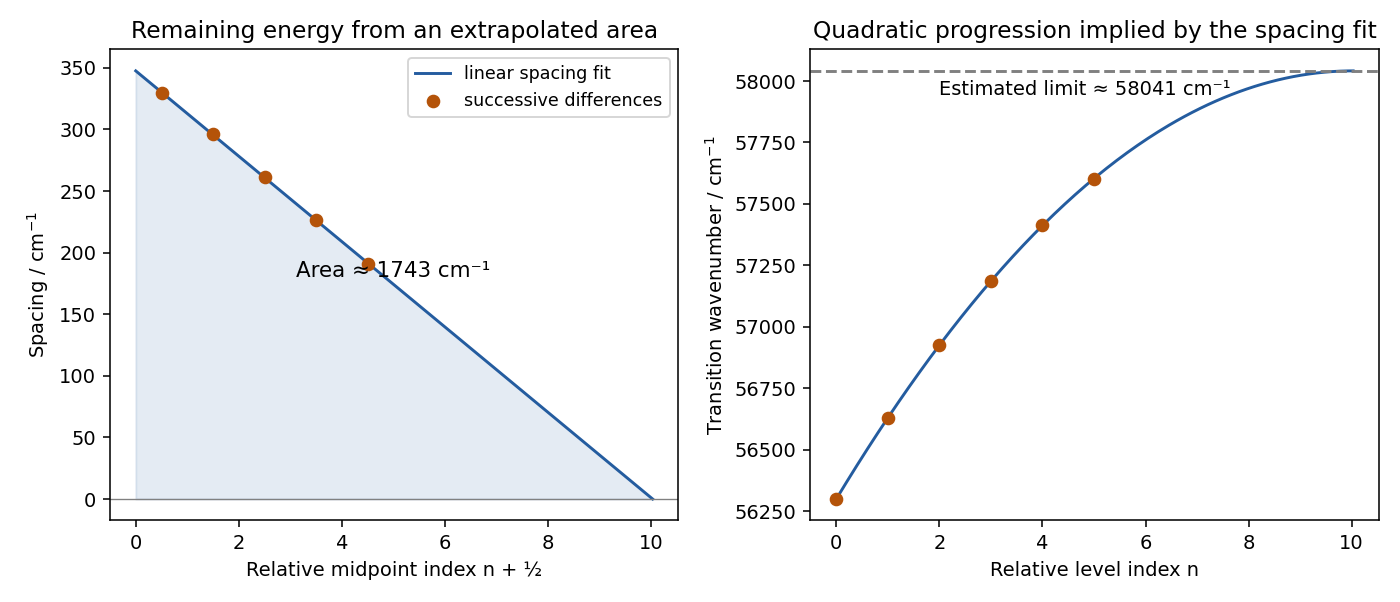
Original relative-index Birge–Sponer extrapolation and the inferred progression limit
. Details. Let . For a fixed row, moving one column to the right therefore givesThus adjacent-column entries decrease by the lower-state vibrational spacing, independent of the upper-state row in the ideal model. If the positive difference is instead defined as left minus right, it is . Stating the subtraction direction prevents an artificial negative vibrational frequency.
Averaging the left-minus-right differences across the three rows gives lower-state spacings of about and . Their difference is , soSimilarly, averaging successive down-column differences across the three columns gives upper-state spacings of about and . HenceUsing the first row and first column alone would give approximately and , respectively. The small inconsistency between nominally identical spacings is already present in the entries; it should be treated as limited data/model precision rather than fitted by assigning different lower-state constants to different rows. Values near for the lower state and for the upper state express the supported precision.
Choose x along O–O. The valence orbital order appropriate to O is approximatelyIts twelve valence electrons occupyThe two degenerate pi-antibonding orbitals are singly occupied with parallel spins according to Hund's rules. Thus , multiplicity , with three possible values. A triplet is a many-electron spin classification, not three electrons in one orbital. The resulting ground term is . Exchange stabilization favours this triplet over the singlets formed within the same frontier-orbital manifold.
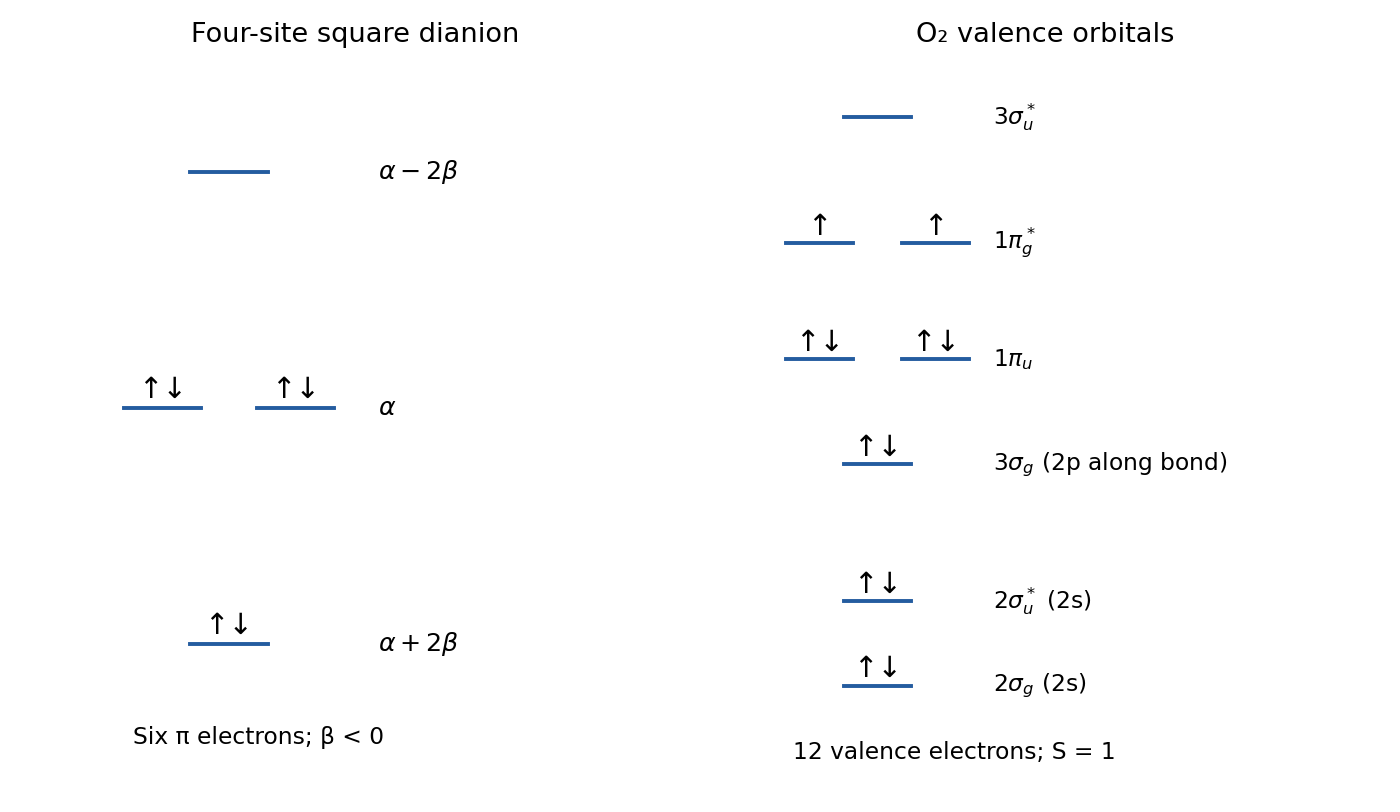
Original valence-O2 diagram with the two singly occupied pi-antibonding orbitals
. Details. The active set contains four oxygen pi orbitals and two carbon pi orbitals, with eight electrons in six orbitals. The noninteracting levels, using the parameters inferred below, areEach bonding oxygen orbital has equal-phase coefficients on its two O atoms; its antibonding partner reverses one coefficient. The two pi directions are z in the prospective ring plane and y perpendicular to it. carbon pi and pi-star use z-directed p orbitals with equal and opposite coefficient signs. In this separated-fragment comparison the occupations are those of neutral triplet O plus neutral ethene. Do not refill the combined list solely by energy, which would move an electron between infinitely separated fragments and describe a charge-transfer state instead.
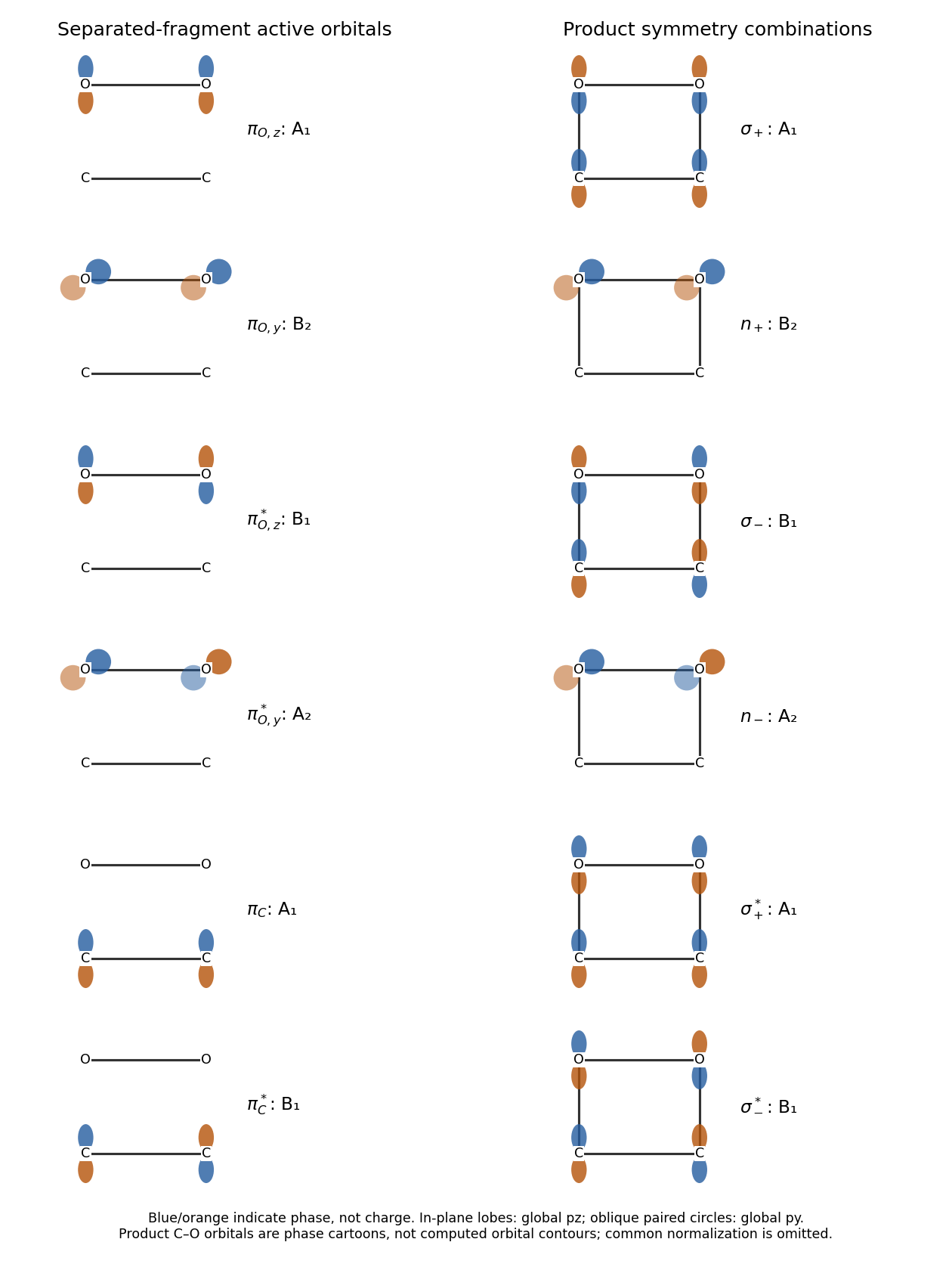
Original signed-orbital sketches for the six reactant and six product active orbitals
. Details. Use negative bonding Hückel resonance integrals, and . The oxygen HOMO is pi-antibonding, whereas the ethene HOMO is pi-bonding. The frozen-orbital Koopmans estimate therefore givesConsequently and . These Hückel Coulomb parameters are effective parameters of this spectroscopically calibrated model. Real ionization energies include relaxation and correlation, so they are not exact matrix elements of an isolated-atom Hamiltonian.
Let be localized bonding orbitals of the two new C–O bonds, and let be their antibonding partners. Their symmetry combinations areThe two remaining active orbitals are out-of-ring oxygen lone-pair combinations, . The opposite-phase combination is the HOMO in the supplied ordering and is HOMO−1. Both are filled, as are the two C–O bonding combinations, givingThe original active-orbital sketches show these phase relations, while the correlation diagram gives a qualitative energy ordering. Precise splittings between unrelated symmetry blocks are not determined by the fragment ionization energies. The retained O–O sigma bond, the C–C sigma bond and the other framework orbitals lie outside this six-orbital active comparison; the eight-electron count does not describe all valence electrons of the product.
The symmetric approach preserves the C2v molecular point group with its twofold axis z and mirror planes xz and yz. The molecular ring lies in xz. Classify orbitals by reflection signs : , , , . With globally defined p-orbital phases the molecular orbital correlation diagram givesWithin either two-orbital symmetry block the lower member remains correlated with the lower product member; the non-crossing rule prevents swapping their order through an ordinary same-symmetry crossing. Crossings between different irreducible representations are allowed. The crucial consequence is that the occupied carbon pi orbital correlates to a C–O-antibonding combination, rather than both initially occupied orbitals becoming the two product bonding orbitals.
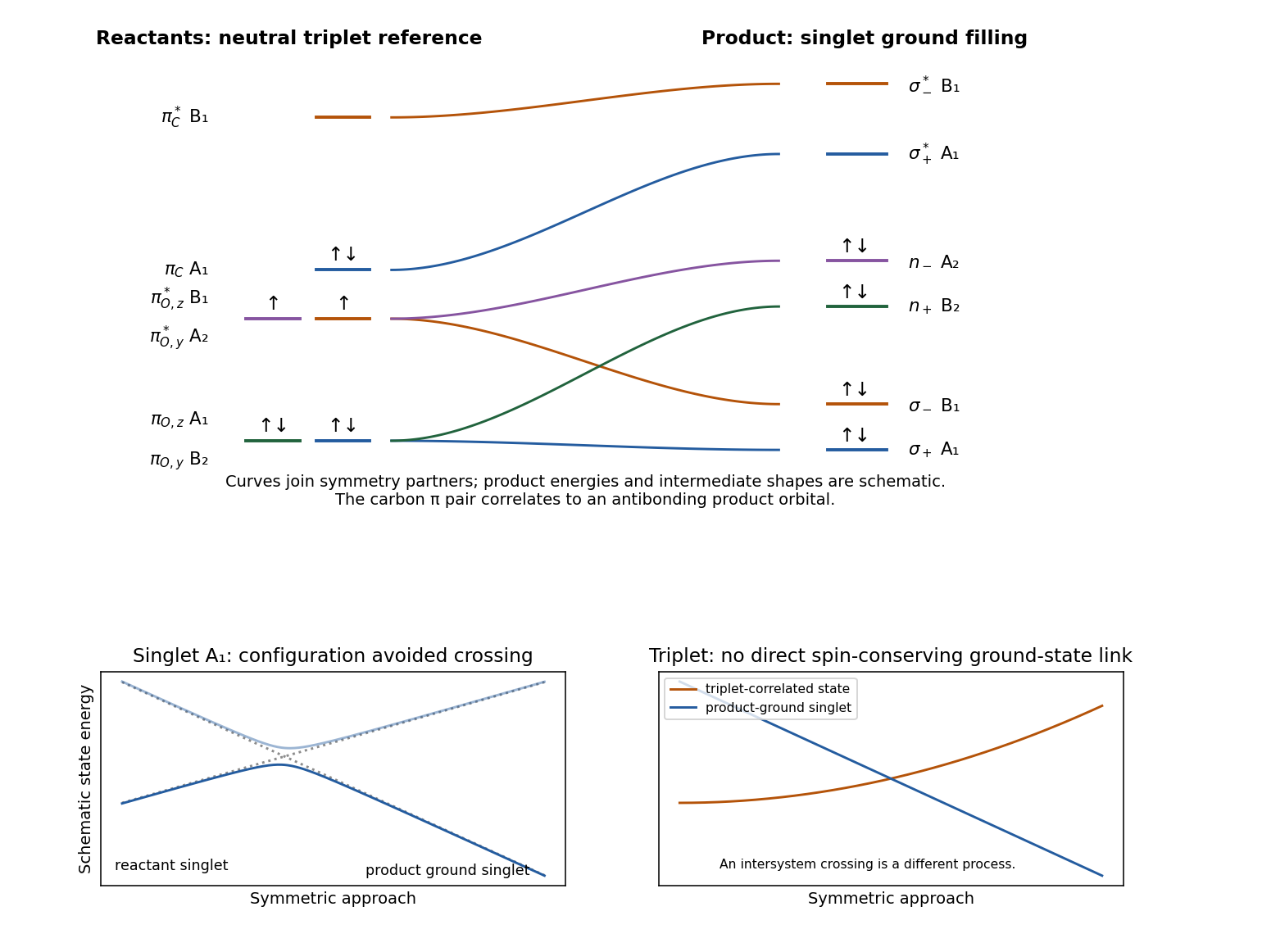
Endpoint energies, endpoint phase patterns and a conserved symmetry fix the qualitative connectivity. Each initial orbital must end in the appropriate product symmetry block, and the ordering within a generic block is preserved by avoided crossings. The two singleton blocks and have unique partners. No numerical calculation at each intermediate separation is required to draw those connections.
This conclusion is limited to a correlation diagram: it does not determine intermediate orbital energies, interaction strengths, the location or height of a reaction energy barrier, or the lowest route on a multidimensional potential energy surface. If the reaction breaks the assumed symmetry, previously distinct symmetry blocks can mix and the diagram must be reconsidered.
In the electronic state correlation diagram, the singly occupied reactant orbitals for triplet oxygen have symmetries and , so their spatial product is . The reactant state is therefore a triplet , whereas the closed-shell product is . A strictly spin-conserving path cannot correlate triplet reactants directly to the ground-state product. It correlates to an excited triplet product configuration or requires intersystem crossing; the symmetric direct reaction consequently has a substantial electronic obstacle.
Simply changing the oxygen spin does not repair the occupied carbon-orbital correlation. The lowest oxygen singlet manifold has spatial components of and symmetry in this subgroup. The singlet can have an avoided crossing with another configuration and reach the product singlet; the singlet cannot mix directly with the product while is maintained. Following either closed-shell oxygen singlet component in the orbital diagram still leaves the carbon-pi electron pair in the rising orbital. Its redistribution into the final occupied orbitals requires configuration mixing at an avoided crossing. A barrier is therefore expected even for the symmetry-constrained concerted singlet addition; singlet does not imply barrierless. The state curves in the original diagram are schematic, illustrating this avoided-crossing argument rather than computed energies.[ref]
Selection rules for singlet-oxygen reactions. Concerted addition reactions by David R. Kearns. 1969, orbital and state correlation for concerted olefin additions
The real singlet reaction can lower this obstacle through asymmetric or stepwise pathways that are absent from the stipulated direct approach. A primary multireference study explicitly distinguishes singlet and triplet addition through biradical intermediates, supporting that limitation of a one-coordinate symmetry argument.[ref]
Singlet and triplet potential surfaces for the O2+C2H4 reaction by Kyoyeon Park and others. 2010, abstract and calculated addition/isomerization surfaces
Neither correlation alone nor a spin label supplies a numerical activation energy.The missing kinetic contribution is . Both atoms contribute independent translational kinetic energy before the coordinates are changed.
Substituting givesThe shifted equilibrium coordinates satisfy . Expanding about them replaces q by displacements without changing the kinetic metric or the Hessian.
Taking the Hessian of the potential with respect to mass-weighted displacements givesThe equations of motion are , so eigenvalues are squared angular frequencies. Normalized eigenvectors and frequencies areBoth vectors are in the q basis, and . The translation corresponds to equal physical displacements . The stretch has and opposite physical displacements with magnitude ratio . Ordinary frequencies are ; spectroscopic wavenumbers are .
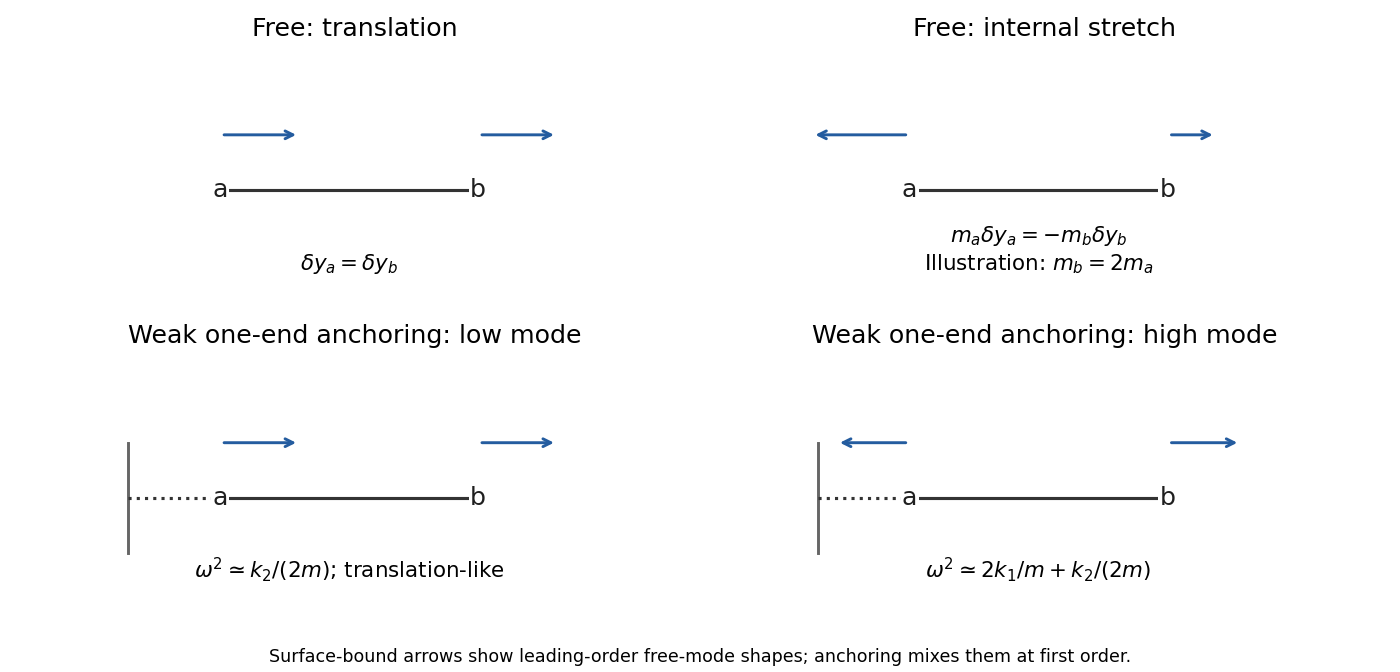


With equal masses m, the two mass-weighted Hessians areFor a uniform displacement vector ,Therefore uniform translation is not a normal mode in orientation (1) when : anchoring only one atom mixes translation with internal stretching. It is an exact normal mode displacement in orientation (2) because both atoms have identical restoring terms. Its frequency is nevertheless nonzero, ; the antisymmetric stretch has . The rigid surface breaks free translational invariance in both orientations. A vector resembling a uniform translation need not be a zero-frequency mode when the molecule is anchored.
For weak anchoring, , use the normalized free-molecule eigenvectors and . The perturbation isIts diagonal matrix elements in this basis are both . First-order time-independent perturbation theory for the eigenvalues therefore givesHence and . The zero free translation requires taking a square root of its new eigenvalue, rather than Taylor-expanding the frequency about zero. It is not a degenerate eigenvalue in the stipulated one-dimensional two-coordinate model.
As a check, the exact squared frequencies areExpansion gives the same first-order results; the next lower-mode correction is . The perturbed eigenvectors contain small translation/stretch admixtures of order , consistent with the failure of uniform translation to remain an exact mode in orientation (1).
Articles by others on the same topic
There are currently no matching articles.